


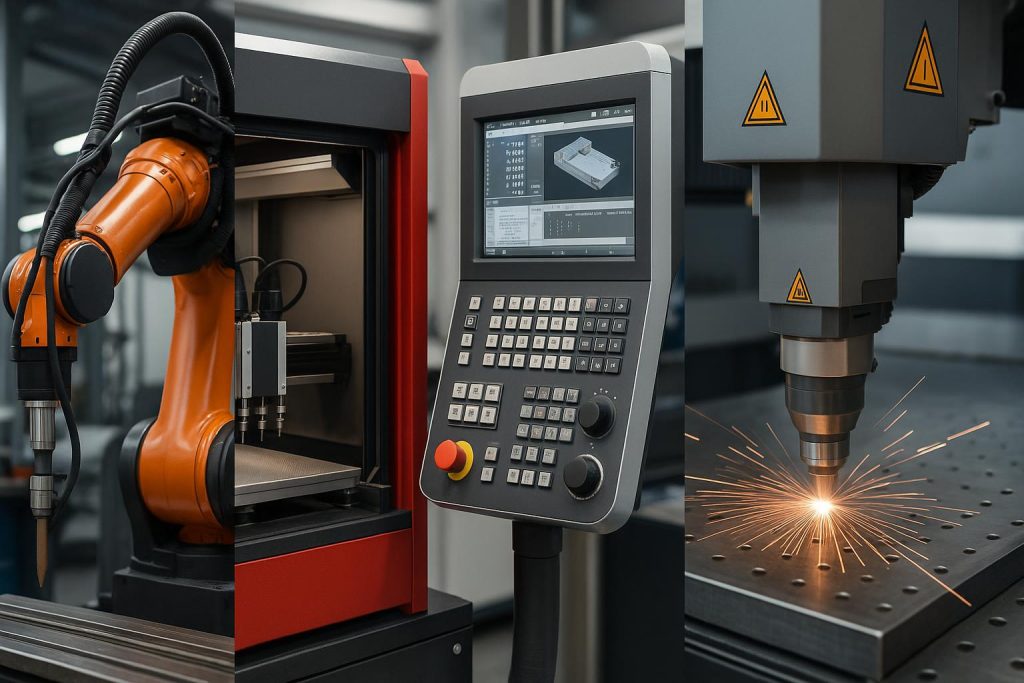
A new phase of commercial fabrication is underway. Even while the equipment on a manufacturing floor may still appear familiar, the technology surrounding them is rapidly evolving. AI, connected sensors, modular equipment, and digital simulation are no longer experimental upgrades that are exclusive to major manufacturers; instead, they are becoming common in production. The most significant change is that these technologies are beginning to interact. Before a little issue turns into a costly disruption, a machine may gather data, software can assess it, and operators can take action.
The World Economic Forum’s 2026 outlook on intelligent industrial operations describes this broader move from traditional automation toward connected and increasingly adaptive industrial systems.
Here are five developments worth watching.
Table of Contents
AI Is Moving Closer to the Machine
Artificial intelligence in manufacturing is no longer limited to analysing reports after production has finished. Edge computing allows processing to happen closer to the equipment generating the data. That matters when a machine needs to detect an unusual vibration, temperature change or production error almost immediately.
For fabrication businesses, this can support predictive maintenance and faster fault detection. Instead of waiting for a machine to fail, monitoring systems can identify patterns that suggest something is beginning to go wrong. That doesn’t mean every machine needs an expensive AI system. In many cases, smaller edge devices can handle specific monitoring tasks while sending only useful information to a central platform. The result is a more responsive production environment, particularly where even a short period of downtime can affect delivery schedules.
Modular Hardware Is Making Production More Flexible
Manufacturers are also looking for equipment that can adapt without requiring an entirely new production line. Modular components make this easier. Machines, fixtures and other hardware can be configured or replaced in sections, allowing businesses to change production requirements without rebuilding everything from scratch.
This approach is particularly useful for commercial fabrication shops handling different materials, product sizes or short production runs. It also reduces the pressure to predict exactly what a facility will need several years from now. A flexible system can be upgraded as requirements change. Software-defined automation is pushing this idea further by allowing production systems to be reconfigured through software rather than replacing large amounts of physical infrastructure.
Material Efficiency Is Becoming a Technology Issue
Sustainability in fabrication isn’t only about choosing recycled materials. It also comes down to how efficiently those materials are processed. Poor cutting parameters, unsuitable tooling and inaccurate machining can all create unnecessary waste. For shops working with multiple materials, tool selection becomes a surprisingly important part of the equation.
A workshop cutting acrylic, polycarbonate and wood, for example, cannot necessarily expect one tool configuration to deliver the same result across every material. Surface finish, heat generation, cutting speed and chip removal all affect the final component. Modern fabrication shops therefore maintain more specialised toolkits, including plastic cutting router bits for applications where cleaner and more controlled plastic cutting is required. The principle is simple: better control at the cutting stage means fewer damaged parts, less wasted material and fewer repeat jobs.
Sustainable manufacturing increasingly depends on this kind of process-level efficiency. The U.S. National Institute of Standards and Technology also highlights the importance of measuring material and process efficiency when developing more sustainable manufacturing systems.
Connected Sensors Are Giving Shops Better Visibility
Industrial IoT is another change that’s becoming harder to ignore. Sensors can monitor equipment condition, operating temperatures, production cycles, energy consumption and other variables continuously. That information can then feed into dashboards or maintenance systems rather than remaining locked inside individual machines. The benefit isn’t simply having more data. It’s having the right data at the right time.
For example, a fabrication manager may be able to see that one machine is consuming more energy than usual or producing longer cycle times. That could indicate wear, incorrect settings or another issue that deserves attention. Connected systems also make it easier to compare performance across equipment and identify patterns that would be difficult to spot through manual checks.
Digital Twins Are Becoming More Practical
Digital twins have been discussed in manufacturing for years, but their usefulness is becoming more tangible as sensors, computing power and AI improve. A digital twin creates a virtual representation of a physical machine, process or production environment. Instead of simply showing what a system looks like, modern versions can use operational data to simulate possible changes and outcomes. That creates an opportunity to test certain decisions digitally before making expensive physical changes.
The World Economic Forum’s 2026 research on technology convergence points to digital twins becoming more capable of combining real-time production data, spatial intelligence and AI-driven simulation. For commercial fabrication, that could mean testing production layouts, equipment settings or component designs before committing time and materials to physical trials.
The Bigger Shift Is Integration
None of these technologies exists alone. AI becomes more useful when it has reliable machine data. IoT becomes more valuable when that data leads to a maintenance decision. Digital twins become more accurate when they receive real production information. Modular hardware becomes more useful when software can manage and coordinate changing configurations. That’s where commercial fabrication is heading: not simply toward smarter machines, but toward systems where machines, software, materials and people work as one connected operation.
The businesses likely to benefit most will not necessarily be those buying the newest hardware first. They will be the ones identifying where technology solves a genuine production problem whether that means reducing downtime, improving material use, increasing flexibility or making quality more consistent. The factory of the future may look familiar from the outside. The difference will be in how much intelligence is working behind the scenes.

