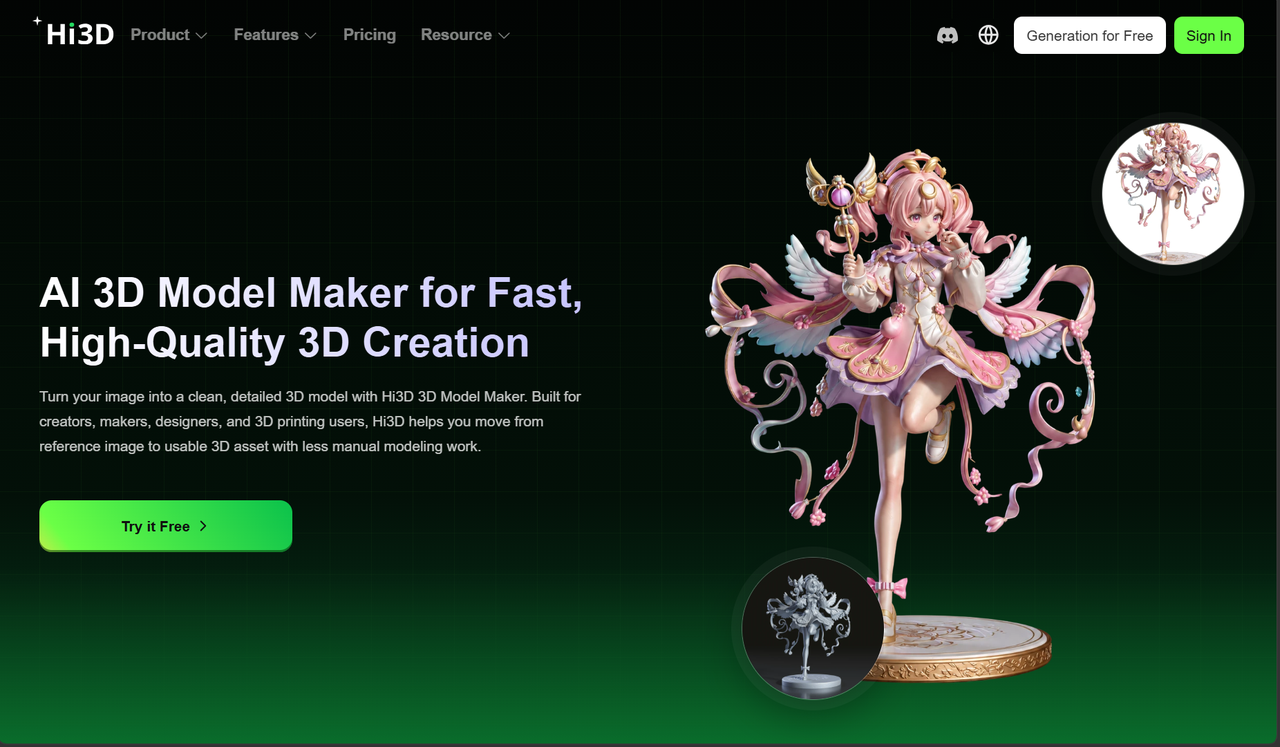
Imagine a professional designer or independent creator who receives an urgent commercial assignment: produce a series of custom multi-color display figurines for an upcoming promotional event with a strict 48-hour delivery deadline. The creator possesses high-quality two-dimensional reference art and concept sketches, but faces severe practical manufacturing constraints: there is zero time available to sculpt complex assets from scratch in traditional CAD applications, the physical build plate of the available desktop 3D printer is far too small to accommodate full-scale models in a single print run, and the intricate surface color details would require dozens of tedious hours to manually paint inside slicing software.
Table of Contents
Analyzing Real-World Friction Points in Additive Manufacturing
This high-pressure production scenario reflects the everyday operational challenges faced by digital designers, hobbyists, and service bureaus trying to move efficiently from flat concepts to finished physical products under demanding timelines. Standard additive manufacturing software tools often treat digital asset creation, geometric repair, surface texturing, and physical slicing as entirely isolated processes, creating substantial workflow friction and unpredictable failure points for creators.
1.1 The Difficulty of Translating Flat Artwork to Geometry
Converting flat graphic assets into functional prints using traditional modeling software is an incredibly time-consuming endeavor that demands years of specialized sculpting expertise. When creators attempt to bypass manual modeling by using basic automated vector extruders or simple depth-mapping tools, the resulting output almost always contains severe topological defects. These primitive conversion utilities frequently produce hollow mesh structures, self-intersecting polygon faces, and open boundaries that fail completely during the slicing stage, requiring extensive manual mesh repair before physical fabrication can even begin.
1.2 Slicer Setup and Manual Prep Time Bottlenecks
Even when a clean three-dimensional digital model is successfully acquired, preparing that model for a physical multi-color build plate introduces massive operational delays during orientation, support placement, and color assignment. Colorizing a complex model manually inside modern slicing software requires exhaustive brush painting across thousands of individual facets. Small manual painting mistakes lead to fragmented color regions that drastically inflate toolhead swap cycles, multiply total print duration, and consume excessive amounts of expensive filament, making tight project deadlines virtually impossible to hit.
2. Rapid Asset Generation from Graphic Concepts
Hi3D resolves these core real-world friction points by unifying geometry creation, surface texturing, and physical print preparation into a single automated, artificial-intelligence-driven engine.
2.1 Instant Image to 3D Conversion
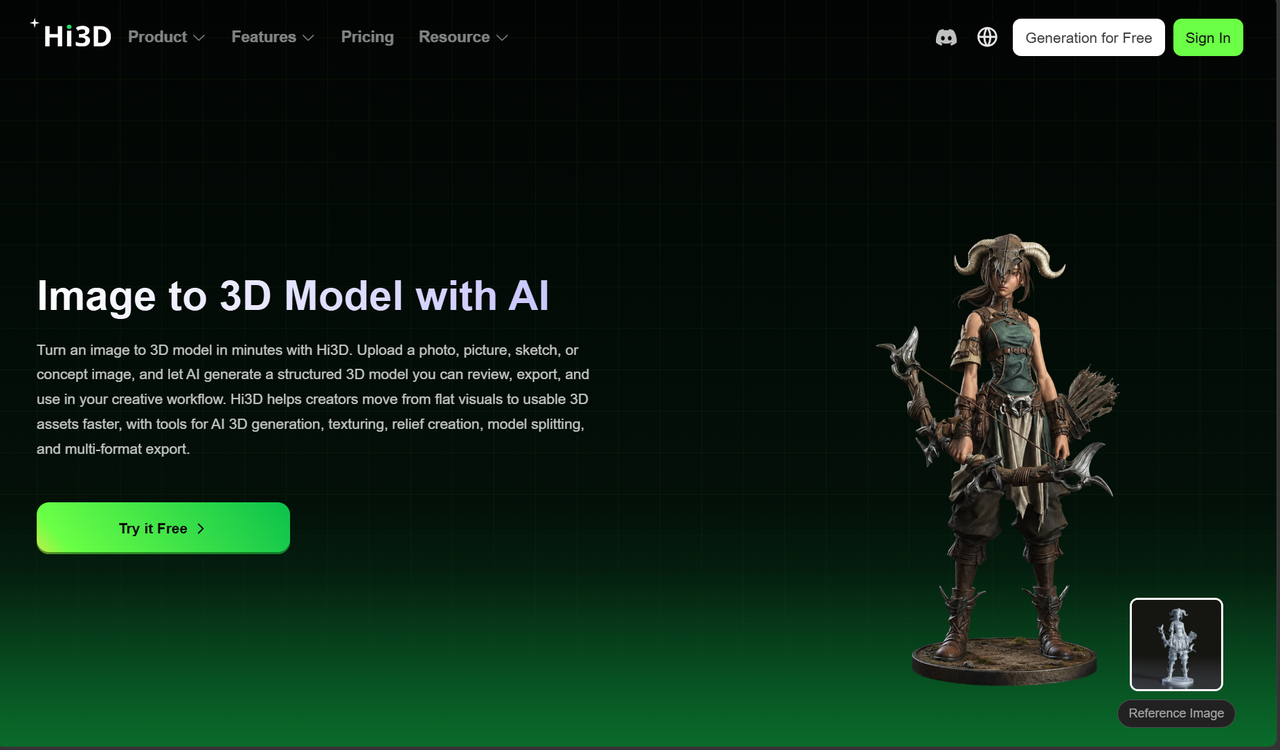
Under tight delivery schedules, the creator can upload 2D reference artwork directly into Hi3D’s advanced image to 3D model AI reconstruction pipeline. The platform analyzes light distribution, surface shading, spatial depth cues, and silhouette boundaries to construct fully closed, watertight 3D geometry in a matter of minutes. Functioning as a high-performance 3D printer model maker, Hi3D processes photo to 3D model and picture to 3D model requests with exceptional structural accuracy, ensuring that generated models possess uniform wall thickness and solid geometric foundations suitable for physical additive manufacturing.
2.2 Frictionless Cloud-Based Asset Processing
By hosting these advanced computational algorithms within an accessible cloud ecosystem, Hi3D provides an efficient 3D model maker online workspace that acts as a comprehensive 2D to 3D image converter and AI 3D model maker free testing environment for creators. Users seeking a reliable AI 3D model maker or free 3D model maker can bypass the steep learning curves and heavy hardware requirements associated with desktop digital sculpting suites, generating production-grade 3D meshes directly through their web browser without technical friction.
3. Automated Surface Texturing and Material Assignment
Once the base three-dimensional geometry is generated from the artwork, applying complex color details and surface materials manually inside a slicing program would consume valuable hours and introduce substantial margin for error.
3.1 Intelligent Procedural Surface Finishing
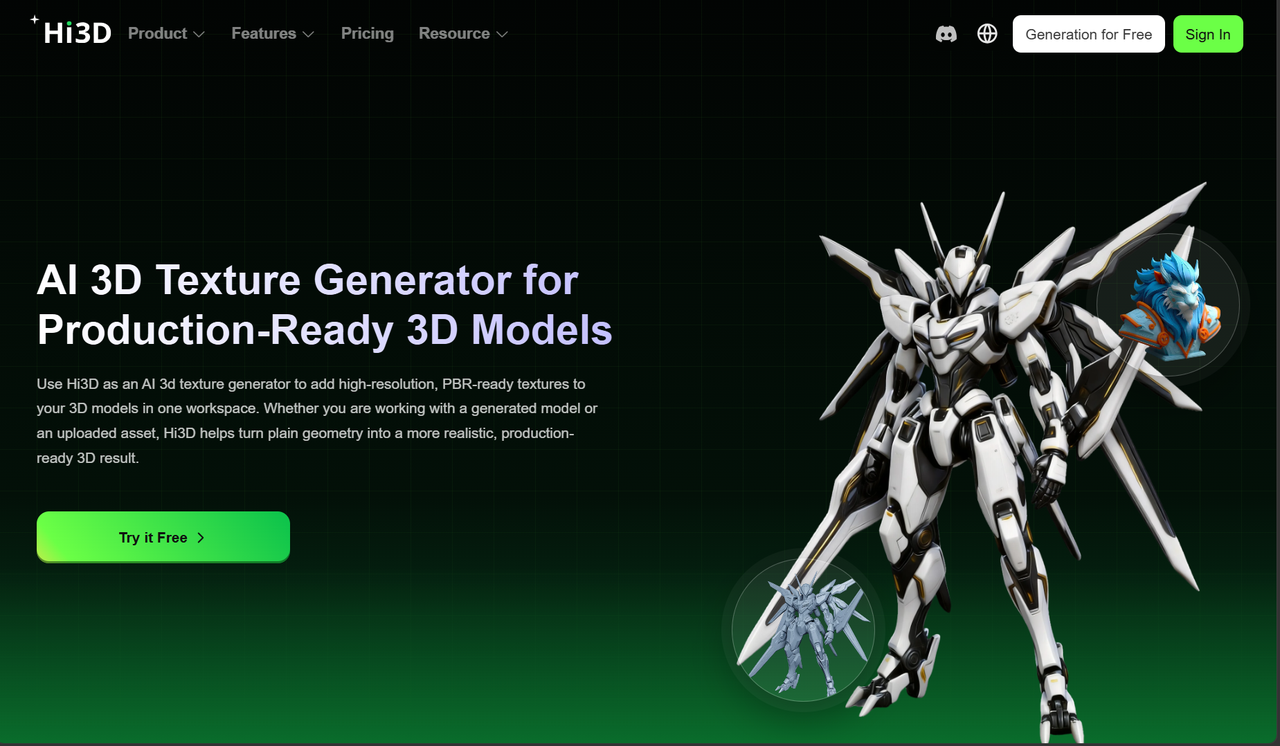
Hi3D streamlines surface finishing by applying its proprietary AI 3D texture generator and AI 3D model texture generator directly to the generated geometry. The AI texturing engine automatically extracts visual attributes, material properties, and color palettes from the original 2D reference image, mapping complex procedural patterns across the model’s surface with precise alignment. Supported by advanced AI 3D model texturing algorithms, the software preserves crisp UV boundaries and prevents surface stretching, ensuring that visual details retain their fidelity when translated onto physical materials.
3.2 Continuous Color Region Clustering and Filament Simulation
To handle multi-color output without manual painting, Hi3D groups surface textures into smooth, continuous color regions and maps them directly to real-world filament stocks. This continuous spatial clustering eliminates microscopic color noise, which in turn prevents the physical printer from executing hundreds of redundant filament purge cycles. Furthermore, the platform simulates material consumption, purge volume, and estimated print duration prior to slicing, allowing the creator to evaluate material costs and optimize color parameters before sending files to the machine.
4. Automated Splitting, Snap-Fit Connectors, and Slicer Integration
To overcome build plate limitations and eliminate unsightly support scarring across prominent visual surfaces, the creator applies Hi3D’s built-in split-for-printing toolset rather than manually executing complex, error-prone Boolean operations inside external CAD software.
4.1 Template-Based Character Segmentation
By selecting a pre-configured 4-part character split template, the software automatically divides the figurine into head, torso, arm, and leg components. During the splitting operation, Hi3D automatically seals all open cut faces, converting the separated parts into watertight, solid volumetric bodies that are instantly ready for individual slicing and printing on smaller build plates.
4.2 Integrated Assembly Joints with Clearance Control
Simultaneously, the platform embeds functional mechanical hardware—such as mortise-and-tenon joints, alignment pins, or dovetail slots—directly along the partition faces. Built-in tolerance compensation settings allow the creator to fine-tune joint clearances according to their specific printer’s dimensional accuracy, guaranteeing that physical components snap together tightly and securely after printing without requiring manual post-print trimming, filing, or adhesive bonding.
4.3 Smart Plate Layout and Direct 3MF Export
To maximize manufacturing efficiency, Hi3D evaluates the split geometry and arranges all components onto virtual build plates using Less Support Mode, which minimizes filament waste and prevents support material from attaching to primary visible surfaces. Finally, the system exports a fully pre-configured 3MF file directly into Bambu Studio, complete with printer profiles, plate orientations, and material parameters, allowing the creator to launch the print job immediately and meet the 48-hour deadline seamlessly.
5. Maximizing Production Capacity During the Anniversary Sale
Creators facing demanding deadlines, complex color requirements, and tight physical manufacturing budgets can upgrade their digital toolkit during Hi3D’s ongoing 1st Anniversary promotion. To help design studios, independent makers, and prototyping facilities streamline their physical workflows, the platform is offering an exclusive 70% discount across its subscription service packages for a limited time. In addition to deep software savings, promotional credit bundles include Buy One, Get One Free incentives, delivering the raw computational power needed to automate design pipelines, scale up generative 3D printing capacity, and convert flat concepts into physical reality with unprecedented speed.