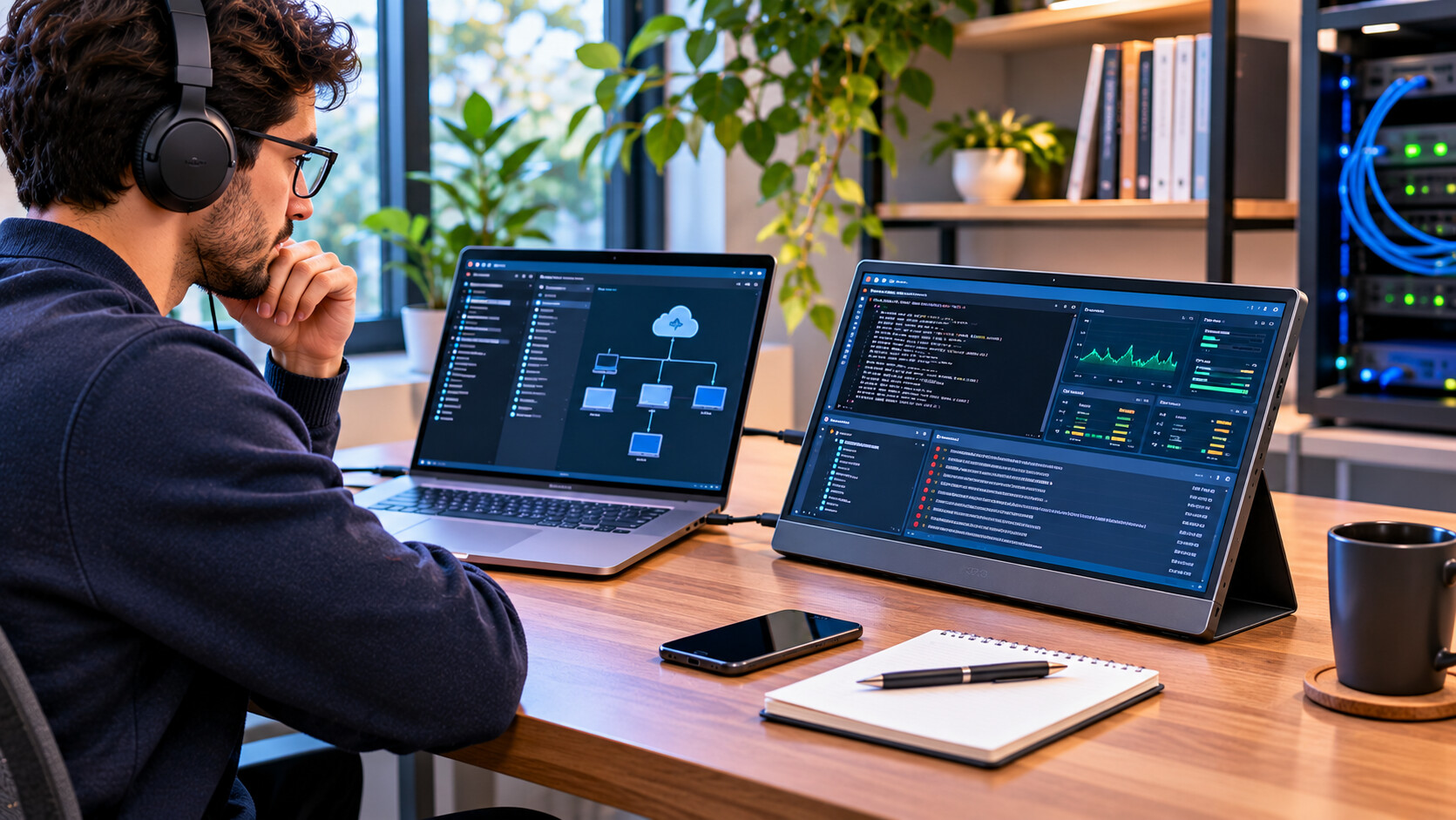
IT staff can also remotely access and operate other systems and handle emergencies and malfunctions.
Having these few tools readily accessible will help make remote IT troubleshooting a smoother experience – at the least, having these tools ready to go will make it easier to walk someone through their IT problems.
Can make unnecessary disruptions when browsing the same screen on a laptop PC. Flipping above and also between windows is uneasy when it happens constantly, as well as it prevents contrast between windows.
Portable monitors are ideal for those who require additional screen space but do not require or want to dedicate space for a permanent workspace. Because of their size and portability, portable monitors work well for IT support, sysadmin, and network administrator roles with multiple sites.
Table of Contents
Why Remote IT Troubleshooting Requires Multiple Screens
Remote tech support combines all of these tasks. For instance, a tech worker investigating an incident might be monitoring logs, watching a server, and chatting with a colleague at the same time.
Even though we can see them on just one screen, the truth is that most of this software has to be turned on and off in order to make them work – a distraction breaks our concentration and prevents us from watching the crucial information.
Extended desktop enables you to have different information on different screens. For instance, you could have the Remote Desktop in use on your main screen and troubleshooters on another.
How Portable Monitors Improve Remote IT Troubleshooting
1. Easier Management of Remote Desktop Sessions
The remote-access tools, such as Remote Desktop Protocol (RDP), enable administrators to log on to computers and servers remotely.
Whilst this is a great advantage for organising remote sessions, a portable monitor can be used to provide extra screen real estate. One display may present information about the connected computer and the other might have diagnostic commands, support tickets, or technical references.
Microsoft’s remote desktop technologies allow multiple monitor setups to be compatible within compatible environments, and features supported depend on the client and connection setup.
2. Better Visibility of System Logs and Monitoring Dashboards
The performance of the applications, network activity, and server performance is monitored regularly by system administrators to detect technical issues. Important operational information can be displayed on monitoring platforms like Grafana, Zabbix, and Azure Monitor. When these dashboards have their own screen, administrators can view system conditions while they work with other systems.
For instance, one display could show CPU utilisation and memory usage, while another may be filled with terminal commands. Having related information visible may help you notice changes after you’ve made a configuration change.
3. Improved Efficiency During Incident Response
Unexpected downtime, application issues, and network problems frequently need to be coordinated to investigate. While responding to an incident, IT personnel can have to check alerts, inspect logs, and connect with other people at once. These activities can be hard to handle when space for displays is limited.
A further monitor is kept to confirm incident-reporting, communication tools, and diagnostic programs are still accessible. Unfortunately, screen space alone won’t fix technical incidents. Escalation should be crystal clear, with documentation and remote-access systems being reliable.
Supporting System Administration From Different Locations
IT specialists are not always sitting at a fixed desk in the office. Instead, they may frequently find themselves using their computers at customer sites, coworking spaces, or temporary support centers. Conventional monitor mounts may be challenging to carry around.
External Displays: External displays with USB-C and HDMI connections are offered by makers like UPERFECT, especially for occasional use. They may be suitable for laptop-based technical workstations that don’t need a huge table. Make sure your computer has a USB-C port for video and the electrical requirements are compatible; not all laptop ports support video output.
Their portability might be especially advantageous to IT consultants working with multiple client environments.
Improving Documentation and Remote Collaboration
Technical support may require documenting error messages, configuration settings, and preparing reports of your work. A second monitor can also keep documentation in your line of sight while you work in a management console or terminal application.
As another example, while an engineer adjusts firewall and other configurations, he might have the pre-approved configuration instructions on one screen and be making adjustments on another.
For business: even a small business monitor can double for use in video conferencing, as you can have your chat app open while viewing files.
Choosing a Suitable Portable Monitor for IT Work
Your choice of display should be dictated more by your technical needs than simply the look and feel of the display. Where simple remote support is required, a Full HD display will be adequate, but higher resolutions do provide extra room for logs, dashboards, etc and paper documentation.
Size of screen, where the light hits your eyes, flexibility of positioning, and data transfer – they all count. Connecting your laptop to a screen via USB-C might make your laptop setup easier, or it could work with an HDMI.
In addition, professionals should also evaluate display stability, cable management, and power needs. An external stand can also provide enhanced viewing angles during workdays.
Important Limitations and Security Considerations
While a portable monitor will offer you additional screen space, it won’t improve the internet speeds or the processors on the remote servers. Other than a reliable network, your performance will also depend on the remote-access software or servers you’re working on.
IT teams should think about how to keep confidential data out of view during remote presentations. Sitting screens away from the camera’s view, using secure, approved hardware, and methods of access all continue to be critical.
Conclusion
Portable monitors are ideal for remote IT troubleshooting and system administration by providing additional space for remote sessions, monitoring dashboards, diagnostic utilities, and technical documentation. They are also particularly convenient for administrators who have to work at several locations thanks to their portable design, and dual screens can help avoid unnecessary task switching.
If you are an IT pro managing several apps, an external monitor that works with several of them can assist you in establishing a more orderly and efficient remote work setup.