Alexandra Forrestall is a Calgary, Alberta based professional whose academic and career background supports a practical understanding of environmental systems, community wellbeing, and sustainability. With formal training in early childhood education and experience across recruitment, customer engagement, and animal care, Alexandra Forrestall brings a multidisciplinary perspective to discussions about natural ecosystems and human responsibility. Her work as a talent sourcer and junior recruiter requires analytical research, long term planning, and collaboration, skills that parallel the careful assessment needed when examining pressures on mountain environments. Outside of her professional work, she regularly participates in outdoor activities such as hiking and fitness, reinforcing a direct connection to natural landscapes. This combination of professional structure and personal engagement with the outdoors provides a grounded, factual lens for exploring how climate change, development, and tourism are affecting mountain ecosystems worldwide.
Mountains and Their Ecosystems Under Pressure
Mountains may appear enduring and resistant to change, shaped over millennia by powerful geological forces, yet their ecosystems are increasingly vulnerable to human-driven pressures. Covering roughly a quarter of Earth’s land surface, mountains support a remarkable share of global biodiversity and provide vital resources to communities far beyond their slopes. Despite these contributions, climate change, habitat degradation, pollution, and overtourism are placing growing strain on mountain environments and the ecosystems they sustain.
Climate change poses the most extensive threat. Mountain ecosystems have evolved under conditions of cold temperatures, steep terrain, and relative isolation, which has encouraged high levels of specialization among plants and animals. This specialization also makes them particularly sensitive to disturbance. Mountains are warming significantly faster than the global average, with temperatures rising 25 to 50 percent more quickly since 1950. As warming accelerates, ecological zones shift upslope, often faster than species can adapt. Alpine plants and animals face shrinking habitat ranges, while diseases and invasive species expand into elevations where they were previously unable to survive.
The warming climate also affects snow and mountain glaciers, which play a central role in shaping mountain ecosystems and sustaining local flora and fauna. Non-polar glaciers have lost hundreds of gigatons of ice each year in recent decades, and scientists estimate nearly half of the world’s glaciers will melt by 2100 even if global warming is restricted to no more than 1.5 degrees Celsius. This loss threatens mountains’ function as the world’s water towers, placing mountain ecosystems that rely on the freshwater, nutrients, and stream habitats provided by glacial meltwater at risk. In addition, glacier retreat and melting permafrost dramatically alter ecosystems by fragmenting habitats and transforming solid ground into marshes.
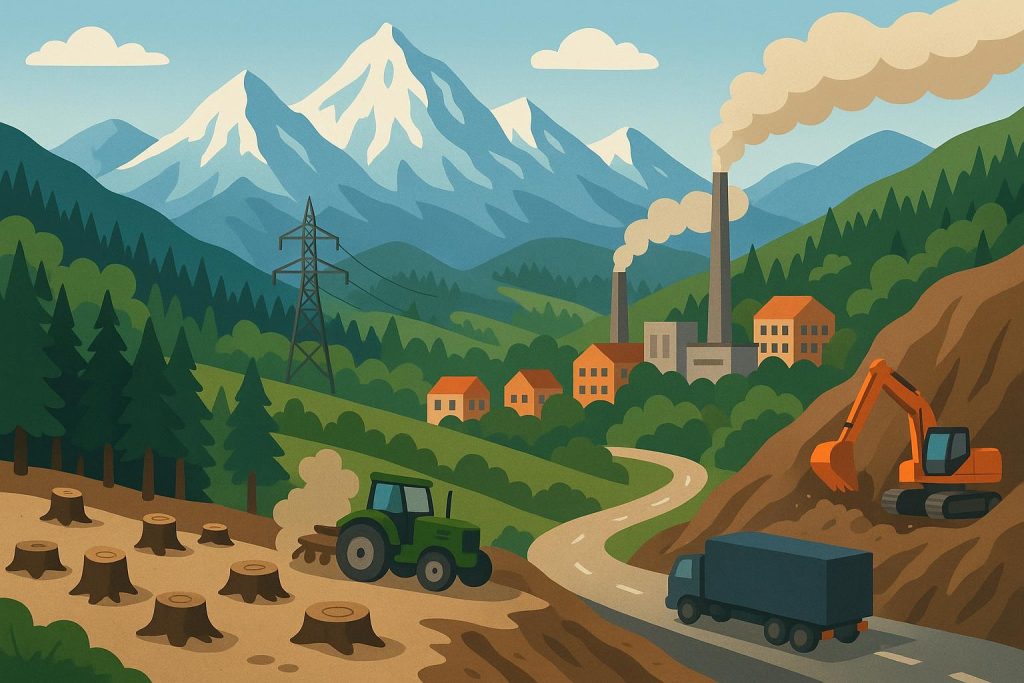
Alongside climate pressures, direct human activity is reshaping mountain landscapes. Development, agricultural activities, and deforestation are increasingly moving into higher elevations, displacing native species and fragmenting ecosystems. Although mountain forests were historically less targeted than lowland forests, tens of millions of hectares have been cleared since 2000. Forest loss reduces carbon storage, worsens erosion and flooding, and limits the space available for species attempting to shift their ranges in response to rising temperatures.
Overtourism has emerged as an additional and increasingly visible threat. Mountain visits account for a significant share of global tourism, and while recreation can support local economies, unmanaged visitor growth places heavy pressure on fragile ecosystems. Increased tourism often leads to expanded infrastructure, vehicle traffic, noise and light pollution, and inadequate waste management. Wildlife disturbance and conflicts with local communities can follow.
Mount Everest illustrates these impacts clearly, with large volumes of abandoned gear and human waste accumulating on the mountain. This waste has increased environmental degradation, exacerbating damage from climate change and other human activities like deforestation and destruction of fragile, slow-growing vegetation by irresponsible hikers.
Other forms of pollution further compound these stresses. Air pollutants from distant cities and industrial areas travel long distances and accumulate in mountain soils, vegetation, and water systems, degrading ecosystem health. Even remote mountain regions are not immune, as microplastics have been detected on peaks ranging from the Alps to Mount Everest. These pollutants can alter plant growth and affect wildlife.
Protecting mountain ecosystems will require coordinated and sustained action. Reducing greenhouse gas emissions is essential to slow warming and glacier loss, while stronger land-use policies can limit deforestation and poorly planned development. Governments can better integrate environmental and economic policies, invest in ecosystem restoration, and regulate tourism to ensure it aligns with ecological limits. Improved waste management, visitor education, and support for conservation research can further reduce human impact. Together, these measures offer practical pathways to preserving mountain ecosystems and the essential services they provide in a rapidly changing world.
About Alexandra Forrestall
Alexandra Forrestall is a Calgary, Alberta based talent sourcer and junior recruiter with experience in recruitment strategy, candidate research, and cross functional collaboration. She holds a diploma in early childhood education from Seneca College, where she graduated with honors, and is a member of the College of Early Childhood Educators. Her professional background also includes customer service and animal care roles. Outside of work, she enjoys hiking, volunteering, and maintaining an active lifestyle.