

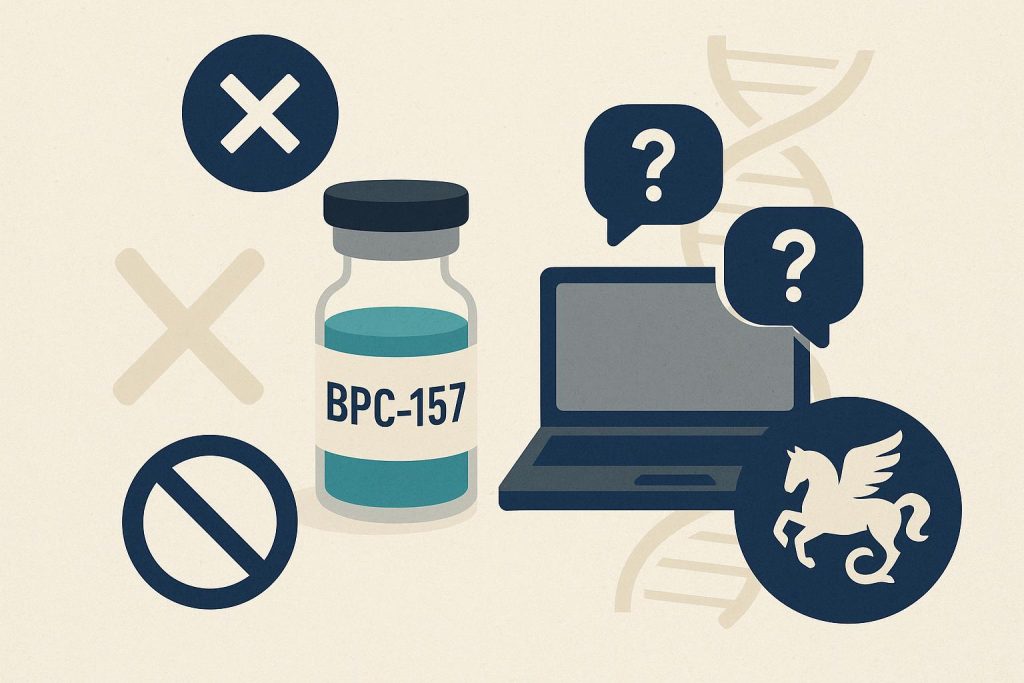
Few research peptides have collected as much folklore as this one. Scroll any forum and you’ll find the same claims repeated as if they were settled fact. Here are some of the most common myths, paired with a more grounded reality.
Table of Contents
Myth: “It’s Clinically Proven”
Reality: the bulk of BPC-157 research lives in cell cultures and animal models, not large human trials. Those early studies are interesting, but they don’t amount to clinical proof. Repeating a claim often doesn’t make it true.
Myth: “If It’s for Sale, It Must Be Approved”
Reality: being available as a research compound is not the same as being an approved drug or supplement. Anyone searching bpc157 will find listings, but those are sold for laboratory and research use only. Availability says nothing about regulatory approval.
Myth: “Research-Use Labels Are Just Legal Cover”
Reality: that label reflects a genuine lack of approval for human use and the early state of the science. It’s not a wink-and-nod formality. Treating it as meaningless ignores real regulatory and safety context.
Myth: “Higher Price Means Higher Quality”
Reality: price tells you very little on its own. Quality is shown through batch-specific testing and documentation, not cost. A premium price with no COA is just an expensive unknown.
Myth: “All BPC-157 Is Basically the Same”
Reality: purity and identity vary between sources, which is exactly why testing exists. Two vials with the same name can differ meaningfully. Verification, not assumption, is how researchers tell them apart.
Myth: “A Purity Percentage Settles Everything”
Reality: a number means little without a method and a batch behind it. HPLC and mass spectrometry results tied to a specific lot carry weight; a bare “99%” claim doesn’t. Context is everything.
How to Stay Grounded
When a claim sounds confident, ask what evidence sits behind it and whether it can be verified. Lean on certificates of analysis, named third-party labs, and research-use-only labeling. Skepticism is a feature, not a flaw, in this space.
The Bottom Line
Most BPC-157 myths come from treating early research as proof, availability as approval, and marketing as data. Swapping those assumptions for verifiable documentation cuts through the noise. The grounded view is far less dramatic, and far more useful.