


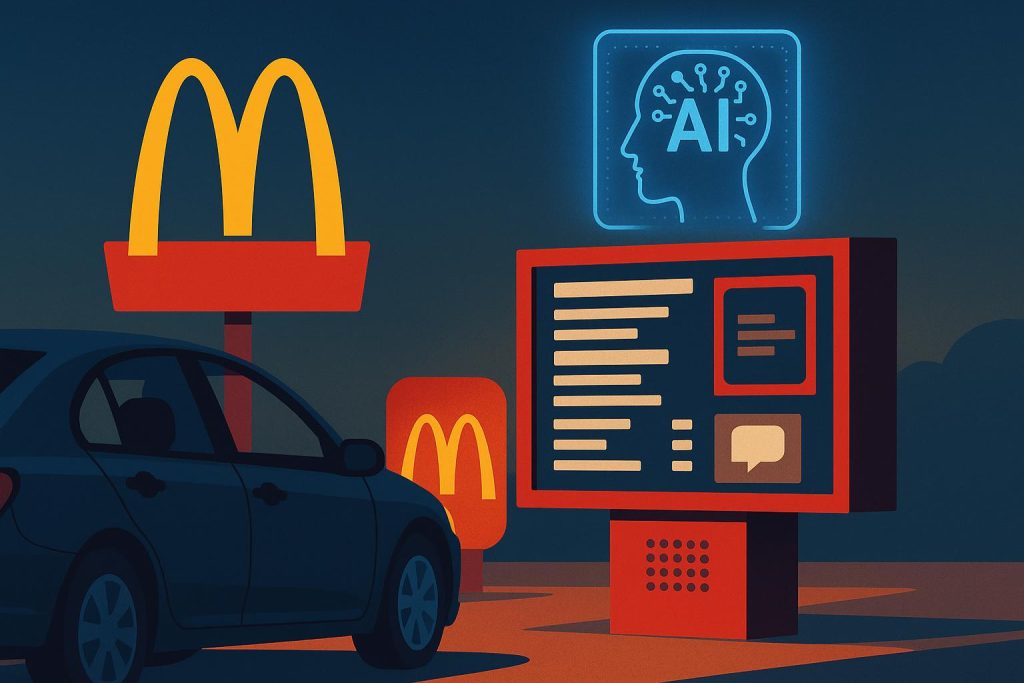
McDonald’s did not begin its artificial intelligence program with robots flipping burgers. It began with a less dramatic question: how can a company operating tens of thousands of restaurants make millions of small decisions faster and with fewer mistakes? That question affects ordering, staffing, equipment maintenance, promotions, inventory, delivery, and the sequence in which food moves through a kitchen. AI gives McDonald’s tools for finding patterns across those activities, but it also creates new risks when software misunderstands customers or makes decisions that employees cannot easily challenge.
The company’s transformation matters because McDonald’s operates at a scale where a minor improvement can produce a large financial result. Saving several seconds on an order, preventing a small percentage of equipment failures, or reducing wasted ingredients in each restaurant can add up across the chain. Yet scale also magnifies failure. A weak recommendation system can annoy millions of customers, while an inaccurate voice assistant can turn a simple drive-thru visit into a public example of technology that was introduced before it was ready.
McDonald’s current approach reflects both realities. The company continues to invest in cloud computing, connected restaurant systems, machine learning, and generative AI. At the same time, it has learned that customers do not care whether a tool looks advanced. They care whether the order is correct, the fries are hot, the wait is reasonable, and a person can help when something goes wrong.
Table of Contents
The Digital Restaurant Came Before the AI Restaurant
McDonald’s built the foundation for AI years before the technology became a common business slogan. Self-service kiosks, digital menu boards, mobile ordering, delivery integrations, loyalty accounts, and electronic kitchen systems created a stream of structured information. Every tap, coupon, substitution, pickup choice, and order time gave the company another signal about customer behavior and restaurant demand.
Digital ordering changed the company’s relationship with its customers. A traditional counter order was often anonymous. The restaurant knew what had been sold, but it usually did not know whether the buyer visited every week, preferred breakfast, responded to discounts, or regularly added fries after receiving a suggestion. The mobile app and loyalty program made those patterns easier to connect to individual accounts, subject to local privacy rules and user permissions.
AI can turn those records into predictions. A system may estimate which offer is most likely to bring a customer back, which product should appear first in the app, or when demand for a particular meal will rise. It can also compare behavior across locations without assuming that every restaurant serves the same audience. A downtown store, a highway drive-thru, and a suburban branch near a school may need different menus, staffing plans, and promotions.
Digital menu boards introduced another capability: the menu no longer had to remain static. McDonald’s can change featured products according to time, location, availability, and business priorities. Earlier systems relied on fixed rules, such as showing breakfast until a set hour. AI-supported systems can consider a wider set of signals, including weather, current traffic, recent sales, and the contents of an order already in progress.
Recommendation technology can make ordering faster when it is used carefully. A customer buying a burger may appreciate a suggestion for fries or a drink. A customer ordering breakfast may respond to coffee. The system becomes less useful when it fills the screen with repeated prompts, hides lower-priced options, or pushes additions that do not fit the order. McDonald’s must treat recommendation quality as a service issue, not merely a way to raise the average bill.
The physical restaurant also became more connected. Modern kitchens receive orders from the counter, kiosks, drive-thru lanes, mobile pickup, and delivery platforms. Those orders may arrive at the same moment but carry different promises. A drive-thru customer is already waiting outside. A delivery courier may arrive before the food is ready. A mobile customer may be several minutes away. Software must decide when preparation should begin and how each order should enter the production queue.
AI can improve those decisions by using data. It can identify recurring bottlenecks, predict a rush, and warn managers that a preparation station is falling behind. It may also help determine how much food to prepare before orders arrive. The goal is not to cook everything early. The goal is to balance speed, freshness, food safety, and waste.
That balance matters because fast-food forecasting is difficult. Demand changes with school schedules, sports events, holidays, road conditions, weather, local promotions, and delivery activity. A manager can recognize many of these patterns, but no person can continuously compare every signal with years of transaction history. Machine-learning models can support the decision while leaving the manager responsible for unusual local conditions the system has not seen.
McDonald’s expanded this infrastructure through a strategic partnership with Google Cloud announced in December 2023. The plan included cloud technology, edge computing inside restaurants, and generative AI applications for business priorities. Edge computing allows data and software to operate close to the restaurant instead of depending entirely on a distant data center, which can improve responsiveness and support operations during connectivity problems. By August 2025, McDonald’s said its Edge platform was live in hundreds of United States restaurants and expanding internationally.
The platform is important because AI needs consistent access to restaurant data. A predictive-maintenance model cannot help if equipment information is isolated in incompatible systems. A kitchen assistant cannot provide useful guidance if it cannot see current orders, preparation times, and machine status. McDonald’s is therefore rebuilding the technical layer beneath the restaurant, not simply adding a chatbot to existing software.
The Most Valuable AI May Be the AI Customers Never See
Predictive maintenance offers one of the clearest uses for restaurant AI. McDonald’s relies on grills, fryers, refrigerators, beverage machines, ordering screens, payment terminals, and other equipment that must work during long operating hours. A breakdown can remove products from the menu, slow the kitchen, frustrate employees, and reduce sales.
Traditional maintenance often begins after a machine fails or displays an obvious error. Predictive systems take a different approach. They monitor temperature, power use, operating cycles, error codes, or performance changes and look for signs that a component is deteriorating. The system can then alert staff or schedule service before the failure disrupts a busy period.
The business case is stronger than the novelty. Customers rarely praise a restaurant because its refrigeration system avoided a failure, but they notice when drinks are unavailable or service stops. Employees also benefit when they do not have to manage a line of customers while explaining that a key machine is broken. McDonald’s has described generative AI and connected systems as tools for reducing operational disruption and helping crews focus on customers.
Demand forecasting provides another quiet advantage. Restaurants must order ingredients before they know exactly what customers will buy. Ordering too little creates shortages. Ordering too much creates waste, storage pressure, and unnecessary cost. AI models can use sales history, seasonality, promotions, local events, and weather to generate a more detailed forecast than a simple comparison with the previous week.
Forecasts can guide labor planning as well. A restaurant needs enough people to handle demand, but scheduling too many workers raises costs and may leave employees without meaningful tasks. Scheduling too few creates long waits and stressful shifts. AI can estimate workload by hour and station, although managers must account for absences, new employees, local rules, and tasks that sales data does not capture.
The risk appears when a prediction becomes an unquestionable command. Forecasting models are built from past data, so they can fail when behavior changes suddenly. A road closure, viral promotion, nearby concert, heat wave, or delivery-platform problem can make the prediction wrong. Managers need authority to override the system without being punished merely because their decision differs from the algorithm.
Kitchen coordination may become the most practical form of restaurant automation. AI can analyze incoming orders and recommend preparation sequences based on cooking times, customer arrival estimates, and current capacity. It could delay a mobile order when the customer remains far away, prioritize a drive-thru order that is already complete except for one item, or group similar products to reduce unnecessary movement.
Computer vision could support accuracy checks. A camera system might recognize whether a bag contains the expected number of packages or whether an item remains on the preparation counter. Such systems would not need to identify a customer’s face to be useful. They could focus on objects, packaging, and workflow events.
Vision systems still require strict boundaries. Cameras used for order accuracy can easily become tools for continuous employee surveillance. McDonald’s and its franchisees would need clear policies covering what is recorded, how long data is stored, who can access it, and whether footage contributes to performance reviews. Workers should know when AI is assessing a process and when a manager is assessing a person.
Generative AI may eventually serve as an internal assistant for managers and crew members. An employee could ask how to respond to an equipment warning, find a cleaning procedure, translate a customer request, or review steps for preparing a less common menu item. A manager could request a summary of yesterday’s delays or ask which station contributed most to longer service times.
Internal assistants must provide controlled answers. A general chatbot that invents a food-safety step or gives outdated maintenance advice would create serious risk. McDonald’s needs systems grounded in approved documents, local procedures, equipment manuals, and current policies. The assistant should cite its source, state uncertainty, and direct employees to a supervisor when the answer affects safety.
The Drive-Thru Experiment Exposed AI’s Hardest Problem
McDonald’s most visible AI project involved automated drive-thru ordering. The company began working with IBM on Automated Order Taking technology in 2021. IBM acquired the McD Tech Labs team that had developed the system, while the companies continued the project.
The concept looked commercially attractive. A voice system could greet customers, recognize spoken orders, enter items into the point-of-sale system, suggest additions, and allow employees to focus on payment, preparation, and handoff. Unlike a human order taker, the software could apply the same process repeatedly and potentially serve several locations from a common technical platform.
Drive-thru speech is far harder than a normal voice-assistant request. Customers speak through open car windows near engines, traffic, wind, music, and conversations inside the vehicle. Several people may talk at once. A passenger may change the driver’s order. Children may shout. Customers use slang, abbreviations, brand-specific names, and incomplete sentences.
Menu customization adds another layer. A customer may remove pickles, change a drink size, request sauce, replace a side, use a coupon, then reverse an earlier choice. The system must understand not only each phrase but also which item the phrase modifies. It must keep track of the conversation and recognize when the customer corrects the machine rather than adding another product.
Accents and dialects expose weaknesses in training data. A model may perform well for speakers whose pronunciation resembles the recordings used during development, then struggle in communities with different speech patterns. The problem is not the customer’s accent. The problem is a system that was not tested broadly enough.
McDonald’s tested the IBM system in more than 100 restaurants, but it ended the trial in 2024 and removed the technology from participating locations by late July. The company said it still believed voice ordering would become part of the drive-thru’s future and planned to evaluate other options.
Public attention focused on unusual errors. Social-media videos appeared to show systems adding excessive quantities or picking up speech from nearby cars. Those examples were entertaining, but the deeper issue involved trust. A customer will tolerate a person asking for clarification. The same customer may become irritated when software repeatedly misunderstands a simple request and no employee intervenes.
The experiment did not prove that voice AI has no place in restaurants. It showed that accuracy averages can hide operational pain. A system might process many simple orders correctly but fail badly on custom orders, noisy conditions, or particular accents. Those failures may require employees to repair the order after the system has already confused the customer, eliminating the expected labor savings.
A future system will probably divide the task rather than replace the order taker completely. AI could handle clear, common requests and immediately transfer uncertain cases to an employee. It could also act as a listening assistant that prepares a draft order for human confirmation. That approach may produce fewer dramatic savings, but it can improve accuracy while employees and customers learn how the system behaves.
Confidence thresholds will matter. The system should not pretend that it understood an order when its confidence is low. It should ask a targeted question, display the interpreted order clearly, or summon a person. A quick handoff is better than a confident mistake that travels into the kitchen.
Voice ordering also raises privacy questions. Customers should know when they are speaking to AI, whether audio is recorded, how recordings are used, and how long they remain stored. Training a model may require examples of real speech, but convenience does not remove the need for consent, security, and retention limits.
Training will become more important as restaurants add interconnected tools. Employees need to know what the system can do, where it commonly fails, and how to take control. They also need a clear way to report repeated errors. Frontline workers often see failure patterns before engineers or executives do.
Franchisees add another layer to implementation. Most McDonald’s restaurants operate through franchisees, so a technology must justify its cost at store level. Corporate leaders may value long-term data and standardization, while an owner focuses on installation expense, service fees, downtime, training, and measurable improvement. AI that works in a laboratory but requires constant employee rescue will not produce a convincing return.
McDonald’s Next Phase Will Be Less Flashy and More Ambitious
McDonald’s future AI strategy will likely focus first on infrastructure and operational reliability. Connected restaurant platforms can standardize how software receives equipment data, order information, and performance metrics. Once that layer is stable, the company can deploy tools across many locations without rebuilding each integration.
The strongest systems will learn across restaurants while preserving local control. A failure pattern discovered in one fryer model could help other restaurants using the same equipment. A forecasting model could recognize how rain changes delivery demand in one market without assuming the same effect everywhere. Shared learning should improve the baseline, while local managers handle exceptions.
Personalization will become more detailed through the app and loyalty program. McDonald’s can use ordering history to select offers, reorder shortcuts, and product recommendations. A frequent breakfast customer may see coffee-related promotions, while a family account may receive a bundle offer at a relevant hour.
Personalization becomes controversial when it affects prices rather than recommendations. Customers may accept different coupons, but they may react strongly if they believe the company charges individuals different base prices based on purchasing behavior or willingness to pay. McDonald’s should separate useful relevance from opaque price discrimination.
Menu design may become responsive to operational conditions. If a restaurant faces a temporary equipment problem or ingredient shortage, digital channels can stop promoting affected items. If the kitchen is overloaded, the system could reduce emphasis on products that create unusual preparation delays. Such changes must remain transparent; customers should not feel manipulated by a menu that quietly hides choices for the restaurant’s convenience.
Governance will determine whether those tools remain useful. McDonald’s needs rules covering approved models, customer data, employee data, copyrighted material, security, human review, and accountability. A generated marketing claim requires verification. A staffing recommendation requires legal and managerial review. An equipment instruction requires an approved technical source.
The company should also test AI by restaurant outcomes rather than demonstration quality. A voice assistant can sound natural while producing more corrections. A forecasting dashboard can look sophisticated while increasing waste. A maintenance alert can create extra work if it generates too many false alarms. Useful measures include order accuracy, service time, employee interventions, food waste, downtime, customer complaints, and labor hours.
Human-centered design will separate durable tools from expensive distractions. Employees should receive fewer, clearer alerts. Customers should always have a visible route to human help. Managers should understand why a prediction changed. Franchisees should see the cost and the measurable benefit. Technology should remove friction rather than moving it from one person to another.
McDonald’s will not become a fully autonomous restaurant chain soon. Food preparation includes irregular movement, cleaning, safety checks, customer questions, damaged packaging, substitutions, and countless exceptions that are difficult to automate economically. Robots may enter narrow tasks, but people will continue to handle judgment, recovery, and hospitality.
McDonald’s experience offers a practical lesson for the wider restaurant industry. AI creates value when it predicts a real problem, supports a clear decision, and allows a person to intervene. It creates frustration when leaders deploy it for visibility, underestimate messy conditions, or measure activity instead of results.
The IBM drive-thru trial gave McDonald’s a public failure, but it also provided valuable operational evidence. The Google Cloud partnership and Edge platform show where the company is placing its next bet: connected restaurants, local computing, generative AI, and systems that improve daily work without demanding attention from every customer.
McDonald’s future will therefore look familiar from the dining room. Customers will still order burgers, collect bags, refill drinks, and complain when something is missing. Behind that familiar routine, however, software will increasingly forecast demand, monitor machines, organize production, personalize offers, and advise employees.
The dining room may also generate useful operational signals. Sensors can measure occupancy without identifying individuals, helping employees understand when cleaning, trash removal, or table checks are needed. The goal should be better timing, not replacing basic observation. No model should matter more than an employee who can see that customers are searching for clean restaurant tables and chairs during a crowded lunch.
The company’s success will depend on restraint. McDonald’s does not need AI in every interaction. It needs AI where prediction beats guesswork, where early warnings prevent disruption, and where automation leaves employees more capable rather than more burdened. The smartest McDonald’s restaurant will not be the one with the most visible technology. It will be the one where fewer things go wrong.

