

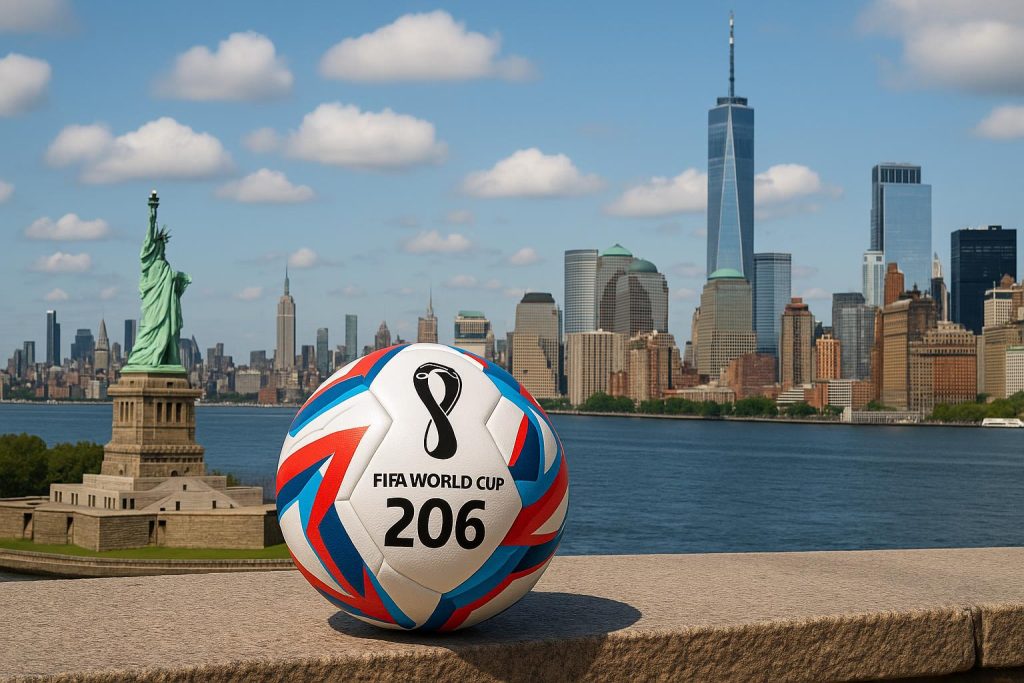
The FIFA World Cup 2026 is the largest sporting event ever staged. Forty-eight teams. Sixteen host cities across three countries. Over 500 million ticket requests were submitted in 33 days, representing 30 times the total available seating capacity of the entire tournament. A projected global television audience of 5 billion viewers. And the final, on July 19, 2026, is happening at MetLife Stadium in East Rutherford, New Jersey, just eight miles from Midtown Manhattan.
For football fans traveling to New York for the World Cup, the city is simultaneously the best possible host and one of the most logistically demanding too. New York’s scale, energy, and cultural range make it a destination that delivers well beyond the 90 minutes on the pitch. But its transit complexity, accommodation pricing, and sheer crowd volume during the tournament require preparation that goes beyond booking a flight and a hotel.
Most World Cup travel guides have covered the surface. But this one here gets into the specifics. Are you ready to take notes?
Table of Contents
MetLife Stadium: What You Actually Need to Know
MetLife Stadium holds approximately 82,500 spectators and will host eight World Cup matches in total. That includes five group-stage games, a Round of 32, a Round of 16, and the July 19 Final.
During the tournament it was temporarily renamed New York New Jersey Stadium to comply with FIFA naming rules. The stadium itself is getting a significant upgrade: around 1,740 seats have been removed to widen the playing surface to FIFA standards, the artificial turf has been replaced with natural grass grown in Hammonton, New Jersey, and a new irrigation system has been installed.
The stadium is located within the Meadowlands Sports Complex in East Rutherford. It is not accessible by the New York City subway. Getting there requires a specific plan, and that plan should be made well before match day.
There is no general parking. This is not a typical NFL game situation. MetLife’s standard parking lots have been repurposed for the FIFA Fan Village, shuttle staging areas, and tournament operations infrastructure. General fans cannot drive and park. This applies to the Final and all other matches. Plan your transportation before you travel, not on the day.
NJ Transit is the primary route. The standard approach is to take NJ Transit from Penn Station in Midtown Manhattan to the Meadowlands Station, which is a direct line to the stadium. The special event round-trip fare from Penn Station is $98, nearly 12 times the regular fare. Expanded match-day train service begins approximately four hours before kickoff and continues for several hours after the final whistle. Buy your train ticket in advance. Penn Station will be extremely crowded on match days and last-minute ticket purchasing adds time and stress you do not need.
Rideshare is an option but not a reliable plan. Uber and Lyft will be operating, but drop-offs and pickups are restricted to a designated zone at Meadowlands Racing and Entertainment, approximately one mile from the stadium entrance. Fans walk that final mile in both directions. On match days, particularly for the Final, surge pricing will be significant and wait times unpredictable given the volume of fans competing for cars simultaneously. Treat rideshare as a contingency, not a primary plan.
Arrive early, leave late. Getting to the stadium two hours before kickoff means you experience the pre-match atmosphere and avoid the worst of the crowd surge at Penn Station. After the match, waiting 30 to 45 minutes before joining the exit crowd reduces congestion considerably. The atmosphere around MetLife during a World Cup match is substantially more intense than a standard NFL game or concert. The crowd is more international, the build-up is longer, and the post-match energy extends well past the final whistle.
Where to Stay?
Manhattan accommodation during the World Cup, particularly in June and July, is expensive and competitive. The straightforward advice most guides give is to book in Manhattan and take transit. The better advice is to look at where you are actually spending your time and choose accommodation accordingly.
If you are primarily attending matches at MetLife, staying in New Jersey is more practical than Manhattan. Towns including Jersey City, Hoboken, Newark, and areas within reasonable NJ Transit distance of the stadium cut both the commute and the accommodation cost. Fans staying near the stadium avoid the Penn Station surge entirely on match days and can reach the venue in a short direct trip rather than a multi-transfer transit run from Midtown.
If you are primarily exploring New York City between matches, Brooklyn offers a better value proposition than Midtown Manhattan for most travelers. Brooklyn has direct subway access to Penn Station (take the 2/3 to Penn, approximately 20 minutes from most of central Brooklyn) and a far broader range of accommodation at lower price points. It also has some of the best food, bar, and neighborhood infrastructure in the city, which is where most of the real New York experience actually lives.
If budget is the primary constraint, look at the outer boroughs (Queens and the Bronx both have reliable subway access to Manhattan) and at hostels and apartment rentals in neighborhoods that are not immediately adjacent to tourist corridors. The subway connects virtually all of it, and once you understand the system, distance from Midtown is far less of an issue than it appears when planning from abroad.
Book as early as possible regardless of where you choose. World Cup demand across all 11 host cities is putting pressure on accommodation supply that was never expanded to match it, and New York is no exception. Availability tightens the closer you get to the tournament.
The New York Fan Experience Beyond the Stadium
The match itself is 90 minutes. The rest of the World Cup experience in New York is built around what you do before and after.
The NYC Neighborhood Passport initiative launched by Mayor Mamdani and NYC Tourism creates a citywide events calendar and mapping tool covering free and affordable programming across all five boroughs throughout the tournament. This is worth bookmarking. It covers neighborhood festivals, cultural events, fan gatherings, and local business programming that runs parallel to the official FIFA structures and gives visitors access to parts of the city that standard tourist itineraries miss entirely.
The NYNJ Fan Hub at Sports Illustrated Stadium in Harrison, New Jersey, broadcasts matches live on a 60-foot screen on the pitch, with entertainment and community programming across all 16 tournament dates. For fans who want the match atmosphere without the MetLife ticket price, this is a legitimate alternative for group-stage games.
Free viewing in the city is available at various public screening locations throughout the five boroughs. These vary by match day and will be confirmed closer to the tournament. The NYC Tourism events calendar is the most reliable source for updated locations.
The food and neighborhood dimension of New York is world-class for a World Cup crowd. The city has substantial communities from nearly every country represented in the tournament, which means there are real cultural hubs for most national fan groups. Jackson Heights in Queens has one of the most concentrated Latin American food and cultural scenes in the US. Astoria has strong Greek, Middle Eastern, and international restaurant culture. Sunset Park in Brooklyn has significant Central American and Chinese communities. Following your team’s fan base into its New York neighborhood is a different and more rewarding experience than watching a match in a tourist-area sports bar.
Multi-City World Cup Travel: Planning for the Full Tournament
- Many international fans attending the World Cup are not coming for a single match. The tournament runs from June 11 to July 19, and fans following their national team could be moving between multiple host cities across different rounds. The 11 US host cities span the continent:
- Los Angeles, California
- San Francisco, California
- Seattle, Washington
- Dallas, Texas
- Houston, Texas
- Kansas City, Missouri
- Atlanta, Georgia
- Miami, Florida
- Philadelphia, Pennsylvania
- Boston, Massachusetts
- New York, New York
- New Jersey, New Jersey
Flights between host cities need to be booked now. Domestic airfare between host cities on match-adjacent dates is already seeing demand pressure. The further out you book, the more options you have on routing and price.
Checked bags become expensive and slow across multiple flights. Paying checked bag fees on every leg, waiting at baggage claim in a busy airport after a night match, and managing large luggage through transit systems in cities you do not know all compound into significant time and cost across a tournament itinerary.
The single most practical equipment decision for multi-city World Cup travel is committing to a carry-on that actually meets airline specifications. NOBL Travel builds carry-on luggage to the 22 x 14 x 9 inch airline standard with internal compression systems that fit a week’s clothing without pushing the exterior shell past gate size limits. For a tournament itinerary involving five or six cities across five weeks, a bag that passes every size on every airline without question is a meaningful investment.
Understand each city’s transit system before you arrive. New York has the subway. Dallas and Houston are driving cities with limited transit options to venues. Miami and Los Angeles have specific match-day transport plans that differ from standard public transit. A quick research session for each host city before arrival saves significant scrambling after landing.
Match Day Practicalities: What to Bring and What to Leave Behind
FIFA enforces strict bag policies at World Cup matches. Clear bags or small bags within specific size limits are typically required for stadium entry. Check the official MetLife Stadium and FIFA guidelines for your specific match date, as policies can vary between group stage and knockout rounds.
Your full carry-on does not go into the stadium. Leave large bags at your accommodation or book luggage storage near Penn Station in advance if you are arriving from another city. Plan your match-day kit to fit the permitted bag: phone, wallet, transit card, and essentials only.
The weather in New York in June and July runs warm to humid. June averages a high of around 80 degrees Fahrenheit, and July climbs higher with the possibility of afternoon thunderstorms. Pack for summer conditions, not mild European temperatures.
For multi-city fans managing one carry-on across different climates, Dallas and Houston in July are significantly hotter than Seattle, and Miami is tropical. NOBL Travel’s guide on packing a carry-on for a week covers compression, layering, and fabric choice for exactly this kind of multi-climate tournament itinerary.
Getting Around New York City
The NYC subway runs 24 hours a day and connects virtually every part of the city relevant to a World Cup visitor. The OMNY system accepts tap-to-pay on any contactless credit or debit card at $2.90 per ride, with automatic daily fare capping. This is the most practical option for most international visitors. Penn Station is served by the 1, 2, 3, A, C, and E trains and is the hub for NJ Transit to MetLife. Rideshare works but is slower and more expensive during peak hours and match days. Carry some cash for smaller vendors and outer-borough businesses where card acceptance is inconsistent.
Lastly
The FIFA World Cup 2026 Final at MetLife Stadium on July 19 is a once-in-a-generation event. New York is built for it. Navigating it well comes down to planning the logistics before you arrive: book your NJ Transit tickets early, choose accommodation based on where you are actually spending your time, pack light if you are city-hopping, and build extra time into every transit plan. The atmosphere will be extraordinary. The preparation and research you put in now will determine how much of it you actually get to enjoy when the D day arrives.