


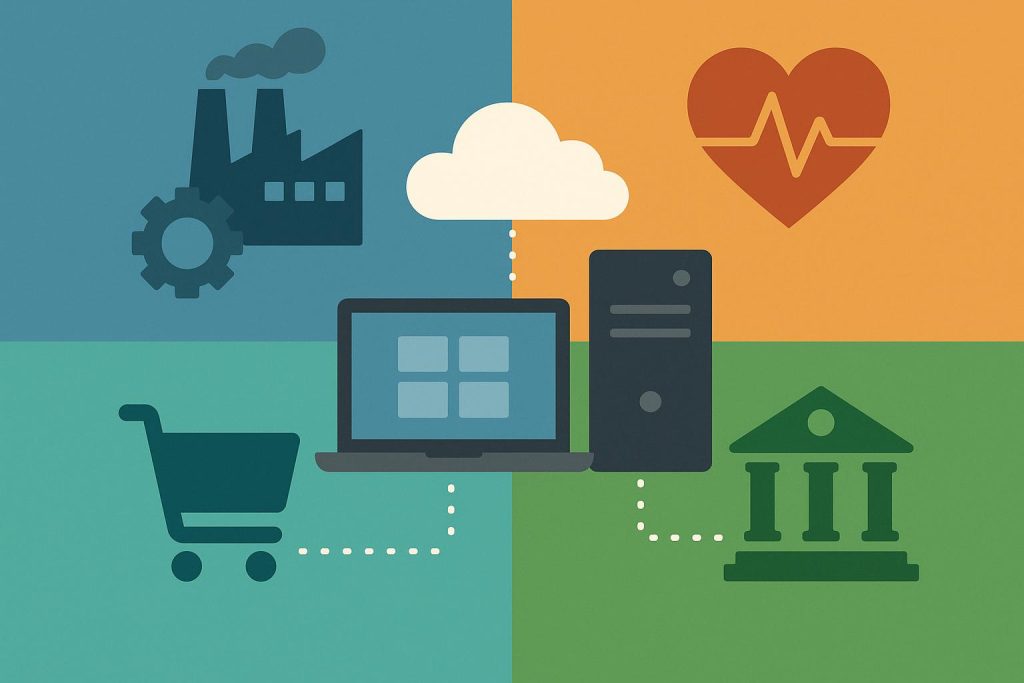
Most business owners understand that technology plays a role in how their organization operates. Fewer stop to think about whether the IT services supporting their business were actually designed with their industry in mind. That gap between general IT support and industry-aligned IT support is smaller than it sounds, but the consequences of getting it wrong are significant.
The truth is, a construction firm and a country club have almost nothing in common when it comes to their technology environments, their compliance risks, or the way a network failure would affect their day. Treating them the same way is one of the most common mistakes IT providers make, and it is one of the most costly ones their clients end up paying for.
Table of Contents
Why Industry Context Changes Everything in IT
When an IT provider walks into a new client relationship, they are not just looking at computers and servers. They are looking at workflows, regulations, staff behavior patterns, customer-facing systems, and operational dependencies. Every one of those factors changes based on what the business actually does.
A manufacturing facility runs industrial control systems that communicate with production equipment. A private golf club runs member management software and point-of-sale systems across multiple buildings. A utility company manages field technicians, remote access connections, and operational technology networks that tie directly to public infrastructure. These are not minor variations on the same theme. They are entirely different technical environments, and they require different expertise, different configurations, and different risk frameworks.
When an IT provider has genuine experience in your industry, they already understand the stakes before the first call ends. When they do not, you spend months educating them on your environment while hoping nothing breaks in the meantime.
Construction: Where Uptime Meets the Field
Construction companies deal with IT challenges that most office-based businesses never encounter. Their teams are spread across job sites that may not have reliable connectivity. Project management platforms, field communication tools, and estimating software need to work whether someone is in the main office or standing on a job site with a spotty signal.
Security is also a growing concern. Construction firms increasingly hold large volumes of sensitive data including client contracts, project financials, subcontractor agreements, and architectural plans. That data is worth targeting. Ransomware groups have identified construction as a sector where businesses often have weak cybersecurity practices but significant financial exposure.
IT support for construction needs to account for mobile device management, secure remote access, cloud-based file storage, and the kind of endpoint protection that covers both office workstations and field devices. A provider who only knows traditional office environments will miss at least half of what makes construction IT unique.
Manufacturing: Legacy Systems, Compliance Pressures, and Operational Risk
Manufacturing environments often run a mix of modern IT and legacy operational technology that was never designed to connect to a network. As more manufacturers integrate their production systems with business systems, the attack surface grows in ways that are genuinely hard to manage without the right expertise.
From a compliance standpoint, manufacturers who supply to defense contractors may face CMMC requirements. Those who operate in regulated industries may need to align with NIST frameworks or ISO standards. And regardless of compliance requirements, any manufacturer knows that a network failure on the production floor is not an inconvenience. It is revenue walking out the door by the minute.
IT services in manufacturing have to bridge the gap between traditional IT and operational technology. Providers need to understand how to protect and support both sides of that environment without disrupting production or creating new vulnerabilities in the process.
Private Clubs and Hospitality: Where Member Trust Is the Product
Golf clubs and country clubs operate in an environment where the member experience is everything. That means tee time booking systems, POS terminals in the pro shop and dining room, member portals, event management platforms, and Wi-Fi coverage across clubhouses, fitness centers, and outdoor spaces all need to work reliably, all the time.
The data security piece is particularly sensitive. Clubs store payment information, personal contact data, and sometimes financial billing records for high-net-worth members. A data breach at a private club does not just create legal liability. It damages trust in a way that is extremely difficult to recover from, especially in communities where reputation travels fast.
Club management software platforms like Jonas Club Software and ClubEssential require specific expertise. Most general IT providers have never touched them. When a problem occurs during a tournament, a wedding, or a gala, there is no time to figure it out on the fly.
Clubs also deal with seasonal staffing swings that create real cybersecurity risk. Temporary employees with system access, network credentials that do not get deactivated at the end of the season, and onboarding that happens too fast to include proper security training are all common patterns. An IT provider who understands the hospitality and club environment builds processes that account for these realities, rather than discovering them after something goes wrong.
Utility Companies: Critical Infrastructure Demands a Different Standard
Utility companies, whether they deliver gas, water, or electricity, carry operational responsibilities that extend well beyond typical business concerns. Service disruptions affect public safety. Regulatory requirements are more demanding. And the technical environments include both traditional IT infrastructure and operational technology networks that control physical systems in the field.
Cybersecurity for utilities is a national conversation. Threat actors have demonstrated that critical infrastructure is a viable target, and the consequences of a successful attack can extend far beyond financial damage. IT support in this space requires providers who understand the intersection of IT and OT security, who are familiar with relevant regulatory frameworks, and who treat availability as a safety issue, not just a performance metric.
Field operations also create unique IT challenges. Fleet-based teams need secure mobile connectivity, device management policies, and communication tools that work reliably across service areas. Managing all of that alongside corporate network security and regulatory compliance requires a level of operational depth that only comes from real experience in the sector.
The Common Thread: Generic IT Support Has a Ceiling
Across every industry, the pattern is the same. Generic IT support can handle the basics. It can keep the lights on, respond to tickets, and manage routine maintenance. But it hits a ceiling the moment you need someone who understands your regulatory environment, your operational dependencies, your software stack, or the specific way your business fails when technology breaks.
That ceiling shows up in a lot of ways. It looks like a provider who did not know your club management software had a known integration issue with your current server configuration. It looks like a cybersecurity recommendation that would have worked fine for a law firm but creates serious operational problems for a production floor. It looks like a compliance audit where your IT documentation does not match the framework your industry requires.
Industry-specific IT expertise is not a marketing phrase. It is the difference between a provider who is always catching up to your environment and one who already understands it before the relationship even starts.
What to Look For When Evaluating an IT Partner
If you are evaluating IT support for your organization, industry experience should be one of the first questions on your list. Ask prospective providers whether they have current clients in your industry. Ask what software platforms they have worked with. Ask how they handle the specific compliance requirements that apply to your sector.
The answers to those questions will tell you a great deal about whether you are about to enter a partnership built on genuine expertise or one where you will spend the first year teaching your provider how your business works.
Technology is too central to operations today to settle for a provider who treats every client the same. The businesses that get the most from their IT investments are the ones working with providers who understand not just the technology, but the industry it has to serve.

