

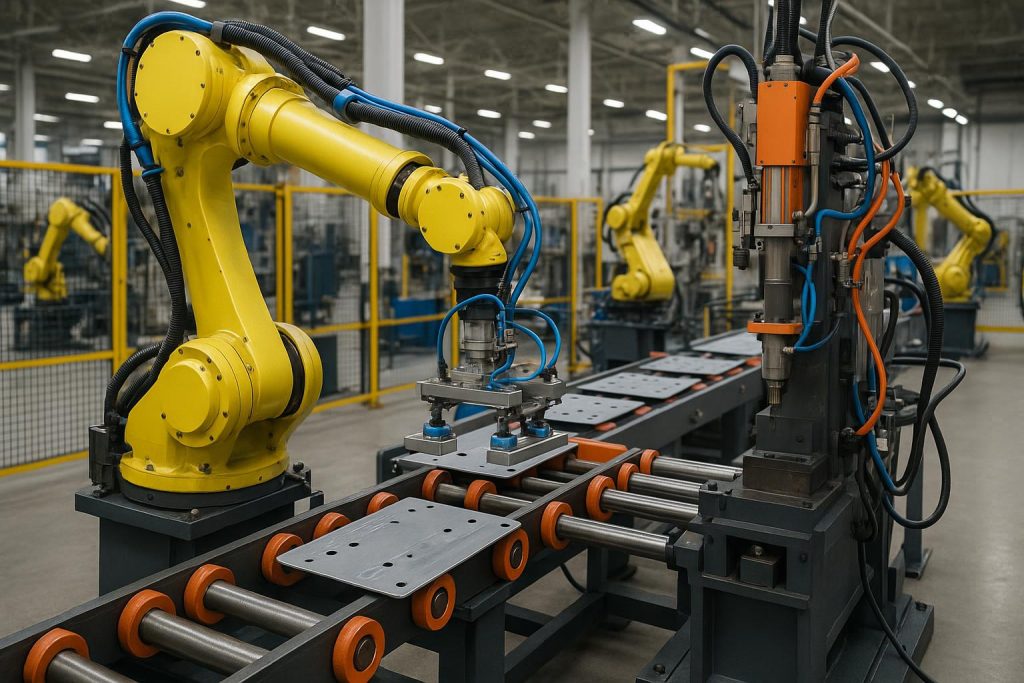
Walk onto any factory floor. The spreadsheets in the boardroom rarely match the concrete reality. Your CFO sees a minor variance in production output at the end of the quarter. Your shift supervisor sees a complete disaster today because three specialized welding jigs are missing, and a critical WIP cart is buried behind a wall of rejected parts. You cannot fix physical bottlenecks with a new management philosophy. You fix them by knowing exactly where your assets are.
Most plant directors bleed margins through these daily, invisible inefficiencies. Operators easily burn 20% of their shift just hunting down equipment or raw materials. This is exactly why pragmatic Manufacturing Automation is no longer a luxury. It is a fundamental requirement to stop the financial bleeding and get your production lines moving at actual capacity.
It is not about dropping a million-dollar robotic arm into a broken process. Automation fails when it ignores the actual physical workflow of your people. It requires a ruthless, unblinking system that tracks every asset, every tool, and every sub-assembly without asking your floor workers to scan a barcode.
Table of Contents
Hidden ROI Loss of Asset Hoarding in Manufacturing
Look at the behavior of your most skilled technicians. If they know a specific calibrator takes two hours to requisition from the central tool crib, they will not return it at the end of their shift. They will hide it under their workbench. This hoarding mentality completely destroys your capital expenditure strategy.
When assets vanish into desk drawers and locker rooms, the procurement team assumes they are lost. Operations directors end up buying 30% more hardware than the facility actually needs, simply to guarantee baseline availability. That is a massive waste of cash. You are paying for phantom inventory. It is a direct hit to your operating margins, disguised as a safe operational buffer. Facilities need to function on lean principles, but you cannot be lean if you are completely blind.
Dashboard Fatigue and Broken Infrastructure without Automation
IT departments frequently try to solve these blind spots by buying another disconnected software suite. This just creates another screen for your supervisors to ignore. Dashboard fatigue is a massive hazard on the floor. When floor managers are forced to toggle between an aging ERP, a clunky WMS, and a proprietary tracking tool, they eventually stop logging in altogether.
The infrastructure fails entirely because it demands manual intervention. If your tracking system requires a human being to stop what they are doing and pick up a scanner, you have already lost the productivity game. Operators need to turn wrenches and assemble products, not do manual data entry for the IT department.
Breaking Out of the Proprietary Hardware Lock-In
Here is the most common trap operations directors fall into: hardware lock-in. A vendor sells you a tracking tag that only communicates with their specific antennas. Those antennas are permanently tied to their expensive, walled-garden software. They own your infrastructure.
Suddenly, your facility is held hostage to a single vendor’s product roadmap. If you need to scale into a new warehouse next year, or integrate a different type of environmental sensor, you are stuck. You are forced to rip and replace the entire setup or pay exorbitant integration fees. That is not a sustainable architecture. It is a ransom note.
Real Throughput Requires Ground Truth with RTLS
True industrial throughput comes from stripping the friction out of human tasks. When a forklift enters a loading zone, the system should instantly update the WMS. It needs to allocate the inventory and signal the next dock door automatically. No clipboards. No manual status updates. Just raw, unedited operational truth.
A WIP cart sitting in a painting queue for three hours should trigger an immediate alert, rerouting the next batch to prevent a massive traffic jam on the floor. It is about predictive movement.
This same failure happens across multiple industries. Whether you are managing hundreds of infusion pumps in a chaotic hospital ward or tracking heavy tooling in an aerospace plant, the blind spots cost real money. When visibility drops, operations grind to an absolute halt.
Your best engineers currently spend hundreds of hours trying to force legacy systems to communicate with mismatched hardware. Instead of driving throughput, they become full-time IT troubleshooters. That is a terrible use of expensive intellectual capital. Your infrastructure must deliver exact coordinates and statuses instantly.
To achieve this level of operational visibility and permanently end the daily scavenger hunts, facility directors rely on a precisely engineered Real-Time Location System that ties physical movement directly to their bottom line.
The End of Operational Guesswork with RTLS Digital Twin
LocaXion is the world’s first pure-play RTLS & Digital Twin systems integrator. We engineer systems for your business outcomes-not just “tracking.”
That means less risk, less integration of guesswork, and faster time-to-value. And because we’re not locked to one technology stack, you get the freedom to scale with the right technology – not the technology we happen to sell.
RTLS tracks your assets. LocaXion transforms how your operation runs.
That’s the difference. And it’s not a small one.
Stop bleeding margins on hidden factory floor bottlenecks and engineer your outcomes today at https://locaxion.com/