


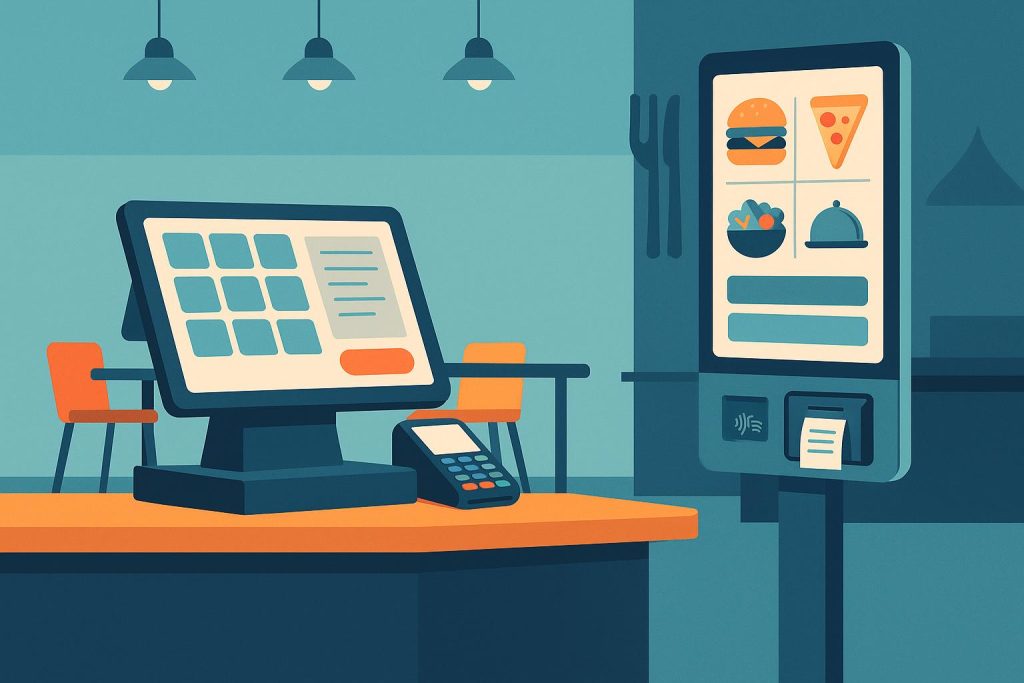
A restaurant can have a packed dining room, a queue at the counter and a stream of online orders arriving at the same time. The challenge is not taking orders; it is making sure every order reaches the right place without creating another layer of work.
That is why choosing the right point of sale for restaurants in 2026 means looking beyond the till and towards a connected system that can bring staff-led ordering, self-service kiosks, payments and kitchen operations together.
The shift is already underway. The National Restaurant Association’s 2026 industry report identifies digital ordering, automation and data analytics as areas where operators are looking for efficiency and long-term competitiveness.
For many operators, the answer is not replacing human service with technology. It is creating a hybrid model where customers and staff can use whichever ordering method makes sense for the moment.
Table of Contents
A Hybrid POS Should Connect Every Ordering Journey
The best hybrid systems are designed around the customer’s journey rather than a particular device. A customer might order at a counter during a quiet afternoon, use a kiosk during the lunch rush or place an order online before arriving. The underlying POS should treat these as connected transactions rather than separate activities.
| Ordering channel | What the POS should manage |
|---|---|
| Counter | Staff-entered orders and payments |
| Kiosk | Self-service orders and customisations |
| Online | Digital orders and scheduled pickups |
| Table | Staff or guest-led ordering |
| Delivery | Incoming orders and fulfilment |
This matters because disconnected channels create duplicated menu updates, inconsistent pricing and opportunities for orders to be missed.
Modular Kiosk Technology Lets Restaurants Add Self-Service Without Redesigning Everything
A kiosk should be an extension of the restaurant’s ordering infrastructure, not another isolated system. Modular technology allows an operator to start with a straightforward self-service setup and expand it as demand changes. For example, a café might deploy one countertop kiosk during peak periods before adding additional units or floor-standing options as transaction volumes grow.
Look for kiosk technology that supports:
- The same menu and pricing as the main POS
- Real-time order transmission to the kitchen
- Multiple payment methods
- Product customisation
- Upselling and add-on prompts
- Accessibility-conscious interface design
- Remote software and menu management
The benefit is practical: the restaurant can adapt its ordering environment without rebuilding its entire technology stack. Once the kiosk and POS speak the same language, the next question is what happens after an order is placed.
Kitchen Synchronisation Is More Important Than the Screen
A visually impressive kiosk means little if kitchen staff still have to re-enter orders manually. The real efficiency gain happens when an order moves automatically from customer selection to preparation.
This can help reduce:
- Duplicate order entry
- Misread handwritten notes
- Incorrect modifications
- Delays between payment and preparation
- Confusion during peak periods
That distinction is important. The goal is not simply to add technology; it is to remove unnecessary steps.
The Right Hybrid POS Should Adapt to Different Service Styles
A quick-service venue may want kiosks to handle a large proportion of transactions. A café might use them only during peak periods. A full-service restaurant may prefer staff-led ordering while using digital ordering primarily for takeaway. There is no single ideal configuration.
| Restaurant model | Useful hybrid approach |
|---|---|
| Café | Counter + kiosk + online pre-ordering |
| Quick-service restaurant | Multiple kiosks + POS + kitchen integration |
| Food court | Kiosks + central production workflow |
| Casual dining | Staff POS + table ordering + online |
| Multi-site group | Cloud POS + shared menus + local controls |
A flexible POS should accommodate these differences rather than forcing every location into an identical workflow. That flexibility becomes even more valuable when restaurants expand.
Cloud Management Makes Multi-Location Kiosk Operations Easier
For operators managing more than one venue, consistency can become a daily headache. Cloud-based management can allow authorised users to update menus, review sales and monitor performance across locations without physically visiting each site.
Useful capabilities include:
- Centralised menu management
- Location-level permissions
- Cross-site reporting
- Shared product catalogues
- Centralised promotions
- Remote device management
However, centralisation should not mean every location loses control. Local menus, pricing, trading conditions and product availability may need to remain configurable.
Payment Security Should Be Part of the POS Selection Process
As more transactions move through digital channels, payment security cannot be treated as an afterthought. Restaurant operators should ask potential providers how payment data is protected, where sensitive information is handled, and how software updates are managed.
The PCI Security Standards Council describes PCI DSS as a baseline of technical and operational requirements designed to protect payment account data. Its current document library lists PCI DSS v4.0.1 as the active standard.
Questions worth asking vendors include:
- Is payment processing integrated securely?
- How are administrator accounts protected?
- How frequently is software updated?
- What happens if a device loses connectivity?
- Who is responsible for security-related maintenance?
A reliable system should make secure operation easier, not add another administrative burden.
The Best Hybrid POS Is the One That Removes Friction
Choosing technology for 2026 is less about finding the POS with the longest feature list and more about identifying where your restaurant loses time today.
A strong hybrid setup should connect staff ordering, kiosks, online transactions, payments and kitchen workflows while giving operators useful data to improve the experience. Before investing, map the customer journey, identify repetitive manual tasks and test whether the proposed system actually removes them.
The result should feel simple to the customer and even simpler to the team behind the scenes. That is the real promise of modern restaurant technology: not more screens, but fewer obstacles between a customer placing an order and receiving exactly what they wanted.

