

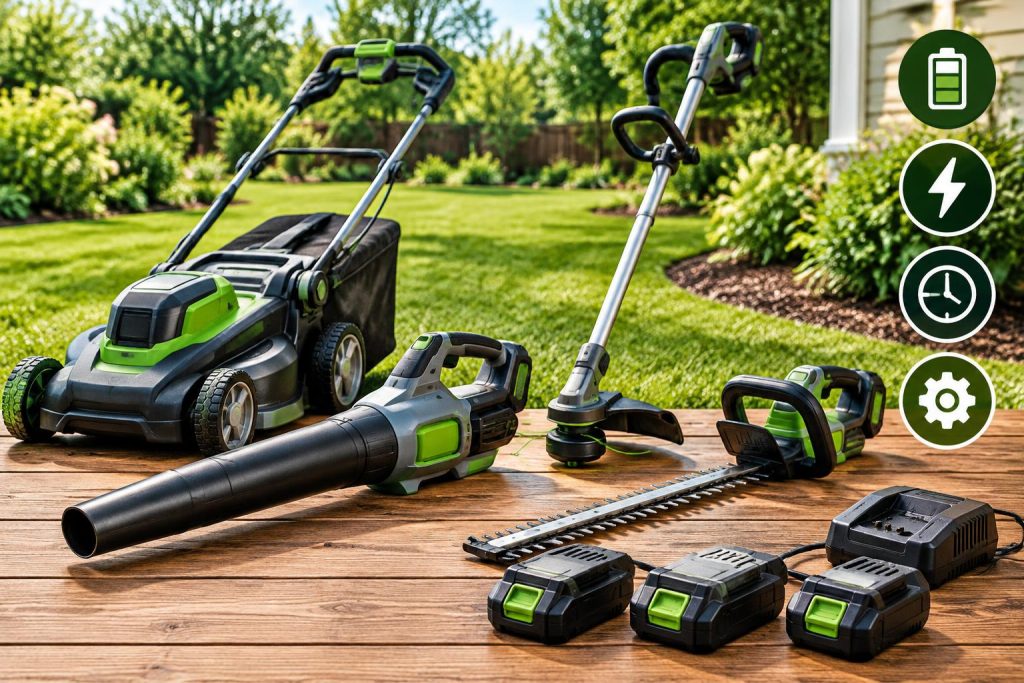
Battery-powered outdoor equipment has changed how homeowners approach routine yard work. Tasks that once required gas engines, extension cords, or repeated trips to an outdoor outlet can now be handled with portable electric tools. For many properties, this means easier equipment startup, less routine maintenance, and greater flexibility when moving between the lawn, garden beds, and outdoor living areas.
However, cordless equipment is not automatically the right choice for every job. Battery capacity, motor performance, tool weight, charging time, and the demands of the property all influence whether a particular model will perform reliably. Choosing equipment based on these factors helps homeowners build a practical system rather than accumulating tools that fall short during demanding work.
Table of Contents
Start With the Work Your Yard Requires
The most useful starting point is a realistic assessment of routine maintenance. A small lawn with a few shrubs presents different demands from a large property with mature trees, long hedges, and extensive garden borders.
Match Tool Capacity to Property Size
For smaller lawns, a cordless mower with an appropriate cutting width and sufficient runtime may handle the entire job on one charge. Larger properties require closer attention to battery capacity, charging intervals, and whether additional batteries are available.
Consider the entire workload, not just the square footage. Thick grass, uneven terrain, and frequent stops around landscaping can increase operating time and energy consumption. A mower that performs well under light conditions may use its battery more quickly when grass is dense or damp.
The same principle applies to string trimmers, hedge trimmers, and leaf blowers. Choose equipment according to the frequency, duration, and intensity of the tasks it will perform.
Understand Battery Voltage and Capacity
Battery specifications can be confusing because voltage and amp-hours describe different characteristics.
Voltage is associated with the electrical potential supplied to the tool, while amp-hour capacity indicates how much charge a battery can store. Within a compatible system, a battery with greater amp-hour capacity will generally offer longer runtime under comparable conditions, although the actual result depends on the tool’s power demand and operating conditions.
Watt-hours provide another useful comparison because they combine voltage and amp-hour capacity. To estimate nominal energy, multiply the battery’s voltage by its amp-hour rating. For example, a 20-volt, 5-amp-hour battery has a nominal energy rating of 100 watt-hours.
That figure is not a guarantee of operating time. Motor efficiency, temperature, battery age, and workload all affect practical performance. For tools used continuously, such as lawn mowers, these differences can determine whether a single battery is sufficient.
Evaluate Runtime, Charging, and Battery Compatibility
Runtime claims are most useful when considered alongside charging time and the availability of replacement batteries. If mowing typically takes 45 minutes but a battery provides substantially less time under your conditions, you will need a second battery, a smaller workload per session, or a different mower.
Consider a Shared Battery Platform
Some manufacturers offer multiple outdoor tools that operate on compatible batteries. This arrangement can reduce the number of chargers and battery types needed in a household.
When comparing greenworks power tools, examine the specifications for each individual model rather than assuming every cordless product uses the same battery. Voltage platforms, battery connections, charging requirements, and included accessories can differ.
A shared system is most useful when the tools complement one another. For instance, a homeowner might use a compatible battery platform for mowing, trimming, and seasonal cleanup. Before expanding a collection, verify that the existing battery is approved for the new tool and that its capacity suits the intended workload.
Compare Performance Beyond the Battery
A powerful battery cannot compensate for an unsuitable tool design. Other specifications affect cutting quality, comfort, and overall productivity.
For lawn mowers, examine cutting width, height adjustment, grass collection options, and performance in thicker turf. For string trimmers, consider weight, cutting swath, line-feed design, and balance. Hedge trimmers should be assessed for blade length, cutting capacity, and the weight that must be held away from the body.
Leaf blowers require particular attention to airflow and airspeed. Higher airspeed can help dislodge stubborn debris, while sufficient airflow helps move larger volumes of leaves. Neither specification alone tells the whole story.
Ergonomics matter just as much. A lightweight tool with a comfortable grip can be preferable to a heavier model with greater capacity if the work involves extended periods of overhead trimming or repeated movement around garden beds.
Weigh the Benefits Against the Limitations
Battery-powered equipment offers several practical advantages. It generally starts without the fuel preparation or engine warm-up associated with gas equipment, produces no direct exhaust emissions during operation, and often requires less routine mechanical maintenance. It can also be quieter than comparable gas-powered equipment, although hearing protection may still be necessary.
The limitations deserve equal consideration. Batteries add weight, require charging, and gradually lose capacity with age and use. Replacement batteries can represent a significant expense, particularly when specialized models are involved. Very demanding jobs may require spare batteries or a different power source.
Cold weather can also reduce battery performance, while hot storage conditions may accelerate degradation. Follow the manufacturer’s guidance for charging, storage, and operating temperatures instead of leaving batteries exposed to extreme conditions.
Plan for Safe Operation and Long-Term Care
Cordless tools still contain sharp blades and moving components. Read the operating manual, wear suitable eye protection and footwear, and use hearing protection when indicated. Keep children and pets away from operating equipment, and remove stones, branches, and other debris before mowing.
Inspect cutting attachments before each use. Disconnect the battery before clearing jams, cleaning cutting components, or performing maintenance whenever the manufacturer directs. Use only compatible chargers, and discontinue use of batteries that show signs of damage.
Store tools in a dry, secure location. Keeping batteries clean and following recommended charging practices can help preserve their service life.
Frequently Asked Questions
Are battery-powered lawn tools suitable for large yards?
Yes, if their runtime, cutting capacity, and battery availability match the workload. Large lawns may require higher-capacity batteries or a spare battery to complete maintenance without lengthy interruptions.
Is a higher-voltage tool always better?
No. Voltage alone does not determine cutting performance or runtime. Compare the complete specifications, including motor design, battery energy, tool weight, and the demands of the intended job.
Should all outdoor tools use the same battery system?
A shared platform can simplify storage and reduce duplicate charging equipment, but compatibility must be confirmed. Different product ranges may use different batteries even when they carry the same brand name.
Make the Choice Around Your Routine
The right cordless equipment fits the property, the operator, and the time available for maintenance. By assessing workload, comparing battery specifications, checking platform compatibility, and considering ergonomics alongside performance, homeowners can make informed purchasing decisions. A well-matched collection of battery-powered tools makes routine lawn care more flexible without sacrificing the practical requirements of a well-maintained outdoor space.