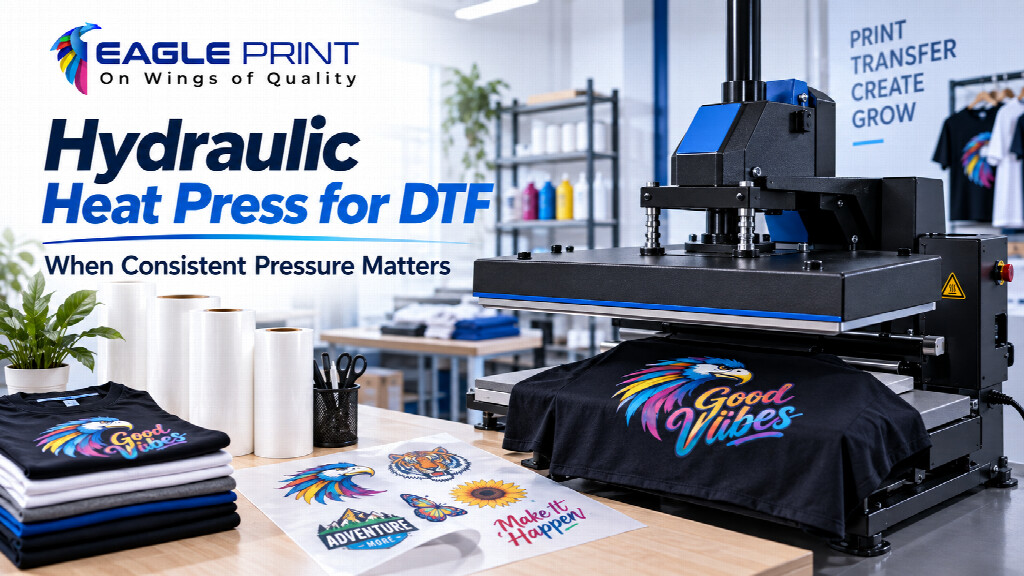
A hydraulic heat press can be attractive to DTF businesses that want a more repeatable pressing process, especially when production volume is growing and operator consistency becomes harder to maintain. The key question is not whether hydraulic pressure is automatically “better” than every other press type. It is whether the machine’s pressure control, platen size, workflow, footprint, and operating style match the transfers and garments your shop produces.
What Is a Hydraulic Heat Press?
A hydraulic heat press uses hydraulic force to apply pressure during the pressing cycle. In a DTF workflow, that pressure works together with heat and time to apply a transfer to a garment. The machine does not replace the need for correct transfer instructions, garment preparation, or testing, but it can change how pressure is delivered from cycle to cycle.
For buyers researching this equipment category, Eagle DTF Print lists the HYDRO1620 hydraulic heat press among its available heat-press equipment. Product-specific operating requirements should always be reviewed before purchase and installation.
Why Pressure Consistency Matters in DTF Production
DTF transfers are applied through a combination of heat, pressure, and time. If one of those variables changes unexpectedly, the result can become harder to repeat. A shop pressing a few garments may be able to monitor every cycle closely. A shop producing many garments across multiple jobs needs a process that different operators can repeat with fewer surprises.
Consistent pressure is especially important when the business is trying to standardize production. That does not mean one pressure setting works for every transfer, fabric, or garment construction. It means the press should make it easier to reproduce the pressure required by the specific application instructions you are following.
Look Beyond Maximum Pressure
Buyers often compare machines by headline specifications, but maximum force does not tell you how the press will feel in daily use. Think about how garments are loaded, how the platen moves, how controls are accessed, and whether operators can maintain a clean, organized pressing area.
- Platen size: Make sure the working area fits the transfer sizes you commonly apply.
- Loading workflow: Consider how easily garments can be positioned and removed during repeated jobs.
- Control access: Operators should be able to confirm time and temperature without disrupting the workflow.
- Pressure repeatability: The machine should support a process your team can document and repeat.
- Workspace: Account for movement, loading clearance, power, maintenance access, and safe operation.
Hydraulic vs. Semi-Automatic or Portable Presses
Different press styles solve different problems. A portable or compact press may suit low-volume work, sampling, travel, or limited space. A semi-automatic press may improve operator flow for shops that want faster loading and less manual effort. A hydraulic press may be more relevant when pressure consistency and a structured production station are higher priorities.
If you are still comparing formats, reviewing a broader range of heat press machines can help separate the press type from the actual workflow requirement. The best choice is the press that fits your transfer sizes, garment mix, staffing, floor plan, and expected production pace.
When Does a Hydraulic Press Make Sense?
A hydraulic heat press becomes easier to justify when pressing is no longer an occasional finishing step but a repeat production task. For example, a shop may reach a point where multiple employees handle transfers, daily order volume increases, or rework from inconsistent pressing becomes expensive.
It may also make sense when a business wants to build a dedicated pressing station with documented operating procedures. In that environment, repeatability can matter more than having the smallest possible machine.
When Might It Be More Machine Than You Need?
Not every DTF business needs hydraulic equipment. If you press only small quantities, operate from a very limited workspace, or need a machine that moves frequently, a larger production press may add complexity without solving a real problem. Equipment should follow the workload.
Before upgrading, identify the problem you are trying to fix. Is the current press too small? Is pressure difficult to reproduce? Are operators spending too much effort opening and closing the machine? Is the loading area slowing production? If the answer is unclear, purchasing a larger press may not improve the workflow.
Build a Test Process Before Full Production
Any new heat press should be incorporated into production through controlled testing. Follow the transfer and equipment instructions, verify the machine setup, and test the garments and transfer types you use most often. Document successful settings instead of relying on memory.
- Confirm the press is installed and operated according to its documentation.
- Use the application instructions for the specific DTF transfer.
- Test on representative garments before a customer production run.
- Record time, temperature, pressure approach, and any finishing steps.
- Train operators to follow the same process and report deviations.
What Should You Ask Before Buying?
Ask practical questions: Does the machine fit the physical workspace? Can your team load garments comfortably? Is the platen appropriate for your common transfer sizes? What maintenance and operating procedures are required? Can the press support the production pace you realistically expect?
These questions are more useful than choosing a press simply because it sounds industrial. A heat press is a production tool, so its value comes from how well it supports repeatable work.
Bottom Line
A hydraulic heat press can be a strong fit for DTF businesses that are moving toward a more standardized, repeatable production process. Its main advantage should be evaluated in context: pressure delivery, operator workflow, platen size, space, and daily volume all matter. Choose the machine that solves a documented production need, then build a tested pressing procedure around it.