Jay Sailesh Sheth is a senior vice president at Arete Wealth, where he provides financial planning and specialized investment strategies for clients seeking structured products and alternative vehicles. With a career distinguished by top performance at National Securities—where he amassed more assets under management than any of the firm’s 100-plus brokers—Mr. Sheth has earned numerous industry and community awards, reflecting his leadership and analytical skill. Beyond his professional achievements, Jay Sailesh Sheth is an avid global traveler with a passion for wildlife exploration, having visited Africa and India on safari. His interest in the natural world aligns closely with the topic of extinct big cats, whose history and paleobiology continue to inspire researchers and wildlife enthusiasts alike. His dual pursuits in finance and global exploration offer a balanced perspective on both human progress and the irreplaceable wonders of the natural world.
Some of the Most Iconic Extinct Big Cats
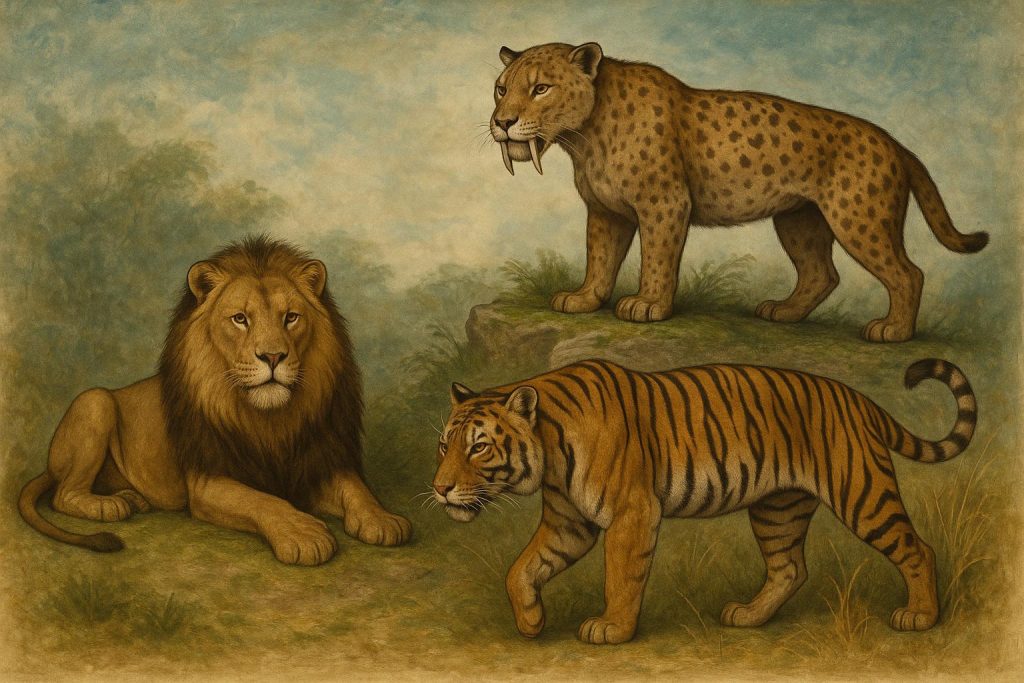
In modern times, the term “big cat” has referred to five species of felines: lions, tigers, jaguars, leopards, and snow leopards. However, several additional species have met the qualifications for big cat status in the past, including the American lion, the cave lion, Smilodon, and various saber-toothed cats.
Not to be confused with the mountain lion, the American lion lived in North America during the most recent ice age. They were larger than the lions of Africa, measuring about eight feet long and weighing 500 to 1,000 pounds, making them the largest big cats of all time. Despite their immense size, American lions were deadly, quick predators, capable of reaching speeds of 30 miles per hour. This unique combination of size and speed enabled the American lion to hunt a wide range of prey, including bison, giant ground sloths, and even juvenile mammoths, though scientists do not know whether American lions hunted in packs or as solitary predators. The last of the American lions died out around 10,000 years ago.
The cave lion, meanwhile, also known as the steppe lion, occupied parts of Eurasia and northwest North America until about 13,000 years ago. The apex predator ruled the mammoth steppe, once Earth’s most extensive biome, though the cave lion often came into conflict with other large predators, such as the cave hyena. Cave lions were similar in size to American lions, measuring up to about seven feet in length and up to 800 pounds.
Cave lions closely resembled their modern-day counterparts, though scientists believe males of the species lacked the African lion’s signature mane. Furthermore, although experts have not reached a consensus, most believe cave lions led relatively solitary lives, more akin to present-day tigers, rather than the complex social structures that define the modern lion.
Many of the largest extinct cats belong to the saber-toothed cat family, one of the most recognizable groups of ice-age animals. The name derives from the animal’s oversized canine teeth, which protruded several inches from their closed mouth. Researchers compare saber-toothed cats to both modern-day lions and tigers. They could roar, an important qualifier for the big cat family, and possibly lived and hunted in packs.
However, saber-toothed cats were very much their own animals, especially when it comes to their preferred method of hunting. Despite their pack tendencies, saber-toothed cats had short legs and bobbed tails, making them slow, unbalanced runners. Instead, saber-toothed cats developed group-ambush tactics, surprising large, slow-moving animals such as sloths, and used their long canine teeth to slash at a prey animal’s belly and throat before it could escape. This method enabled saber-toothed cats to thrive across North America, with a habitat range spanning coast to coast from Canada to Peru.
Smilodon fatalis was the largest of the saber-toothed cats. They measured nearly six feet from nose to tail and could weigh over 600 pounds. The Smilodon’s iconic canine teeth grew to about seven inches. To make use of these teeth, the Smilodon could open its jaws to a 130-degree angle, nearly twice the gape of modern cats. The last Smilodon lived roughly 13,000 years ago, meaning much of its behavior remains a mystery to modern scientists. For instance, while the Smilodon would benefit from group hunting tactics, the animal’s small brain size suggests it was a mostly solitary animal.
About Jay Sailesh Sheth
Jay Sailesh Sheth is a senior vice president at Arete Wealth, specializing in financial planning and alternative investment strategies for high-net-worth clients. Before joining the firm, he spent nearly 20 years at National Securities, where he became the company’s top-producing broker and earned numerous awards for leadership and performance. Mr. Sheth holds a business administration degree from Adelphi University and has been recognized by organizations such as AAPI-QLI and the Rajasthan Alliance of North America. Outside of finance, he is an avid traveler with a passion for wildlife and global exploration, interests that complement his appreciation for topics such as the history of extinct big cats.