


Joel Bartsch is a museum executive and earth sciences leader who has spent decades working with geological collections and public education. As president and chief executive officer of the Houston Museum of Natural Science since 2004, Bartsch oversees exhibit development, educational programming, and institutional growth. His career began in geology-focused museum roles, including positions at the Colorado School of Mines Geology Museum and the California State Mining and Mineral Museum, where he served as director and curator. Returning to Houston, he led earth sciences initiatives before advancing to executive leadership. His work connects scientific research with public engagement, making complex topics more accessible to broad audiences. This background aligns closely with the study of minerals and gems, which offer insight into Earth’s history while also reflecting cultural and scientific narratives presented in museum settings.
Table of Contents
Gems, Minerals, and the Stories They Tell About the Planet
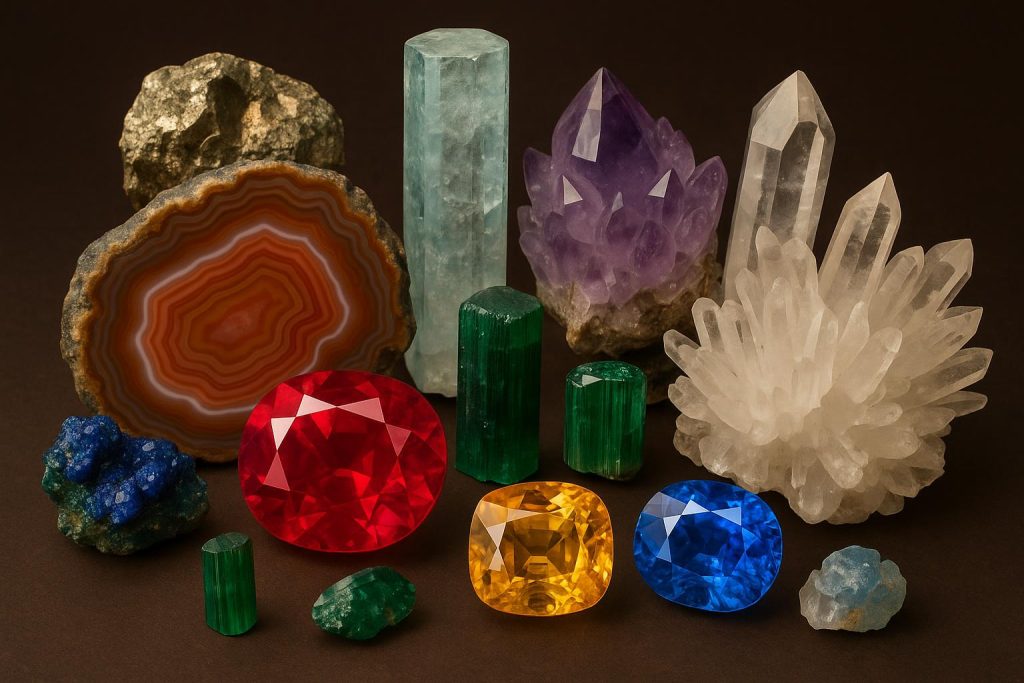
Minerals are often admired for their beauty, but their deeper value lies in what they reveal. Each crystal and gemstone is a record of Earth’s history, formed through physical processes that span immense stretches of time. To study minerals is to examine evidence of how the planet has evolved and how human societies have interacted with it.
A mineral is a naturally occurring substance with a specific chemical composition and internal structure. According to the United States Geological Survey, minerals are the fundamental building blocks of rocks and form through processes such as crystallization from molten material or precipitation from water. These processes occur under distinct conditions, meaning every mineral carries clues about the environment in which it formed.
Diamonds offer a striking example. They crystallize deep within the Earth’s mantle under extreme pressure and temperature, then reach the surface through volcanic eruptions. Their presence provides evidence of processes occurring far below the crust, revealing a dynamic Earth shaped by forces that operate on a scale difficult to imagine.
Other minerals tell quieter but equally important stories. Quartz, one of the most abundant minerals in the Earth’s crust, forms from silica-rich fluids that cool and solidify over time. Its widespread presence reflects the chemical composition of the crust and the long history of hydrothermal activity that has shaped it. Even common minerals contribute essential pieces to the broader geological narrative.
Minerals also illuminate the history of human civilization. Long before modern transportation, certain stones traveled vast distances along early trade routes. Lapis lazuli, known for its deep blue color, has been mined in present-day Afghanistan for thousands of years. The Metropolitan Museum of Art notes that this stone was transported across the ancient world and used in jewelry, decorative objects, and eventually as a pigment in some of the most significant paintings of the Renaissance.
Gold provides another example of how minerals have shaped human history. Its rarity, durability, and resistance to corrosion made it a natural store of value. Over time, it became a symbol of wealth and authority, influencing trade systems, political power, and exploration.
Beyond economic importance, minerals have carried cultural and symbolic meaning. Jade has long been associated with virtue and harmony in East Asia, while turquoise has been used in protective and ceremonial objects across multiple cultures. These associations reflect how people interpret the natural world, assigning meaning to materials that originate deep within the Earth.
Museums bring these scientific and cultural narratives together. A well-curated mineral exhibit does more than display specimens. It provides context, connecting the geological processes that formed a mineral with the human stories that gave it significance. Visitors are often drawn in by visual appeal, but they leave with a broader understanding of Earth’s history and humanity’s place within it.
For scientists, minerals are tools for reconstructing the past. For the public, they offer an accessible entry point into complex ideas about time, change, and interconnected systems. A single specimen can prompt questions about formation, movement, and use across cultures.
In that sense, minerals are storytellers. They record the forces that shaped the planet and reflect the values of the societies that have prized them. When examined closely, they connect the deep history of the Earth with the ongoing story of human civilization.
About Joel Bartsch
Joel Bartsch is the president and chief executive officer of the Houston Museum of Natural Science. With a background in earth sciences and museum leadership, he has held roles including curator, director, and project manager in geological and mineral-focused institutions. He began his career at the Colorado School of Mines Geology Museum and later led the California State Mining and Mineral Museum. He holds a master of arts in history and the history of science from Rice University and has received recognition for his contributions to mineralogy.

