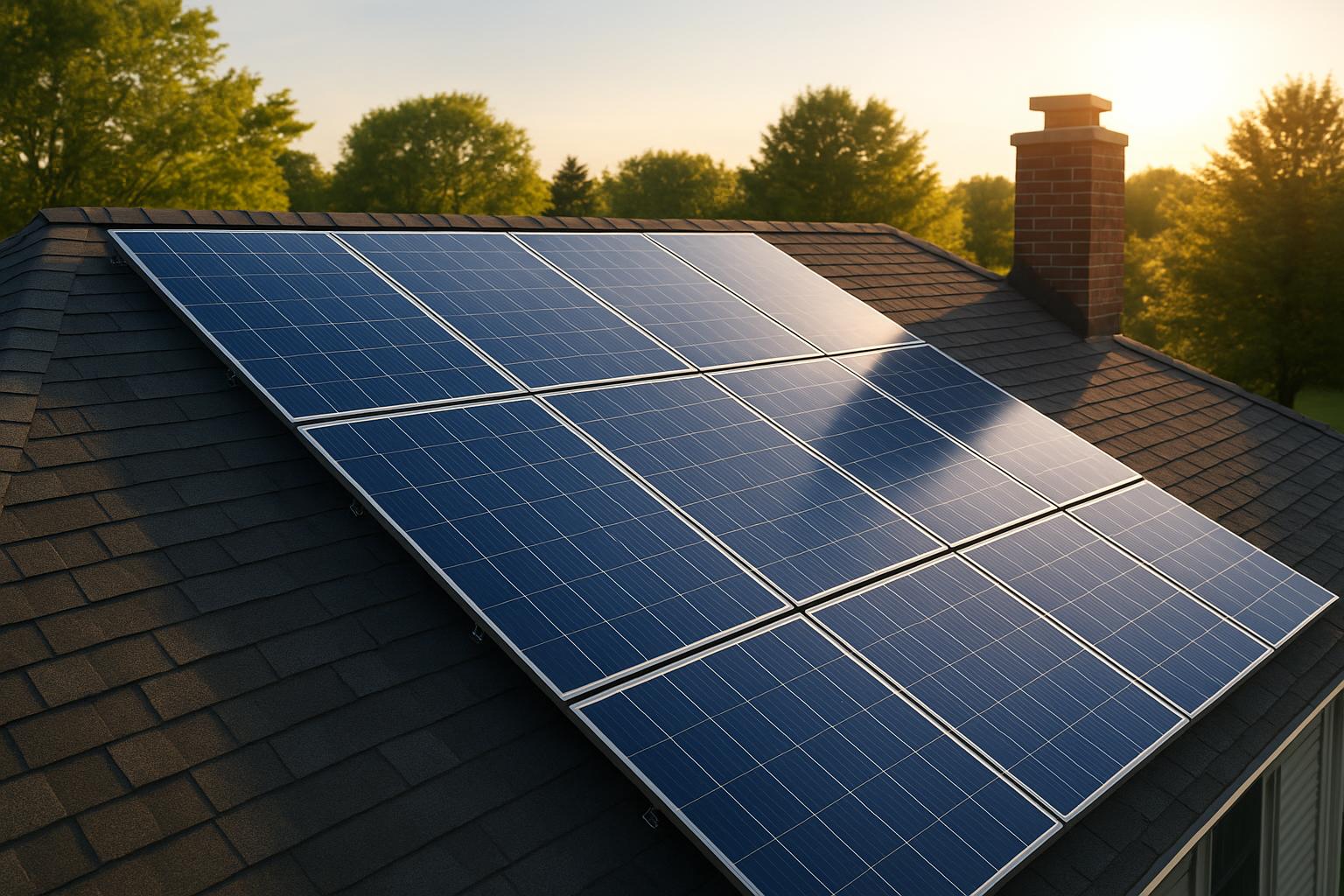
A homeowner in Cape Elizabeth signed a solar installation contract in March 2025. The proposal her installer had sent showed a payback period of 10 to 11 years, calculated against CMP’s current rate of $0.27 per kilowatt-hour. She had the federal tax credit factored in. She was among the last residential customers in Maine who would.
The One Big Beautiful Bill, signed July 4, 2025, ended the Section 25D residential clean energy credit effective Dec. 31, 2025, nearly a decade ahead of its scheduled 2034 expiration under the Inflation Reduction Act. On a $30,000 installation, that credit had been worth $9,000.
Yehuda Gittelson installs residential and commercial solar across southern Maine for Solaris Energy Solutions, where he holds a NABCEP PV Installation Professional certification. He dealt with the fallout through the second half of 2025, mostly in the form of customers who had been tracking prices and hadn’t understood the urgency of the timeline. “The homeowners who signed before July were fine,” he said. “The ones who were still in conversation, comparing installers, waiting to see if rates would change. Some of them didn’t realize the deadline had teeth until it was already past. And by then the proposal they were comparing was based on a number that didn’t exist anymore.” That number, he added, had been doing a lot of work in a lot of proposals.
Without the federal credit, the payback period for a rooftop system in CMP territory now runs 15 to 17 years at current rates. CMP raised its residential rate to $0.27 per kilowatt-hour in 2024; Versant customers in eastern and northern Maine pay $0.32. Before the credit expired, payback timelines in most southern Maine proposals ran closer to 10 or 11 years. The $9,000 credit on a $30,000 system removed roughly a third of the effective project cost and, with it, several years from the payback calculation.
When Gittelson sits across from a homeowner reviewing a proposal, one of the first questions he asks is whether the installer has explained the difference between an installation date and an interconnection date. They are different things. A solar system can be physically complete on the roof and sit dark for weeks while the utility processes its interconnection review and issues permission to operate. Installers typically quote an installation date. The date the system actually begins generating power depends on how many applications are ahead of it in the utility queue, and in Maine that queue can run from two weeks to six months depending on grid conditions at the point of connection and the volume of pending applications.
Gittelson has gotten calls from customers with completed systems that weren’t generating power. “The panels are there. They look like they should be working,” he said. “But the utility hasn’t flipped the switch yet. That’s just something people should understand before they sign.” He walked one family through the process twice before the timeline made sense to them. The installation had been finished for three weeks by the time permission to operate arrived.
Interconnection application fees run $50 to $400 depending on the utility, a cost that shows up in final contracts but rarely in the estimate-stage conversations where customers are deciding whether to proceed. More consequential is the panel upgrade question. A 100-amp electrical service was adequate for a 1960s household and is often not adequate for a home that has since acquired a heat pump, an electric vehicle charger, and a solar array with battery storage. Service upgrades add $2,000 to $4,000 to a project that was quoted without them, and the assessment that reveals the need for an upgrade is sometimes the site visit that happens after the initial proposal has already been accepted.
Per EnergySage’s 2026 installer survey data, the average gap between online estimate tools and final signed contracts runs $2,400 to $4,800 once permit fees, upgrade costs, and interconnection charges are factored in. “People come in having done real homework,” Gittelson said. “What they’ve usually modeled is the system. The number they’re worried about is the solar number. What they haven’t priced is everything the solar requires.” That gap, he added, was where most of the surprises landed.
One piece of information that turned out not to be a problem was the net energy billing question. Maine’s LD 1777, passed in 2024, restructured compensation rates for large commercial and community solar projects. Residential rooftop installations were not included. The net energy billing program remains intact for homeowners putting panels on their own roofs, on the same terms as before. Gittelson fielded calls through late 2024 from homeowners who had read coverage of the bill and assumed its changes applied to them.
“The sale is usually done before I get there,” he said. “My job is to make sure they know what they actually bought.” Most of the time, that means confirming the proposal was accurate. Occasionally it means a longer conversation than the homeowner had expected. Both are part of the work.
The Cape Elizabeth homeowner’s system came online in late spring, after a six-week interconnection review. The installation itself had gone quickly. She knew the wait was coming.