

In the modern Software as a Service (SaaS) landscape, achieving sustainable, long-term growth is harder than ever. Customer acquisition costs (CAC) are rising across major ad platforms, and competition for organic visibility in search engine results pages (SERPs) is fierce.
Many SaaS marketing teams make the mistake of operating in silos: the performance marketing team handles paid acquisition, while the SEO and content team works independently on organic reach. However, the fastest-growing B2B and B2C software companies operate differently. They combine performance marketing with long-term authority building to create a compound growth engine.
By pairing immediate targeted traffic with long-term domain authority and trust, software brands can lower their overall CAC, boost trial-to-paid conversions, and dominate search visibility.
Table of Contents
The Dual-Engine Growth Framework: Immediate Impact vs. Compound Authority
To understand why combining paid search and link building works so well, it helps to look at the strengths and weaknesses of each channel when used in isolation:
- saas ppc: Provides instant visibility, predictable lead volume, and immediate feedback on key offer messaging and conversion rates. However, the moment you stop spending, traffic drops to zero.
- SEO & link building services: Creates long-term organic equity, builds industry trust, and lowers reliance on paid ads over time. However, building strong domain authority takes months of consistent effort before generating significant organic traffic.
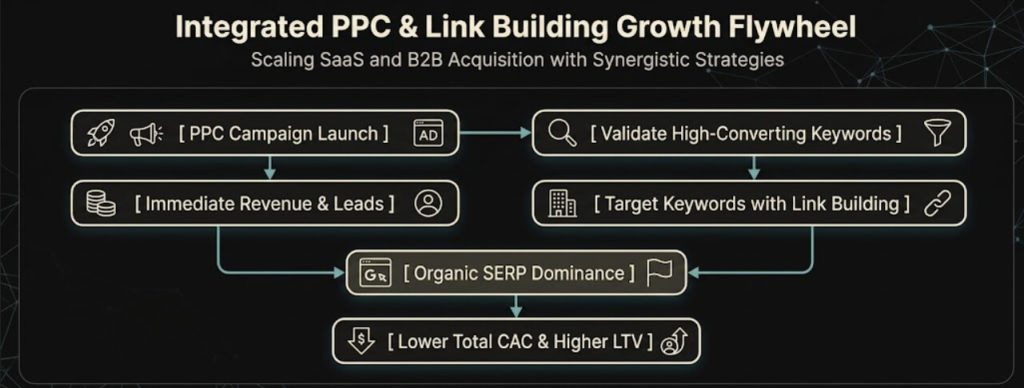
When you fuse these two channels, PPC covers the short-term pipeline needs while link building builds the organic moat that keeps acquisition costs sustainable over the long haul.
Phase 1: Leveraging SaaS PPC for Quick Wins and Intent Validation
Paid search is often the first growth channel a SaaS startup leverages because it captures high-intent prospects who are actively looking for a solution to their problem.
Focusing on High-Intent Keywords
Unlike traditional e-commerce or B2C advertising, SaaS pay-per-click management requires precise keyword selection. B2B buyer journeys are complex, and driving non-converting traffic burns through ad spend rapidly.
Winning SaaS paid campaigns typically target three core intent tiers:
- Bottom-of-Funnel (BOFU): Keywords like "[Category] software," "best [category] tool," or "[Competitor] alternative." These users are ready to start a free trial or book a demo.
- Middle-of-Funnel (MOFU): Keywords focused on solutions, such as "how to automate [process]" or "template for [task]."
- Competitor Conquesting: Bidding on competitor brand names to capture buyers dissatisfied with their current software provider.
Extracting Conversion Insights for SEO
PPC isn't just a lead generation channel; it is a rapid market research tool. Running paid campaigns allows SaaS marketers to quickly test:
- Which call-to-action (CTA) converts best ("Start Free Trial" vs. "Book a Demo").
- Which pain points resonate most with target personas.
- Which landing page layouts yield the highest conversion rates.
Once your paid campaigns reveal the exact headlines, value propositions, and keywords that convert paid visitors into paying customers, you can pass this data directly to your organic search team.
Phase 2: Reinforcing Authority with Strategic Link Building Services
While paid campaigns validate keywords and generate quick pipeline revenue, organic search dominance requires backlink authority. Search engines like Google still rely heavily on external links as a primary signal of trust, expertise, and relevance.
Partnering with specialized link building partners allows software brands to earn high-authority backlinks from reputable media, industry blogs, and SaaS resource hubs.
Building Links to Bottom-of-Funnel Assets
The most effective link building campaigns for SaaS focus on assets that eventually drive conversions:
- Alternative & Comparison Pages: Creating comprehensive "VS" pages (e.g., YourTool vs. Competitor) and securing backlinks to them signals to search engines that your page is an authoritative resource in the space.
- Free Tools & Calculators: Building free tools (like an ROI calculator or headline analyzer) gives websites a genuine reason to link to you organically.
- Data-Driven Industry Reports: Original research, surveys, and proprietary data attract natural press coverage and editorial links from top-tier publications.
As these backlinks build your site's Domain Rating (DR) and Page Authority, your organic rankings for high-value transactional keywords begin to climb.
Phase 3: The Flywheel Effect—Integrating PPC and Link Building
When PPC data and link building strategies work together, they trigger a compounding growth flywheel that radically improves acquisition metrics.
1. Lowering Total CAC via Dual-SERP Dominance
If you own the top paid ad position and the top organic search result for a high-intent term like "enterprise CRM software," you effectively capture the majority of search traffic for that query.
Over time, as your link building efforts elevate your organic rankings into the top three positions, you can gradually reduce your paid ad bids on those terms, lowering your overall customer acquisition costs without losing lead volume.
2. Re-targeting High-Intent Organic Traffic
Link building drives targeted organic visitors to your high-level educational content, blog posts, and research reports. While these visitors may not buy immediately, you can use paid retargeting campaigns (via Google Display, LinkedIn, or Meta) to keep your SaaS top-of-mind until they are ready for a demo.
3. Boosting Paid Landing Page Quality Scores
Google Ads evaluates landing pages based on relevance, user experience, and overall site trustworthiness. A domain backed by strong, editorial links built through professional outreach often enjoys higher site health and trust metrics, contributing positively to ad Quality Scores and lowering your Cost-Per-Click (CPC).
Key Takeaways for SaaS Marketing Leaders
To build a scalable growth strategy that delivers both short-term revenue and long-term search dominance:
- Start with Paid Search for Fast Validation: Use targeted paid search campaigns to generate pipeline quickly and identify the exact keywords and messages that drive actual revenue.
- Invest in Quality Backlinks: Scale your search authority by leveraging white-hat link building tactics to target high-intent comparison pages, free tools, and core feature pages.
- Break Down Channel Silos: Align your performance marketers and SEO strategists so that paid ad insights directly inform link-building target lists and content creation.
By combining the immediate execution of paid search with the long-term compound interest of backlink acquisition, SaaS companies can build a predictable, defensible acquisition channel that scales alongside their ARR goals.