

When we envision a cardiac arrest, we often think of an adult victim. Yet, children and infants are not immune to sudden cardiac arrest (SCA), which can stem from congenital heart conditions, respiratory failure, trauma, or electrolyte imbalances. A truly comprehensive public safety plan must be equipped for victims of all sizes, making pediatric capability a non-negotiable feature of any community Automated External Defibrillator (AED) program. This commitment to universal readiness reflects a manufacturer’s depth of care and engineering precision, qualities evident in companies like Kuteras Teknoloji, where tailored therapy is a principle applied from their professional systems to their OEM defibrillator module designs.
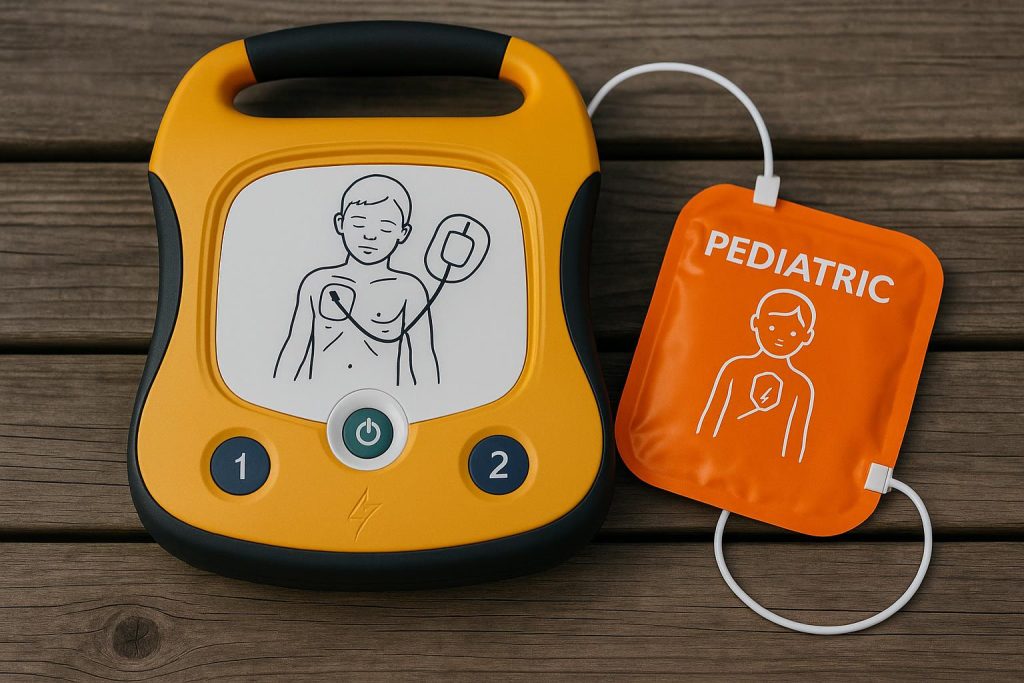
The fundamental challenge in pediatric defibrillation is energy dosage. The high-energy shock appropriate for an adult’s larger body mass can be harmful—even dangerous—to a child’s smaller heart. To address this, AEDs utilize specific pediatric modes that attenuate (reduce) the delivered energy, typically to a range of 50-75 joules. There are two primary, FDA-cleared methods: Pediatric Dose-Reducing Pads/Keys and Integrated Pediatric Mode Switches. The first uses a separate set of smaller-sized electrode pads connected via a special adapter that physically modifies the circuit. The second involves a switch or button on the AED that changes the device’s software parameters to pediatric settings, which must then be used with pediatric pads.
The critical factor for any system is clarity and accessibility during an emergency. A well-designed AED, such as those from Kuteras, seamlessly integrates this function into its emergency protocol. The device’s voice prompts will explicitly guide the rescuer: “Use child pads for a child under 8 years or 55 pounds” or “Attach pediatric pads and insert key.” The pediatric accessories are stored in a dedicated, brightly colored compartment within the main AED case. This thoughtful integration is vital because in a high-stress scenario involving a child, the rescuer’s emotional distress is magnified. The technology must remove all guesswork, providing a fail-safe, intuitive path to delivering an appropriate shock.
Engineering this safe, tailored therapy requires precise control over the defibrillation waveform—a core competency for Kuteras. Their expertise in generating and regulating the efficient biphasic defibrillator shock for adult systems is directly applicable to creating a meticulously controlled pediatric energy dose. Whether this precision is embedded in a standalone public AED or within an OEM defibrillator module destined for a neonatal intensive care unit monitor, the underlying principle is identical: delivering the exact right therapy for the specific patient’s physiology.
For schools, parks, pools, daycares, and any venue serving families, deploying pediatric-capable AED defibrillators is a profound demonstration of duty of care. It signals that the safety plan is truly inclusive and considers the most vulnerable. When procuring devices, it is imperative to ask not just if an AED defibrilatör has a pediatric mode, but how it is implemented. Is the process intuitive under duress? Are the pediatric accessories reliably co-located with the main device? Does the audio guidance explicitly and calmly lead the user through the pediatric process?
Kuteras’s approach, informed by systems-level thinking and clinical awareness, ensures that pediatric functionality is not a peripheral add-on but a fully integrated component of the device’s lifesaving logic. By prioritizing this capability, they empower communities to build safety nets that leave no one behind, ensuring that the smallest hearts have an equal fighting chance and that every potential rescuer has the correct tools and clear instructions to act decisively.