

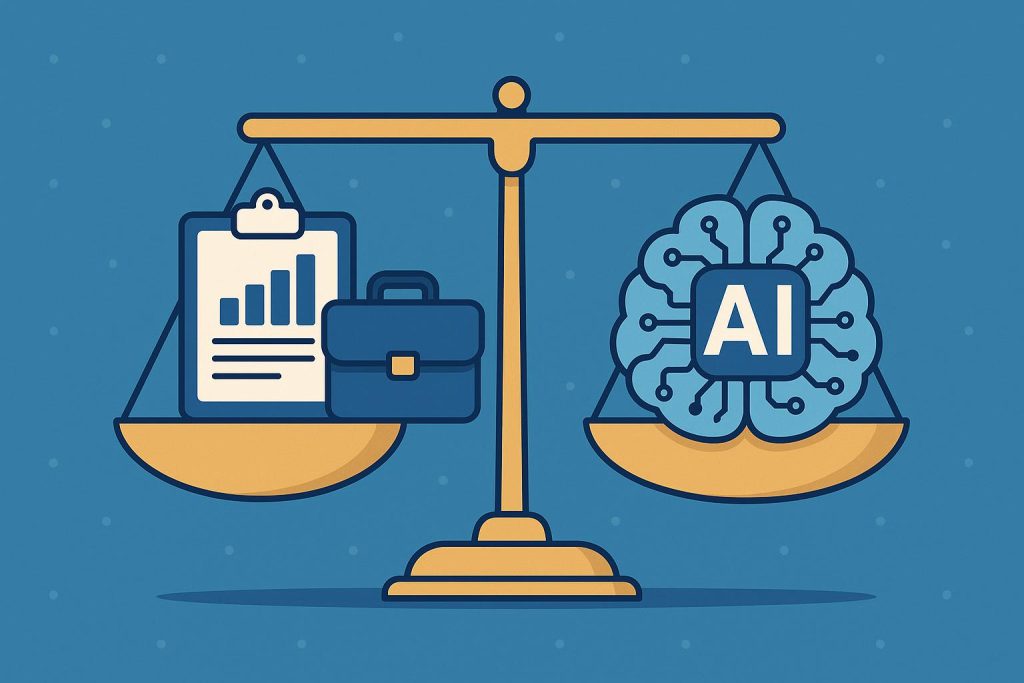
Walk into any company adopting artificial intelligence and you will find the same gap. On one side sit technical specialists who understand the models but not the market. On the other sit managers who understand the business but cannot judge what the technology can realistically do.
Projects stall in the space between them, budgets get spent on tools nobody uses, and opportunities go unclaimed because nobody in the room can connect the two conversations. The people who can bridge that gap are becoming some of the most valuable hires in modern business, and they are still surprisingly rare.
The interesting question for anyone planning a career is how you become one of them, because it is not a matter of stacking a course or two on top of an unrelated degree. The combination has to be built in from the start.
Table of Contents
A degree designed for the middle ground
Most education forces a choice: study business and treat technology as background noise, or study computer science and treat commerce as someone else’s problem. A hybrid path is harder to find, which is what makes a programme built deliberately for that middle ground worth examining.
That is the thinking behind Nexford’s bachelor’s degree in AI for Business, formally the Bachelor of Science in AI for Business. The programme builds two capabilities at once. The first is a genuine grounding in how organizations work, covering strategy, financial accounting, marketing, operations, economics, and management.
The second is applied technical fluency with the tools companies actually use, including Python and SQL for working with data, cloud services, machine learning and predictive analytics, and low code development for building working applications. The stated goal is not to produce engineers. It is to produce the professional who can sit in a strategy meeting and a data notebook in the same afternoon and be useful in both.
What the coursework actually involves
The degree consists of forty courses arranged across general education, a core of business and AI subjects, electives, and a final capstone. What stands out is how consistently the technical material is tied back to business decisions. A course on cloud computing teaches you to evaluate cloud options against security, cost, and compliance and then to build the business case for adopting one.
A course on data storytelling and visualization teaches you to turn analysis into a narrative that changes what an organization actually does. Governance and law for intelligent systems tackles data privacy, algorithmic bias, and the regulatory frameworks that determine whether an AI deployment is defensible.
Every technical skill arrives attached to the judgement about when and why to use it. Machine learning and predictive analytics, for example, is taught through the lens of forecasting outcomes that matter to a company, from customer behaviour to operational risk, so the algorithms are always a means to a commercial end rather than the end itself.
The programme closes with the AI in Business Capstone, a single integrated project in which you take a complex business challenge from problem definition through data modelling and machine learning execution to an executive level plan covering implementation, risk, and governance.
It is deliberately designed as a portfolio piece, something you can put in front of an employer as evidence of what you can do rather than a list of what you have studied. Along the way, individual courses use projects modelled on real scenarios at major organizations, and you earn a digital badge for each one you complete, so your growing capability is visible throughout the degree rather than only at the end.
Where this combination leads
Graduates of this kind of programme step into roles such as AI business analyst, data analyst, automation specialist, and AI product coordinator, positions that exist precisely because organizations need translators between their technical and commercial functions. The value of the hybrid profile tends to compound over time as well.
Early in a career it makes you the analyst who can actually build the dashboard rather than request it. Later it makes you the manager who can challenge a vendor’s claims, scope a realistic project, and explain to senior leadership what an initiative will genuinely deliver.
Ethics and governance run through the curriculum too, which matters because organizations increasingly need people who can deploy these tools responsibly, not just enthusiastically. That responsibility angle is not a footnote. As rules around data and algorithms tighten worldwide, the graduate who can pair innovation with defensible governance will be the one organizations promote into decision making roles.
The practical arrangements suit people building this future alongside a present. Nexford University delivers the degree entirely online with flexible pacing held together by weekly deadlines, so it can be completed around work and family commitments.
Tuition is paid per course, meaning you control both the pace and the spend, and transfer credits from prior study can shorten the route. Support is close at hand throughout, with one to one access to faculty and advisors, a global community of fellow learners, and a career platform offering coaching, resume tools, and interview preparation when you are ready to put the qualification to work.
Each course is designed to be completed in around two months, and you can move faster as your confidence grows, which keeps the degree feeling like steady progress rather than a distant summit.
Every era of business has rewarded a particular kind of hybrid. There was a time when the accountant who understood computers had an edge, and a time when the marketer who understood the internet did. The current version of that advantage belongs to the professional who understands both commerce and artificial intelligence, and it is an advantage that will define careers for decades rather than seasons.
Nexford University has built a degree squarely aimed at creating that professional, with a curriculum that takes both halves of the equation seriously and a delivery model that working people can actually sustain. For anyone deciding what to study in a world being rearranged by AI, it is difficult to think of a more directly useful preparation.