

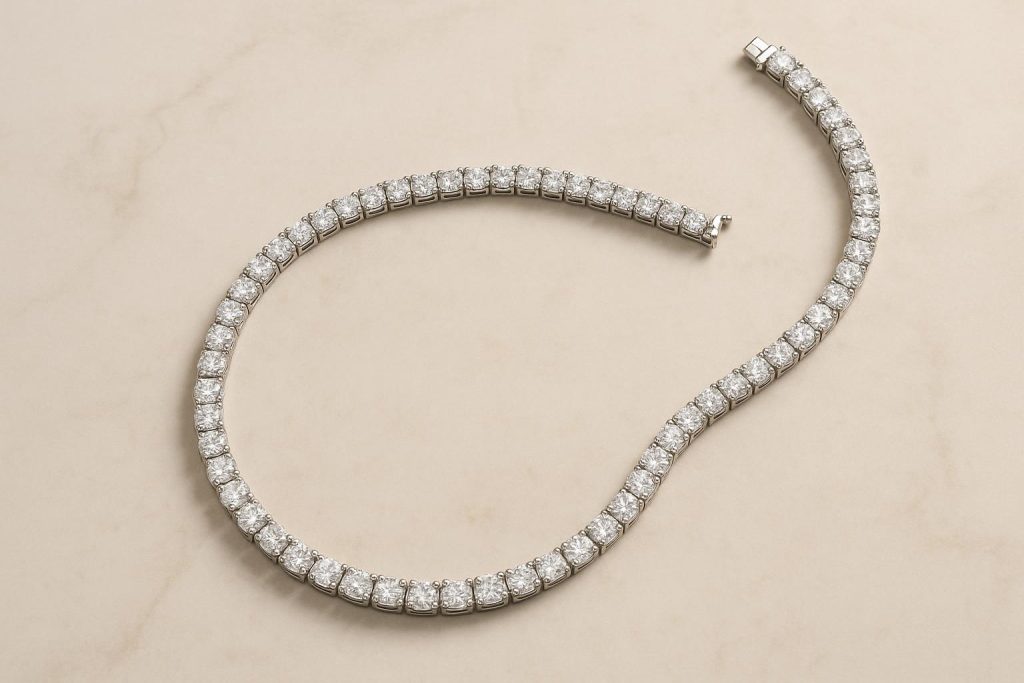
A line of diamonds around the neck is one of the few pieces of fine jewellery that reads as both formal and completely ordinary. It works over a shirt collar on a Tuesday and it works with nothing at all on a Saturday. That flexibility is why the tennis necklace has quietly become a first serious purchase for people who would never describe themselves as jewellery collectors.
Table of Contents
What actually makes it a tennis necklace
The defining feature is the construction. A continuous line of individually set diamonds, each held in its own setting and linked to the next, so the whole piece articulates and follows the curve of the neck. There is no chain doing the work in between. The stones are the structure, which is why the engineering matters more here than in almost any other piece.
The name comes from tennis, and from a bracelet that came off a player’s wrist mid-match — an anecdote every jeweller repeats. What stuck was not the story but the format: a flexible line of stones, secure enough to be worn without thinking about it.
The setting is where quality shows
Look first at how each stone is held. In a well-made piece, every tennis necklace diamond sits in its own prong basket, hinged to its neighbours so the line drapes rather than sitting stiff against the collarbone. Prongs should be even, tight and properly finished; a rough setting can be felt against the skin long before it can be seen.
Then look at the clasp, which is the part most buyers ignore and the part most likely to fail. A secure latch clasp, ideally with a safety catch, is not an indulgence on a piece that carries its entire value in one continuous line.
Uniform stones, or mixed shapes
The traditional version repeats a single shape, usually round brilliants, at a consistent size. It is calm and symmetrical and never looks like anything other than what it is, which is much of its appeal.
The alternative is a multishape line, with round, marquise and pear cuts alternating so the necklace catches light unevenly and reads as a designed object rather than a specification. FYNE’s certified multishape necklace is built this way, in 18kt solid gold with an IGI certificate, and it is a useful illustration of how much the choice of shapes changes the character of an otherwise identical construction.
Carat weight is a total, not a stone size
Tennis necklaces are quoted by total carat weight, which is the sum of every stone in the line rather than the size of any one of them. Two necklaces at the same total weight can look quite different: more stones means smaller ones and a finer, more fluid line, while fewer and larger stones read bolder and sit with more weight.
Ask for the stone count alongside the total carat weight, and ask what length the line is. A shorter necklace concentrates the same weight into a denser line and will sit higher on the collarbone, which is as much a styling decision as a technical one.
Wearing it, and keeping it
Fine jewellery worn often needs occasional attention rather than constant care. Check the clasp with your fingers now and then; if it has developed any play, have it looked at before it opens on its own. Keep the piece away from chlorine and household chemicals, and have it professionally cleaned and re-polished rather than scrubbed at home.
Before buying, ask specifically what the jeweller’s return and resizing terms are for certified pieces. Certified jewellery is frequently treated differently from everyday lines because recertification is involved, and it is a five-second question that avoids a much longer conversation later.
A tennis necklace is a piece of engineering as much as a piece of jewellery: a few hundred small decisions about setting, articulation and balance, resolved into something that looks as though it could not have been made any other way. Judge the construction, ask about the clasp, and the light takes care of itself.