Picture this.
A large event. Hundreds of people moving around. Music playing, trucks unloading, security staff scanning the crowd.
Someone needs to relay an update.
They pull out a phone… no signal. Or worse—five people are calling at once and no one can get through.
Frustrating.
Then someone presses a single button on a walkie talkie.
“Stage team, we’re ready on the north entrance.”
Immediate response. No dialing. No waiting. No “Can you hear me now?”
Just instant communication.
That’s why push-to-talk radios never disappeared. In fact, they’ve quietly evolved into something far more powerful than the short-range gadgets many people remember from camping trips.
Let’s talk about how today’s nationwide radios actually work.
Table of Contents
The Classic Walkie Talkie: Simple and Surprisingly Brilliant
Before smartphones ruled communication, the walkie talkie was the ultimate coordination tool.
The technology is refreshingly straightforward.
Press the talk button.
Speak into the microphone.
Your voice converts into a radio signal and broadcasts across a specific frequency.
Anyone tuned to that channel hears it instantly.
No network.
No towers.
No apps.
Just direct radio communication between devices.
The catch? Distance.
Traditional walkie talkies usually work within a few miles. Terrain, buildings, and interference can shrink that range even further.
Great for a campsite.
Less helpful when your team is spread across multiple cities.
So engineers did the obvious thing.
They upgraded the system.
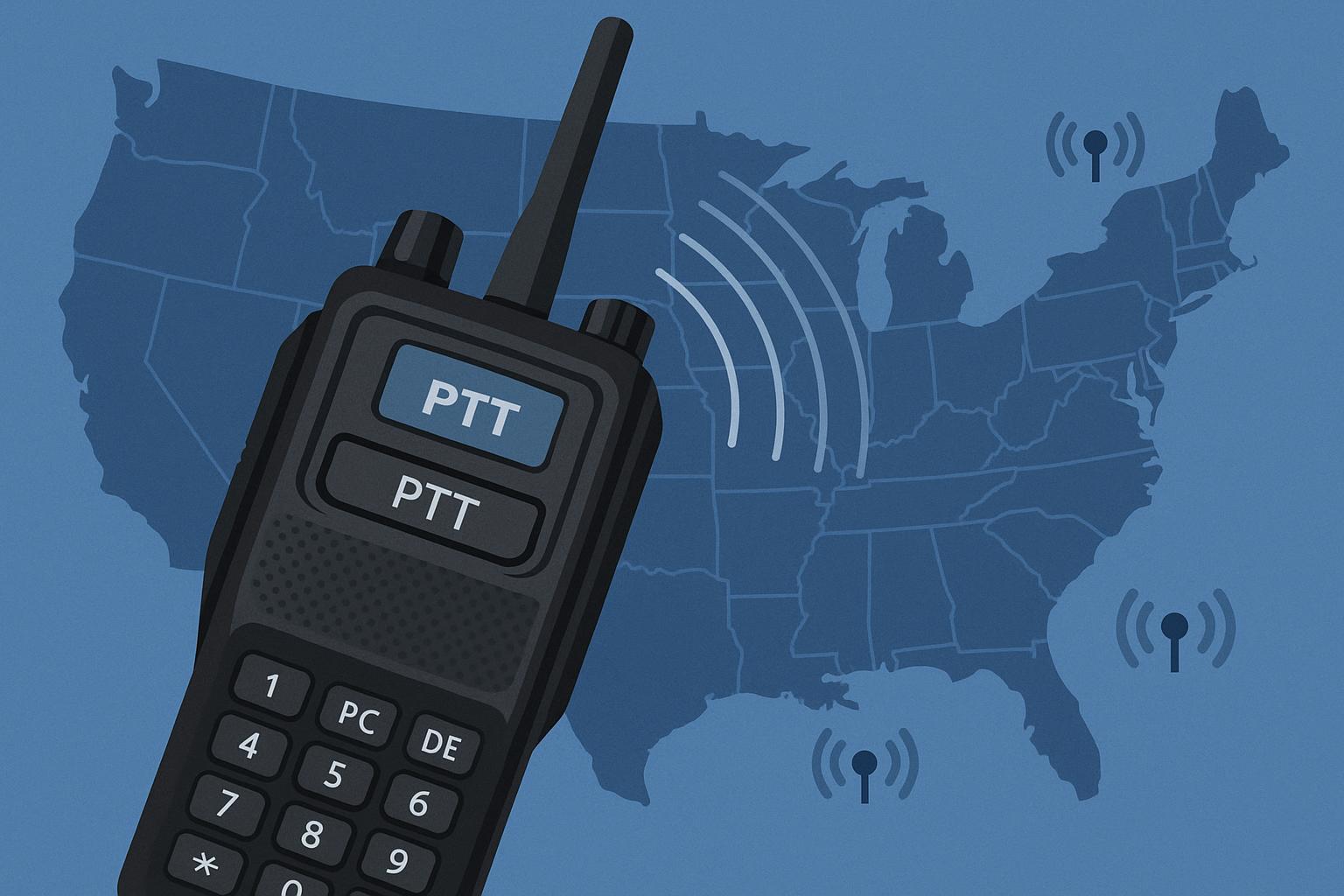
Enter Nationwide Push-To-Talk
Modern radios still feel like a traditional walkie talkie, but the technology underneath is completely different.
Instead of sending signals directly between nearby devices, many push-to-talk radios now transmit through cellular networks.
Think of it as a hybrid system.
The radio captures your voice… but instead of broadcasting locally, it sends that audio through mobile data infrastructure. The network then routes the message to every radio in your communication group.
Result?
Your voice can travel across an entire country.
Yet the experience remains beautifully simple:
Press button.
Speak message.
Release.
No phone calls. No ringing.
Just instant communication.
What Actually Happens When You Press the Button
It feels instant. But there’s a surprisingly efficient process happening in the background.
Here’s the quick breakdown:
Voice capture:
The microphone converts your speech into digital data.
Network transmission:
The device sends that data through the cellular network.
Server routing:
The system directs the transmission to radios connected to your group.
Playback:
Receiving radios instantly convert the signal back into sound.
The entire process takes about a second.
Which explains why push-to-talk communication often feels faster than calling someone on a phone.
Phones require dialing, ringing, and answering.
Radios?
Just talk.
Why Businesses Still Love Walkie Talkies
Here’s something interesting.
Even in a world dominated by smartphones, industries still rely heavily on the walkie talkie.
Why?
Because phones are built for conversations.
Radios are built for coordination.
Big difference.
A single transmission can reach an entire team instantly. No group chat. No calling multiple people.
Construction crews use them to manage large job sites.
Event teams rely on them during concerts and festivals.
Logistics companies use them to coordinate drivers and dispatch.
And outdoor groups? They appreciate reliable communication when traditional signals become unreliable.
Sometimes simple tools survive because they solve real problems.
Modern Radios Are Built for Distance
The biggest upgrade in today’s push-to-talk systems is range.
Traditional radios might cover a few miles.
Nationwide systems can reach virtually anywhere with network coverage. That means teams separated by hundreds or even thousands of miles can communicate instantly.
In other words, the classic two-way radio just got a major upgrade.
Final Thoughts: Simple Technology, Smarter Network
The core idea behind a walkie talkie hasn’t changed in decades.
Press a button.
Speak your message.
Someone hears you instantly.
What has changed is the infrastructure supporting it.
By combining the simplicity of push-to-talk radios with modern network coverage, today’s devices turn a once-local communication tool into a nationwide system.
Which proves something interesting about technology.
Sometimes the best innovations don’t replace old ideas.
They simply make them work everywhere.