

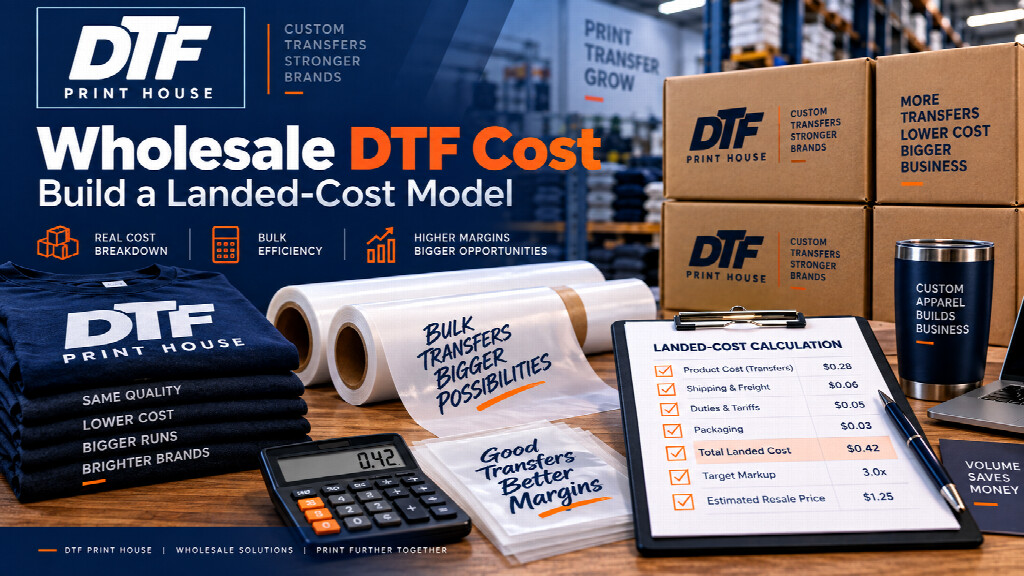
When a print shop compares wholesale DTF options, the easiest number to notice is the transfer price. It is visible, simple, and easy to compare between orders. It is also incomplete. A lower transfer price does not automatically create a lower finished-apparel cost if the job requires more cutting, more handling, more rework, more administrative time, or more inventory than the shop expected.
A better purchasing model looks at landed production cost: the total cost required to move a transfer from purchase through a usable, sellable garment. A supplier such as DTF Print House can be assessed with the same framework as any wholesale source. The question is not only what the transfer costs to buy, but what the transfer costs your operation to use.
Table of Contents
Start With the Transfer Expense, Then Keep Going
The transfer expense is still important. Record it clearly. If freight, order fees, or other transaction costs apply, assign them to the job rather than hiding them in a general overhead account. The goal is to understand what the transfer inventory actually costs when it reaches your production area.
Then add the internal work needed before pressing begins. This may include sorting, cutting, labeling, job separation, count verification, and movement between receiving and the press station. A format that looks inexpensive per piece can become less attractive when every job requires significant handling time.
Measure Labor by Production Step
Do not estimate labor with a single vague percentage. Break the workflow into steps that can be observed. How long does receiving take? How long does sorting take? How long does cutting take? How much operator time is spent pressing? How much time is used for quality checks, packing, or correcting preventable mistakes?
You do not need a stopwatch on every employee all day. A short sample of typical jobs can create a reasonable baseline. The point is to see which parts of the wholesale transfer workflow consume labor and whether one order format consistently creates more touch time than another.
Add a Rework and Spoilage Allowance
Not every transfer becomes a sellable garment. Some are used for setup or testing. Some may be damaged during handling. A garment may be pressed incorrectly. A transfer may be assigned to the wrong piece. These losses should not be ignored simply because they are inconvenient to measure.
Create a rework allowance from actual history. If the shop tracks losses by cause, even better. A realistic landed-cost model should reflect what normally happens on the production floor, not an ideal run in which every transfer becomes a perfect finished product.
Include the Cost of Carrying Extra Inventory
Wholesale buying can encourage larger orders, but excess inventory has a cost. Money tied up in unused transfers cannot be spent elsewhere. Storage requires space and labeling. Designs can become obsolete when a client changes a logo, campaign, sponsor, date, or product line.
This does not mean bulk purchasing is a bad idea. It means the shop should separate productive volume from speculative volume. When reviewing bulk DTF transfer options, compare the quantity you expect to use within a defined production window with the quantity you would be buying only to reach a lower unit price.
Calculate Cost Per Sellable Garment
The final denominator should be the number of sellable garments, not the number of transfers purchased. A simple model can be written as:
Landed DTF cost per sellable garment = transfer expense + allocated freight + handling labor + pressing labor + rework allowance + inventory carrying cost, divided by sellable garments produced.
This formula can be simplified if your shop does not track every category yet. Start with transfer expense, freight, handling, pressing labor, and rework. The value of the model comes from consistency. A simple calculation used every month is more useful than a perfect formula that nobody maintains.
Compare Jobs by Similar Production Conditions
Do not compare a simple one-design job with a complex multi-design order and conclude that one supplier or format is always cheaper. Compare jobs with similar garment types, order sizes, artwork complexity, and production conditions. Otherwise the data will reflect different jobs rather than different purchasing choices.
Over time, build a small library of job categories. You may find that one wholesale format performs well for stable repeat production, while another is better for varied small batches. The landed-cost model should help the shop recognize those patterns without forcing every job into the same buying rule.
Do Not Ignore Administrative Cost
Purchasing and production teams also spend time resolving order questions. If an order requires repeated emails to confirm quantities, filenames, shipping details, or account information, that time is part of the transaction. It may be small on one order but significant across dozens of orders.
Track recurring administrative friction as a note even if you do not assign a dollar value immediately. If the same issue appears often, it belongs in the buying decision. Wholesale efficiency is partly about transfer price and partly about how cleanly the order moves through the business.
Use the Model to Set Buying Rules
Once the shop has several months of data, turn the findings into simple purchasing rules. For example, define the order sizes where bulk buying normally makes sense, the amount of excess inventory the shop is willing to carry, and the rework rate that triggers a workflow review. These rules should come from your own production history rather than generic assumptions.
The objective is not to find the cheapest transfer on paper. It is to find the purchasing approach that creates the lowest reliable cost for a sellable finished garment. That is the number that protects margin, improves forecasting, and gives a print shop a more realistic view of what wholesale DTF production actually costs.