

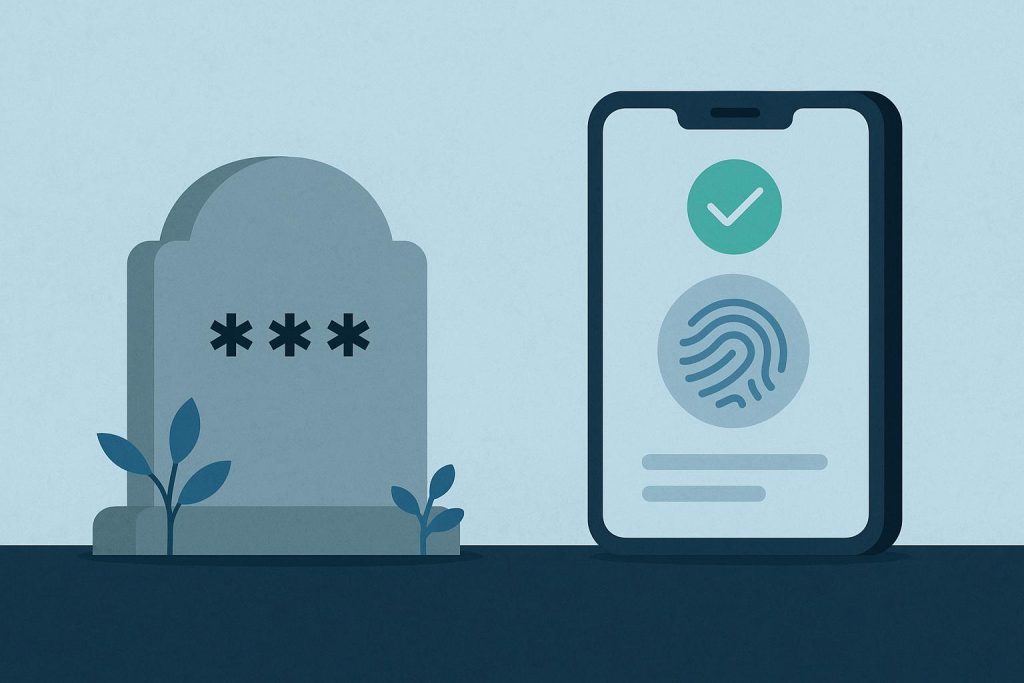
Think about the last time you forgot a password. Now multiply that frustration by the 300 billion passwords that security researchers estimate will be in use globally by the end of this decade. The uncomfortable truth is this: the password invented in the 1960s is still the primary line of defense for most organizations in 2026. And cybercriminals know it.
Credential-based attacks now account for over 80% of data breaches according to the Verizon Data Breach Investigations Report. Phishing campaigns have grown more sophisticated, adversarial AI is cracking weak passwords at unprecedented speeds, and even multi-layered organizations are falling victim to simple credential theft. The era of password-based security is not just outdated, it is actively dangerous.
This is why forward-thinking enterprises in 2026 are making a decisive shift: away from passwords entirely, toward passwordless authentication solutions that are faster, safer, and built for the way modern work actually happens.
Table of Contents
What Is Passwordless Authentication and Why Does It Matter?
Passwordless authentication is exactly what it sounds like a way to verify a user’s identity without requiring them to enter a password. Instead of relying on something a user knows (which can be stolen, guessed, or forgotten), passwordless methods authenticate users based on something they have (a registered device or hardware token) or something they are (biometrics such as a fingerprint or facial scan).
The most widely adopted passwordless standards today are built on FIDO2 and WebAuthn protocols, backed by the FIDO Alliance and supported by Microsoft, Apple, Google, and virtually every major identity platform. When a user registers a device using FIDO2, a cryptographic key pair is generated: the private key stays on the device, and the public key is registered with the service. Authentication happens locally, meaning credentials are never transmitted over a network and cannot be intercepted.
For organizations, this shift delivers three immediate benefits. First, it eliminates the attack surface that password theft and phishing exploit. Second, it reduces the operational burden of password resets, which IT helpdesks estimate account for 20 to 50 percent of their support tickets. Third, it dramatically improves user experience. A biometric tap or device confirmation takes less than a second compared to typing a complex password.
The Phishing Problem and Why Traditional MFA Is No Longer Enough
Many organizations that have moved beyond passwords have implemented multi-factor authentication as their security layer, typically a combination of a password and a one-time passcode (OTP) sent via SMS or an authenticator app. This was a meaningful improvement over password-only security, and for years it was considered best practice.
But 2026 has exposed the limits of traditional MFA. Attackers have evolved. Adversary-in-the-middle (AiTM) phishing attacks where attackers intercept both the user’s credentials and their OTP in real time have become disturbingly routine. High-profile breaches at technology companies, government agencies, and financial institutions in recent years were executed not by cracking passwords, but by bypassing traditional MFA entirely through real-time session hijacking.
This is where a phishing-resistant MFA solution becomes not just a best practice but a business imperative. Unlike traditional OTP-based MFA, phishing-resistant MFA is cryptographically bound to the specific website or application the user is authenticating to. Even if an attacker tricks a user into visiting a convincing fake login page, the authentication simply will not work because the cryptographic handshake will not validate against a different domain.
The United States Cybersecurity and Infrastructure Security Agency (CISA) has explicitly called for the adoption of phishing-resistant MFA across federal agencies, and the private sector is rapidly following. Organizations subject to CMMC, HIPAA, SOC 2, and NIST SP 800-63 compliance requirements are increasingly finding that regulators are pushing beyond traditional MFA toward phishing-resistant alternatives.
Passwordless + MFA: A Unified Security Strategy
It is important to understand that passwordless authentication and MFA are not competing approaches, they are complementary ones. The most robust security posture in 2026 combines both: eliminating passwords as a factor while retaining and strengthening multi-factor verification.
A modern MFA solution that incorporates passwordless principles might authenticate a user through a combination of their registered device (something they have) and a biometric scan (something they are) with no password involved at any point. This is inherently phishing-resistant, because there is no shareable credential for an attacker to intercept.
For enterprises managing hybrid environments where employees access cloud applications, on-premise systems, VPNs, and Windows desktops the implementation challenge is ensuring that passwordless authentication works consistently across all these surfaces. This is where purpose-built identity and access management platforms become critical. A well-deployed MFA solution should support FIDO2/WebAuthn passkeys, hardware tokens (such as YubiKey), biometric authentication, and adaptive risk-based policies all from a single unified platform that works whether users are accessing cloud services or legacy on-premise applications.
Adaptive Authentication The Intelligence Layer
One of the most significant developments in enterprise authentication in 2026 is the rise of adaptive authentication, a risk-based approach where the level of authentication required dynamically adjusts based on the context of each login attempt.
In practice, this means an employee logging in from their registered office laptop on a Tuesday morning might be authenticated with a simple biometric tap. The same employee attempting to access sensitive financial data from an unrecognized device in a different country at 2 AM will be prompted for additional verification or blocked entirely pending review.
Adaptive MFA uses signals including device fingerprinting, IP reputation, geolocation, login time patterns, and behavioral analytics to make real-time risk assessments. For organizations dealing with a distributed workforce across multiple time zones and access points, this contextual intelligence is what separates meaningful security from security theater.
Implementation Where Organizations Get Stuck and How to Move Forward
Despite widespread agreement that passwordless is the future, many organizations are still in early stages of adoption. The barriers are rarely technical; they are organizational. Legacy applications that do not support modern authentication protocols, IT teams stretched thin across competing priorities, and concerns about user adoption all slow progress.
The practical path forward for most organizations is a phased approach. Start with your highest-risk access points, privileged accounts, VPN access, and remote desktop access where the impact of a credential compromise is most severe. Deploy a passwordless authentication solution that supports both modern FIDO2 standards and legacy application compatibility, so you can modernize authentication without requiring a complete overhaul of your existing infrastructure.
User training is equally important. Employees who understand why the change is being made, not just how to use the new system, adopt new authentication methods far more readily. Frame the shift as a user experience improvement (no more forgotten passwords, no more locked accounts) alongside the security rationale.
The Bottom Line
Passwords have had a long run over 60 years as the default mechanism for proving digital identity. But the threat landscape of 2026 has made clear that they are no longer adequate. Phishing attacks bypass them. Credential stuffing exploits them. And the sheer cognitive burden of managing hundreds of unique passwords means most users will always find workarounds that undermine security.
The future is passwordless, built on phishing-resistant MFA that is cryptographically strong, contextually intelligent, and genuinely easier for users than the systems it replaces. Organizations that make this shift in 2026 are not just improving their security posture. They are building the identity foundation that every other aspect of their digital security strategy depends on.
The question is no longer whether to move beyond passwords. It is how quickly your organization can make the transition and whether you will act before a breach forces the decision for you.