

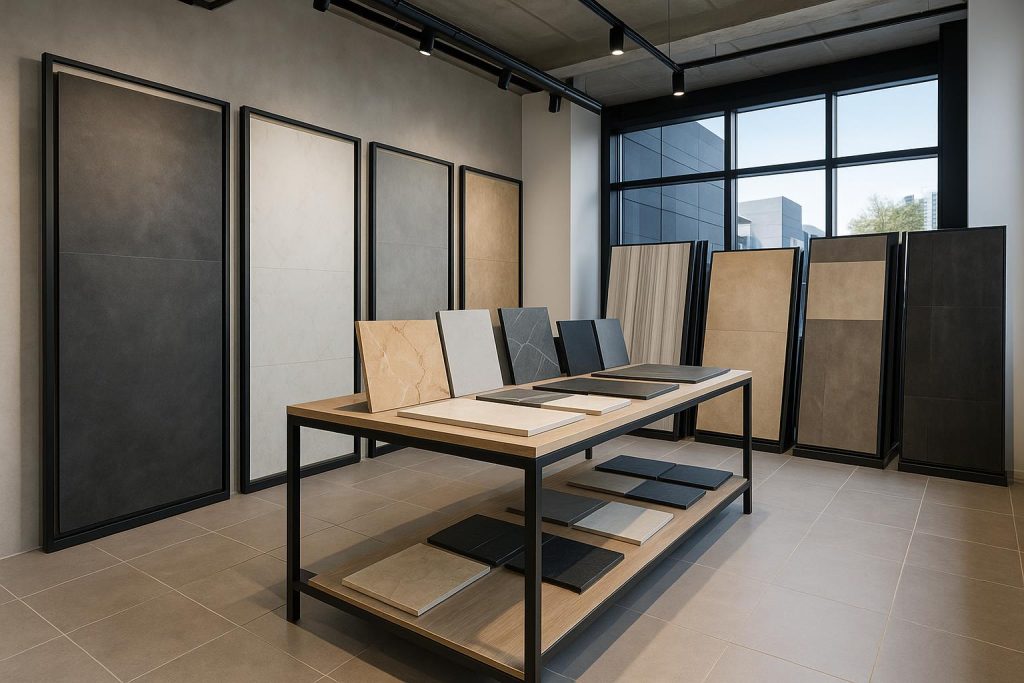
For decades, growth in the tile industry was often associated with larger showrooms, bigger inventories, and broader product ranges. Today, however, the UK market presents a different reality. With a mature customer base, increasing competition, and rapidly changing design trends, profitability is no longer determined by the size of a showroom alone. Instead, success increasingly depends on flexibility, customer experience, and the ability to showcase products efficiently.
For distributors, manufacturers, and specialist retailers, showroom design has become a strategic business tool rather than a purely aesthetic investment. The question is no longer “How much can we display?” but “How effectively can we present what matters?”
Table of Contents
The Challenge of Operating in a Mature Market
The UK tile sector is highly developed, with numerous established distributors and retail networks competing for the attention of homeowners, architects, interior designers, and contractors. In this saturated environment, simply adding more products or expanding floor space does not automatically generate higher sales.
Customers today expect curated experiences, expert guidance, and showroom environments that help them visualise complete projects rather than individual products. They arrive with Pinterest boards, specification lists, and technical requirements—not just a desire to browse. As a result, many businesses are focusing on quality of presentation rather than quantity of stock, recognising that a well-organised, adaptable space creates more value than sheer square footage.
Why Flexible Display Systems Matter
Modern tile collections evolve rapidly. Manufacturers introduce new colours, finishes, formats, and technical solutions every year. Traditional fixed displays—built into walls or permanently mounted—can quickly become outdated, forcing retailers to invest in costly showroom modifications or live with an increasingly irrelevant presentation.
Flexible display systems solve this challenge by allowing products to be updated, replaced, or reorganised without major structural changes. This adaptability provides several tangible advantages:
Faster Product Rotation
Retailers can introduce new collections seasonally or in response to emerging trends without disrupting showroom operations or closing for refurbishment. This agility keeps the showroom feeling fresh and relevant.
Better Customer Experience
Visitors can compare products more efficiently through organised, modular presentation systems. Adjustable panels, interchangeable sample holders, and reconfigurable layouts enable customers to explore combinations and visualise applications with greater ease.
Reduced Long-Term Costs
Modular displays eliminate the need for frequent, expensive refurbishment projects. Investment shifts from permanent construction to adaptable fixtures that can be reused across multiple collections and campaigns.
Improved Space Utilisation
Showrooms can display more products within the same footprint while maintaining a clean, professional appearance. Vertical displays, rotating racks, and multi-sided panels maximise visibility without creating visual clutter.
The Growing Importance of Specialist Presentation Areas
Today’s buyers often require more information than ever before making purchasing decisions. Architects and designers frequently need access to technical specifications, material samples, installation guidelines, and sustainability certifications. Professional installers look for practical product comparisons, performance data, and compatibility information.
To support these requirements, successful showrooms increasingly include dedicated zones designed for specific professional needs:
- Technical specification areas: Detailed product data, installation manuals, and compliance documentation readily accessible
- Large-format tile presentation zones: Properly supported displays that showcase the scale and impact of oversized formats
- Material libraries: Organised sample collections that allow tactile exploration and side-by-side comparison
- Design consultation spaces: Private or semi-private areas where professionals can review projects with expert support
- Dedicated flooring and sanitary ware sections: Integrated displays that demonstrate how tiles work within complete bathroom or kitchen schemes
These specialised environments help transform a showroom from a product warehouse into a decision-making centre, where customers leave with confidence rather than confusion.
Access to Comprehensive Display Solutions
Achieving this level of flexibility requires access to a wide range of specialised display systems. Professionals seeking tailored solutions can explore equipment designed specifically for:
- Standard and large-format ceramic and porcelain tiles
- Technical materials and natural stone
- Sanitary ware and bathroom fixtures
- Parquet, engineered wood, and luxury vinyl flooring
Access to a broad portfolio allows distributors and manufacturers to select equipment that matches their commercial objectives while maintaining future adaptability. Rather than relying on generic retail fixtures, specialised display systems are engineered to enhance product visibility, improve customer interaction, and support long-term showroom evolution.
Key considerations include load-bearing capacity for heavy materials, ease of reconfiguration, compatibility with digital integration (such as QR codes linking to technical data), and aesthetic coherence with the overall showroom design.
Why European Manufacturing Continues to Add Value
For many UK businesses, supplier reliability is just as important as product quality. Manufacturing expertise developed within Europe’s ceramic and display industries provides distinct advantages in engineering precision, material durability, and sustainable production practices.
Centralised production processes help ensure consistency across projects while maintaining strict quality standards—critical when display systems must support heavy materials, large-format products, and intensive daily use within commercial environments. European manufacturers also tend to offer stronger after-sales support, spare parts availability, and technical assistance, reducing downtime and maintenance costs over the lifespan of the investment.
Additionally, shorter supply chains and clearer regulatory alignment simplify logistics and compliance for UK-based businesses, particularly in a post-Brexit trading environment.
From Individual Displays to Complete Showroom Concepts
Display equipment alone does not create a successful showroom. The most effective projects combine commercial design, customer flow planning, merchandising strategy, and technical installation into a single, cohesive solution.
Increasingly, distributors and manufacturers are seeking partners capable of delivering complete showroom concepts, including:
- Space planning: Optimising layout for traffic flow, product visibility, and consultation zones
- Product zoning: Strategically grouping collections to guide customer journeys and highlight key ranges
- Display selection: Choosing fixtures from a comprehensive catalogue of tile displays that align with brand identity and product characteristics
- Manufacturing and procurement: Ensuring quality, consistency, and timely delivery
- Logistics and installation: Coordinating delivery, assembly, and final positioning with minimal disruption
This integrated approach helps ensure that every element of the showroom supports business objectives and customer engagement, rather than functioning as a collection of disconnected components.
Looking Ahead
As the UK tile market continues to evolve, competitive advantage will increasingly come from differentiation rather than expansion alone. Businesses that invest in adaptable showroom environments, specialist presentation areas, and customer-focused design strategies are likely to be better positioned to attract architects, designers, contractors, and premium consumers.
Technology will play an expanding role: augmented reality visualisation tools, digital product catalogues accessible via in-showroom tablets, and data-driven insights into customer behaviour can all enhance the experience without replacing the tactile, human element that remains central to tile selection.
In a mature market, profitability is rarely about selling more of the same products. Instead, it comes from presenting those products more effectively, creating stronger customer experiences, and building showroom environments capable of evolving alongside the industry itself. Flexibility is no longer optional—it is the foundation of sustainable growth.