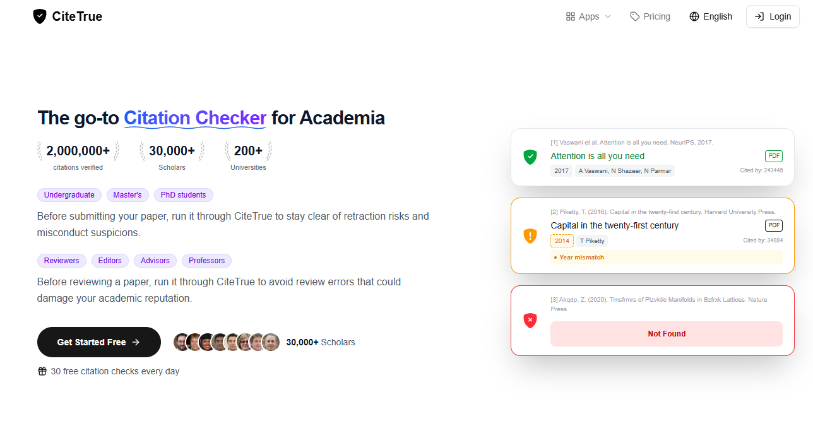
The return email landed at 11:40 p.m. Not a peer-review report — a desk note: multiple references could not be matched; revise before the manuscript re-enters the queue. I was the author, not the editor. I had no authority to argue policy. I had a forty-eight-hour window before the special-issue soft close, a reference list that had looked finished in the PDF, and a career timing problem if this round slipped. I pasted the block into a Citation Checker the same night because pride was slower than the deadline.
CiteTrue did not restore dignity. It gave me a countable map of what the desk had already seen: Unsure and Inauthentic clusters I should have found before submission. In our desk-to-author pipeline, that map is the difference between a repairable night and a lost issue window. I kept the browser tab open beside the manuscript for the full repair, not as superstition, but so every cut decision had a card next to it. My coauthor was asleep in another timezone. That was fine. This failure was mine to clean.
I had drafted the related-work section with an assistant weeks earlier, then “cleaned” it by eye during a Sunday afternoon that I now recognize as theater. Eye-cleaning is how fluent ghosts survive. The desk note was the first reader who refused to play along.
Table of Contents
Three Paths After A Reference Return
Authors in that hour invent coping strategies. Mine reduced to three, and only one protected the special-issue slot without burning remaining goodwill at the journal. I wrote the three paths on the same scrap later used for the worst titles, so the choice stayed visible while I worked.
| Path | Speed | What it fixes | Risk to the resubmit |
|---|---|---|---|
| Argue the email | Fast emotionally | Almost nothing | High — looks like denial |
| Manual Google of every line | Slow | Strong if you stay awake | Medium — easy to miss clusters |
| Batch verify, then repair flags | Medium | Not-found and mismatch clusters | Lowest if you act on cards |
The third path is where I stayed. Paste, Fast Verify, read the stats bar, decide which sentences die. I was not comparing vendors for a board purchase. I was trying not to waste the one editor who had already spent political capital returning me kindly instead of issuing a flat reject. CiteTrue’s cards became the only negotiation partner I trusted at midnight — not because software is wise, but because my own optimism had already failed the audition.
What The Stats Bar Made Undeniable At Midnight
When I opened the results, four of twelve lines I sampled in panic mode were Unsure or worse. The typed PDF had looked complete. The card cluster matched the desk note’s tone without requiring me to invent a conspiracy about bias. Numbers traveled better than my first draft reply, which I deleted before sending. Could not defend the list to myself, let alone to the associate editor. I wrote the four worst titles on a scrap of paper and taped it to the monitor so I would not soften them after coffee.

Repair Work The Night After A Desk Note
Notice rows were mostly metadata drift — fixable in minutes once I stopped defending them. Unsure rows demanded a PDF or a cut. Inauthentic rows after a serious look meant rewriting the claim sentence, not bargaining for the citation. I killed three ghost articles that had entered during an AI-assisted related-work pass weeks earlier. They had sounded like papers I might have read at a workshop. They had never existed. The moment I lined one title against every index I trust, the performance collapsed. One of those ghosts had been supporting a contrast sentence in the introduction; cutting it forced a narrower claim, which was the honest claim anyway.
Suggested Replacements Without Auto-Inserting Trouble
On deeper not-found checks, suggested replacements appeared as leads. Two of three were usable after I opened the actual records. One was adjacent enough to waste twenty minutes and still get discarded. I treated every suggestion as a research hint, never as a paste-back into the manuscript. Resubmitting with a new set of unverified ghosts would have been a second humiliation I could not afford inside the same forty-eight hours.
Paying For A Sprint When The Lab Card Is Slow
Free daily credits were not enough for a full list rebuild at midnight plus retries after each rewrite. I moved to a paid tier out of pocket because reimbursement would take longer than the soft close. Public pricing made the arithmetic dull in a useful way: Plus at $5.99 for 1,000 credits, Pro at $11.99 for 3,000, Max at $47.99 for 20,000. I bought Pro because I expected at least two full-list passes after paragraph surgery. I needed exportable proof of what I had checked more than I needed a logo on a slide. The money hurt less than losing the issue window. Wasted hours on a second desk return would have cost more than a Pro month. That is a different ledger from a library pilot or a bind-week student pass — I was buying time I had already burned.
Policy Language I Finally Understood From The Wrong Side
Desk notes that say submissions may be returned when automated verification plus editor spot-checks find unmatchable citations are not theater. From the author side, they are capacity protection for reviewers who should not be the first citation police. I had skimmed those policies as boilerplate. After the return, I read them as the reason I still had a path back into the queue instead of a silent discard. I forwarded the cleaned export to myself with a timestamp, in case the journal asked what had changed between versions.
An AI Citation Checker did not make me a better rhetorician. It made the fabricated-existence class visible fast enough to repair before the soft close. Reviewers never saw the first list. That was the entire win. Sent back once with a clean repair is survivable. Sent back twice looks like a pattern. I said that sentence out loud to the empty kitchen at 3 a.m., which is an undignified way to learn editorial policy, and also an effective one.
When the cleaned manuscript went back, I attached a short cover note listing the three removed citations and the two replaced ones. No apology essay. Just a change log. Editors are busy. Change logs travel.
What Existence Checks Still Will Not Save Overnight
A real paper cited for the wrong reason sails through. Predatory-but-real venues may match and still be poor scholarship. Those remain author and editor problems. Automated verification narrows ghosts; it does not grade argument quality. I still had to rewrite two paragraphs whose citations were real and wrongly used — work the cards never flagged, and work that ate the second half of the night after the ghosts were gone.
Who Should Verify Before The Desk Does It For You
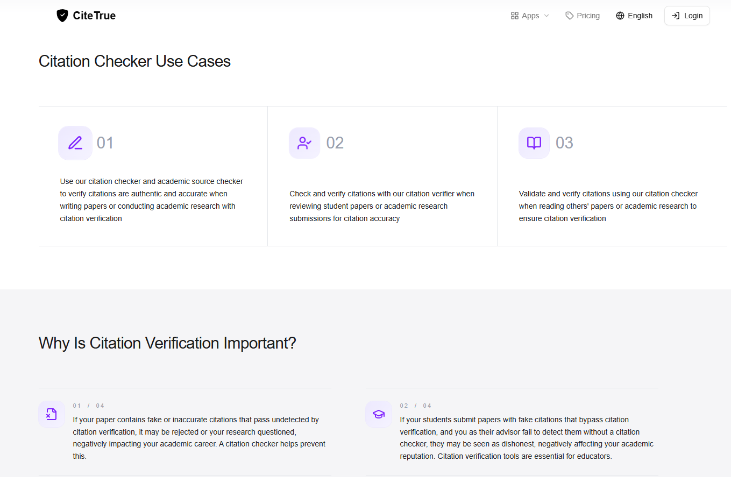
Use CiteTrue before submit if you draft with assistants, your issue window is real, and you can act on Unsure rows the same night. Skip a new tool if a librarian already co-reviews every line and your false-reference rate is already near zero. I did not have that staffing. I had forty-eight hours, a stats bar, and a scrap log of killed lines I now show students I mentor — so they meet the desk on the second path, not the first. The log is short. The night was not.
