
There is no denying the fact that organisations had to change their priorities to survive through the COVID-19 pandemic. Instead of resource management or planning new projects, global firms had to concentrate more on realigning their workforce – with remote working and social distancing getting the majority of attention. Besides that, there were economic threats to account for, as businesses were relentlessly cutting down on overheads to make ventures sustainable.
Amid the chaos, perilous financial standing, and the dwindling health-infrastructure, the time was right for cyber attackers and criminals to wreak havoc on organisational resources.
Based on the latest Tanium survey, almost 90 percent security specialists revealed that various industries have seen a 90% increase in cybersecurity threats during the past few months. Most of these threats have escalated into fully-developed attacks.
Also, nearly 93 percent of organisations had to delay the completion and delivery of high-end security projects due to validated concerns.
For example, Forbes reported over 80% increase in cybercrime during the period of March-April alone. And an Interpol assessment report has revealed a significant shift from individual to big corporation type of cybercrimes.
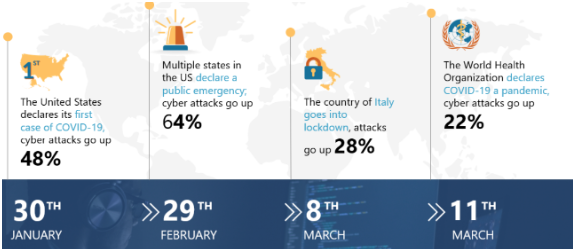
Simply put, remote working conditions weren’t conducive to security strategizing and asset management as Covid-19 exposed each one of the numerous security inadequacies. It was the remote working device patching that experienced issues with almost 88 percent of employees finding it hard to sync their gadgets with the system for getting the requisite number of security updates.
Table of Contents
COVID-19 Unmask Massive Cybersecurity Gaps
The pandemic has brought the concept of social distancing upon us, thereby increasing our dependency on the existing digital infrastructure. Businesses are also encouraging work from home, online connectivity, and increased adoption of network infrastructure to make up for lost time and resources.
With a majority of the workforce going remote during the pandemic, working with legacy devices and outdated firmware has become the new normal. As a majority of these home-bound devices lack the requisite security drivers or the infrastructure to install the latest patches, every piece of information worked upon is prone to cyber-attack.
Besides the threats surrounding the concerned IT sector in general, the pandemic has seen a surge due to general health worries. Spam emails have amplified in number as people are getting notifications related to hand sanitisers, Coronavirus updates, vitamins, they end up clicking on suspicious links.
For remote workers, the primary form of attack or threat is a falsified IT contact or HR-initiated coronavirus survey. In essence, anything that looks the least suspicious is being used to compromise the security standards of the concerned gadget.
It might be appropriate to term cyber threats as the precursors to the upcoming cyber-pandemic as the attackers exploit security gaps in a majority of organisational sectors, leading to DDoS, ransomware, and phishing attacks.
Gaps that were revealed by COVID-19, despite 85 percent of employees being ready to adapt to the remote working lifestyle include:
- 27 percent of individuals faced issues identifying new devices
- 22 percent were overwhelmed by the VPN standards
- 20 percent experienced video-centric security threats
All these issues translated into pressing security worries with the compacts felt in the form of transactional frauds, and data exposure.
Cyber-threats Impact on Businesses
As the Tanium survey shows, most of the cyber-security issues seen in the last few months, have transformed into fully-developed attacks. With the distributed workforce failing to value endpoint security measures due to lack of device compatibility or the vision, the threats are amplifying.
However, the blame of these proliferating threats shouldn’t be put on COVID-19, as the virus didn’t do anything, but exposed our already faulty system with over-reliance on on-premise security standards, infrastructural threat management, and restrictive end-point security measures.
Therefore, once the workforce went remote, the prying attackers grabbed every possible chance to attack. As Chris Hudson, the Tanium Chief Information Security Officer stated the rapid transition to remote-working forced changes which most organisations were unprepared for.
The impact of these threats includes misinformation, fear-mongering, lack of employee productivity, the pillage of valuable information due to the lack of organisational firewalls, economic hits, and massive financial losses. Not just that, companies dealing in security essentials are also finding it hard to work on newer projects with employees contributing remotely.
Attackers Leveraging on the Incessant Pandemic Fears
Another aspect that needs to be taken into account is the longevity of this pandemic which is also bringing up several time-based challenges. For instance, some companies work with a fraction of the existing workforce. Moreover, over 85% of surveyed individuals are sure of the fact that COVID-19 will be staying for the better part of this year and businesses will have to think about remote workforce, in a different and restructured manner.
The report emphasises the other threat-pronged challenges for the businesses, including compliance regulations and guidelines with 26% of security leaders saying it’ll be challenging to implement for the long term. 25% of the surveyed individuals are worried about managing newer risks from seasoned attackers, and 19% main worry is balancing the threats with the privacy of the employee. These challenges can only be tackled if proper endpoint management resources are put in place.
How to Steer Clear of Cyber Threats
From a layman’s perspective, updating the system is the key to keep the cybersecurity threats at a fair distance. As an employee, you must never undermine the importance of updates and installing them, as and when the company recommends.
Apart from that, adding a two-factor authentication system is yet another approach of combating the threats, especially if they are more gadget-intrusive. For DDoS and ransomware attacks, the right approach is to keep encrypted systems in place while backing up the existing datasets.
A holistic approach towards maintaining the cybersecurity threats and impacts at minimum is dedicating a substantial budget to the cybersecurity sector to counter them. In other words, cybersecurity needs to be the first line of defense for almost every organisation, going into the future.
As per the survey, 48% of top-level professionals are already considering end-point solutions, whereas nearly 47% are more concerned about a more cohesive patch management process. This approach towards security will fill-up all the glaring voids while paving the way for a better and more orderly transition towards a distributed and remote workforce.
About Tanium
Tanium offers a platform that enables Business Resilience in some of the world’s largest organizations. More than half of the organizations in the Fortune 100, trusts Tanium to enable them to handle the complexities and demands of the current IT environments. In addition, the world’s top financial institutions, retailers, and even the US Armed forces, all rely on Tanium when they want to make critical decisions. Tanium also recently grabbed the 4th position on the list of “Top 100 Private Companies in Cloud Computing For 2018” by Forbes.