
According to a report, Gen Z makes 32% of the global population, and Gen Z marketing requires more than just selling a product.
planpop, a calendar app to plan events and share videos with close friends and families, has a diverse team with a blend of college students and recent graduates to focus on the Gen Z market. The team led by the founder of Japan’s first Web-based groupware company Toru Takasuka and Yudai Nishiyama is handpicked to create a unique brand experience for Gen Z and Millennials.
Table of Contents
What do you Think About the Future of Social Media?
In order to think about the future of social media, it is important to look back at the past to see if we can find trends that have a lasting impact. Looking back, Facebook and Twitter were the first tides of social media, changing how we connect and share information. Then, Instagram and Snapchat came in with new user experiences optimized for smartphones and cameras. From this history of social media, we found three lasting trends for the future.
One, from text to visuals. On Facebook and Twitter, texts were the main communication channels to update our daily lives, short essays to show how your summer break was meaningful or how you appreciate friendships. With Instagram and Snapchat adopted by smartphone users, the content has become driven by visuals. We upload more photos with less text information to be creative. Text requires a medium, a language, to process the information while visuals do not. Our brain processes visuals faster than languages that have to be acquired. In the future, visuals will take up a larger share of social media information. The rise of YouTube and TikTok has confirmed this trend.
Second, friends to followers. Before the social media era, you had to exchange phone numbers to stay connected, which required both parties’ agreement. With the “follow” feature introduced on Twitter that agreement has become one way. You only have to follow someone to stay connected, which was innovative at that time and therefore introduced by other social media platforms later on, such as Instagram, TikTok, YouTube, and so on. Your personal contents can be shared publicly with a few taps today. No one can confirm this trend would be completely reversed in the short term, whether we like it or not.
Third, information overload to personalization. It is natural that we have access to more information as the number of internet users who upload content has increased over the years. Today, we are all overwhelmed by the amount of information that is increasingly available. We’re coming up with a solution though. That is a recommendation by the algorithm. Whether it’s search or feed content, we appreciate it if we can get sorted information that’s personalized.
How does Social Media Influence the needs of Gen-Z and how Planpop Satisfies Them?
Gen-Z is a generation that is heavily influenced by all these three trends. They are the main customers of most social media platforms. Therefore, I think all the new features or trends that we can see in the market are actually created by Gen-Z. They say what they want to the media and the media develops features to answer their needs. Though they stay connected online, they are also the loneliest generation and strive for authenticity and genuine relationships.
Our app, planpop, plans to approach their needs differently though. planpop delivers the information about what’s coming next in the future instead of what’s happening right now. It is a social planning tool to connect people with future information. It can be depressing to know that you could have spent today differently. However, it is exciting to know how you could improve your tomorrow.
Our main target is Gen-Z. Most of them are students from middle school to high school or college. They are busy with their school, social lives, and family relationships. If they can stay organized about their future plans or goals, it will help them become who they want to be. If they share their future with their friends, they can support each other. For example, if you know your friend has an important exam, you can cheer them up instead of inviting them to a plan that might distract them from their studying. If you know when your friend’s birthday is coming up, you can plan something out. Gen Z is not using Facebook for birthday updates.
Over a number of customer interviews, we found Gen Z is interested in events in the real world such as live music, concerts, or beach days, instead of the virtual interactions. Our app, planpop, is trying to be an intersection of the real world and virtual worlds by delivering future information. In order to adopt them to the planpop platform, we made sure our platform embraces those three trends.
First, we made sure users can process information visually. Text information is still a popular medium among planning tools or calendar apps. If you look at Google calendar or iOS default calendar, its design is plain with a focus on text. This doesn’t align with the trend. Instead, we prepared preset designs for users to organize their plan visually. It’s more fun and casual.
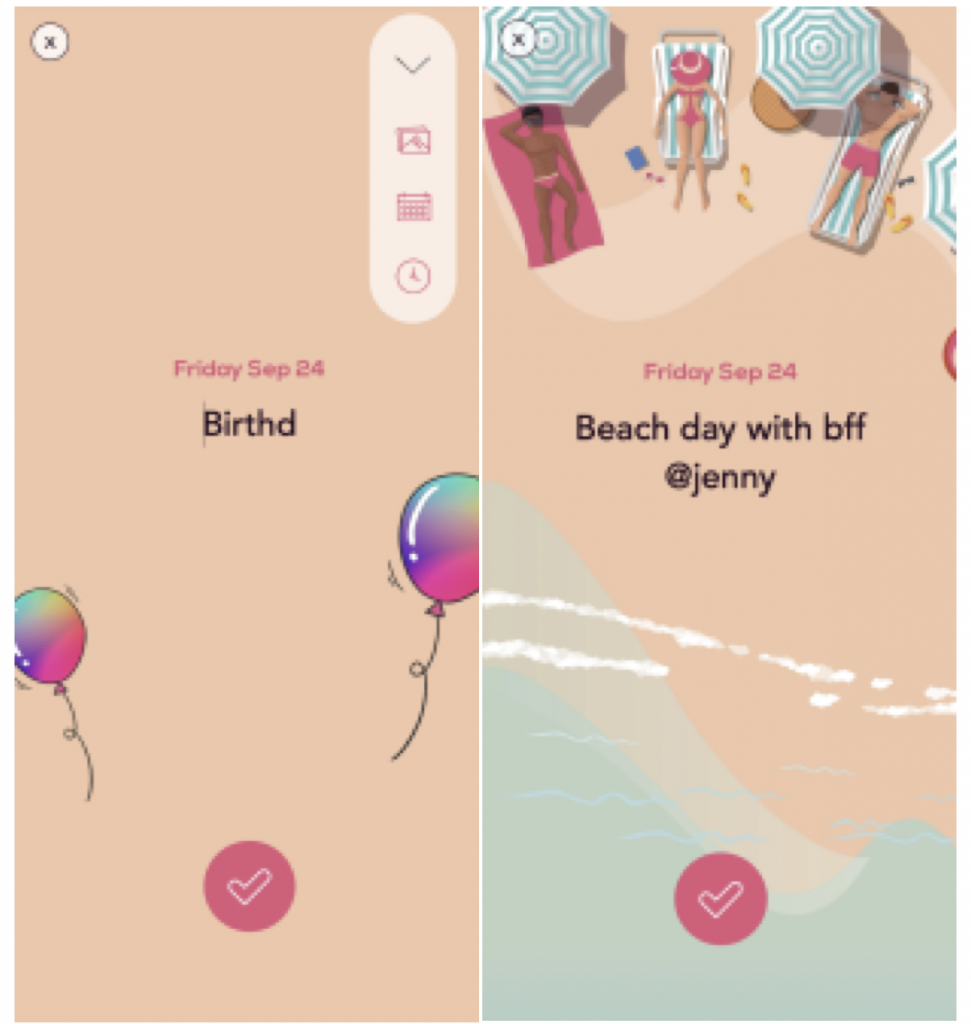
Second, you will follow someone you care about. It can be your friend, your classmate, or your favorite artists. We are in talks with musicians and artists communities in Los Angeles, and they found planpop a great way to connect with their fans. They can broadcast when their live performances are coming up and where they are going for the next tour. Lastly, planpop timestamps all your content to give you a sense of the sequence of time — the past, present and future. It is cool to know when and where you took your favorite photos during your road trip. You are able to look back at your life in the calendar format and see how far you have come. The more you use it, the more your memories will be available for you to see how much you have grown up as a person. It’s like a visual casual diary with a focus on planning your future.
How Difficult was it to Build a Team that has a Thorough Knowledge of Generation Z and its Behavior?
Initially, our team consisted of Millennials and Gen-X. It was pretty challenging to understand the Gen-Z market. However, I was lucky enough to be a graduate student at UCLA. They have great campuses that were designed for all students, regardless of what they study or what year they are in, to collaborate on-campus. For example, undergraduate students often use graduate school buildings for their classes. Graduate students use the main library, where lots of undergraduate students study for their finals. With that environment, I was able to recruit a handful of undergraduate students and expanded from there — thanks to UCLA’s collaborative culture. If I wasn’t a student, I would have had difficulties getting connected with Gen-Z communities.
Once you get the initial community of Gen-Z, it was all about interactions with them through startup projects. We did a lot of projects together from customer interviews to ambassador programs to test-market our app for feedback. Also, I personally tried to spend some time on several rising social media platforms that are popular among Gen-Z. Through daily interactions with them over a year, I feel like our team has a good sense of what they want from their online platforms.
Millennials and Generation Z are the Most likely Among Generations to Switch Careers. How do you Plan to Handle this Issue?
I focus on why they switch careers. As a millennial, it’s not difficult to understand why they do so. I switched my location from my home country, Japan, to the US, where I studied abroad and where our company operates. I’ve seen so many friends and classmates discuss switching careers. It’s all about opportunities to be more independent. It’s been important to build a beautiful resume to climb the corporate ladder for Gen-Z or Baby boomers. It stays the same for younger people, but our generation has different options. Freelancing has been adopted widely in society and starting up requires much less initial capitals compared to 10 years ago. Millennials and Gen-Z want freedom and independence both financially and professionally. If we spend longer hours with corporate jobs, we may not have energy left to catch up with all the changes that our society has been seeing. We have to learn new skill sets. We have to learn what will be the next trend so that we don’t miss out on opportunities. We want to grow faster while keeping a good quality of life. If we think current positions are not the best for our learning and personal growth, that’s when we explore other opportunities. Fortunately, you are only a few smartphone taps from accessing those opportunities.
At our company, we do three things to satisfy their career needs. First, no micromanagement. We do our best to let our team be independent. We ask them to think on their own so they can make their own decisions. Second, we encourage them to challenge themselves by making sure failure doesn’t hurt your career. Failure is a necessary step to learn something new. That way, they can accelerate their learning. Lastly, we have them work on a project that’s interesting. Everyone is different. Following their own curiosity is the best way to grow. When it comes to those three things, I also enjoy those principles.
How Challenging is it to Keep a Remote, Young Team Motivated?
It’s always challenging to have people stay motivated. When it comes to remote working, I don’t see it’s very challenging anymore. As I answered in the previous section, I want everyone to be as independent as possible so that they can be responsible for their own decisions. Remote-working is the best way to do so and employees can enjoy their freedom on how to work.
To keep the team motivated, we make sure we are transparent to the team. We all have access to the company information through the company cloud drive and chat tools. We all use a public channel to update each other, except personal information such as salary. I think it’s important to send a message that employees can step up to be a leader if they want to and want to make sure they have access to the relevant information.
Lastly, our vision. I always make sure that employees understand what really matters to our startup — future information. We can be all overwhelmed by lots of information on our professional and personal life. We could forget why we’re working for this company. The vision can inspire people, motivate them, and give us new insights when we talk to customers or think about new projects. Fortunately, a young workforce such as Gen-Z or Millennials really value the company vision. They want to make sure they are involved in something they can be proud of themselves. In that sense, we send a simple and meaningful message so the team can stay motivated.
What will be your Advice to the Hiring Managers Reading this Article?
Everyone knows hiring is important as well as challenging. If you experience hiring, you would find it more challenging than expected. I can share what I learned from my experience though — hiring is just the first step of that person’s growth within your organization. When you decide to hire someone, you can’t tell if that decision will deliver the right results or not. It takes time to see how that person performs within your organization. The interesting thing is the result relies on the whole process after the hiring. If you talk with them frequently, they might perform better, or vice versa. If you support their projects, they might grow faster or maybe keep relying on your leadership. You never know what result your decision at the time of hiring can lead to.
With that said, what’s important is to make sure they would fit into your company culture. If you don’t have a culture yet, set one today. I think a well-defined culture helps the new team member understand our expectations. You can’t really define what exactly they should approach to their projects under highly uncertain market conditions. But culture can tell them how to do so. If you are responsible for hiring, I recommend setting a culture first. Only after that can you see if a candidate fits or not.