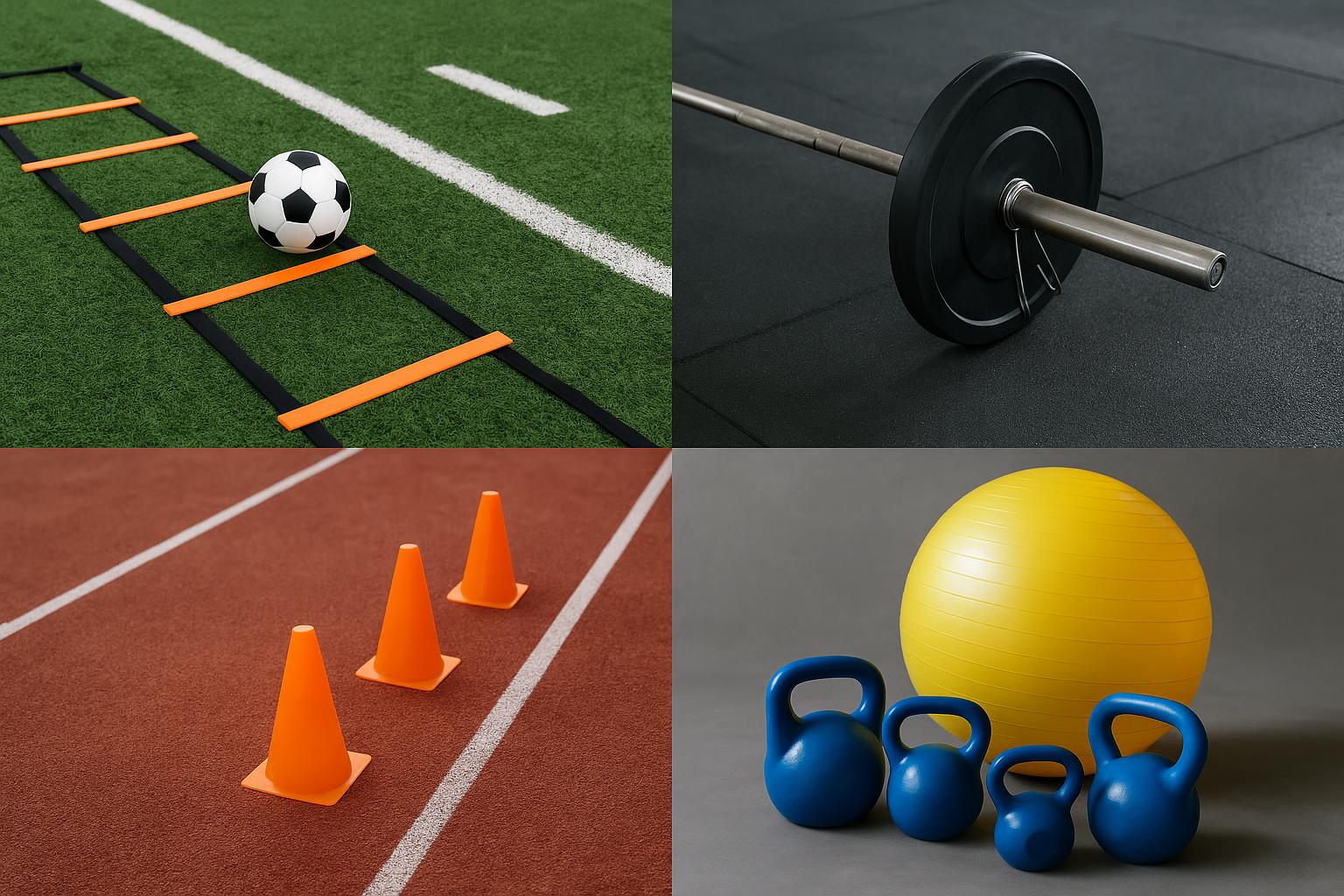
Modern football demands much more than technical ability. During a match, players sprint, change direction, compete physically, jump for headers, and repeat high-intensity movements while still being expected to make good decisions on the ball.
That makes athletic development an important part of football training. Alongside regular pitch sessions, access to suitable exercise equipment can help players work on strength, speed, power and conditioning. The objective is not simply to become fitter, but to build physical qualities that translate into better performances on the pitch.
Table of Contents
Strength Training
Strength training can provide an important physical foundation for footballers, with the right exercise equipment making it possible to incorporate resistance work that targets different areas of the body.
Squats, lunges, deadlift variations and split squats can help develop the lower-body strength involved in accelerating, changing direction and competing for possession. Single-leg exercises are particularly relevant because so many football actions, from shooting to sprinting, involve producing or controlling force through one leg.
Upper-body and core strength also matter when shielding the ball, challenging opponents and maintaining balance under pressure.
Sprint and Acceleration Training
Some of the most important moments in football happen over only a few metres. A striker may need a sudden burst to beat the defensive line, while a full-back might have to accelerate quickly to stop a counterattack. Sprint sessions can therefore focus on explosive starts, acceleration and maximum-speed running.
Repeated sprint training can also help prepare players for matches where those efforts need to be produced several times.
Agility and Direction Changes
Footballers rarely run in straight lines for long. They constantly stop, turn, and respond to what is happening around them. Cone drills, shuttle runs, and short change-of-direction exercises can develop acceleration, deceleration, and body control. Adding reaction-based elements can make training even more relevant. Instead of knowing where to move next, players can respond to a coach, teammate or visual signal.
This introduces the unpredictability that defines real matches.
Plyometric Training
Explosive actions such as jumping for headers and accelerating away from opponents require players to generate force quickly. Plyometric exercises including jumps, hops and lateral bounds can help develop this quality. They can complement conventional strength training by encouraging athletes to produce power rapidly rather than simply becoming stronger.
Quality is particularly important here. Explosive movements should generally be performed with control and intent rather than turning into another endurance exercise.
Football-Specific Conditioning
Football fitness is very different from preparing for a long-distance race. Players constantly move between walking, jogging, sprinting and recovering. Conditioning should therefore reflect the stop-start nature of the sport.
Interval running, circuits and other conditioning exercises can help develop the ability to perform repeated efforts. This becomes particularly important late in matches, when players must continue making explosive movements despite accumulating fatigue.
Mobility and Core Training
Good movement provides another piece of the athletic puzzle. Core exercises can support stability when players turn, shoot, sprint or protect possession. Meanwhile, regular mobility work can help maintain the movement required for football’s repetitive demands.
Rather than treating these areas as occasional additions, they can form part of warm-ups, gym sessions and recovery days throughout the season.
Training for Different Positions
Not every footballer requires exactly the same physical programme. A winger who regularly makes high-speed runs may have different priorities from a centre-back competing for aerial balls. Goalkeepers require explosive movement across relatively short distances, while central midfielders can face significant endurance demands.
Training can therefore be adapted around position, playing style and individual weaknesses rather than applying an identical programme to an entire squad.
Creating a More Complete Player
No single type of training creates a complete footballer. Strength without endurance has limitations, just as speed becomes less useful without the ability to stop, turn and react effectively.
Combining strength, sprinting, agility, plyometrics, conditioning, and mobility can create a broader athletic foundation. When those physical qualities are developed alongside technical skills and tactical understanding, players are better equipped to handle the varied demands of competitive football.