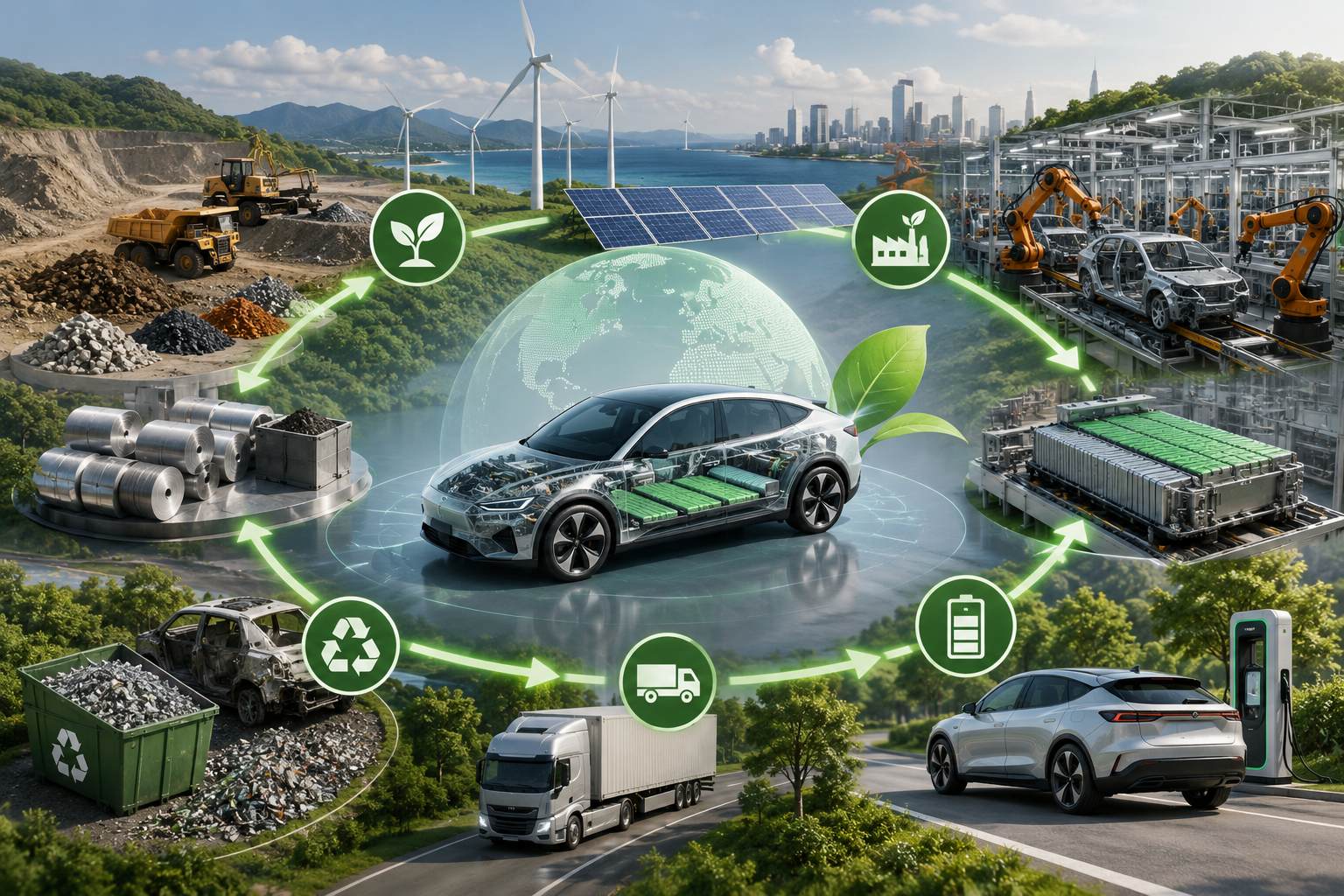
The automotive industry is undergoing one of the most significant structural transformations in its history. While electric vehicles are often seen as the most visible symbol of this change, a deeper shift is taking place behind the scenes — in the supply chains that make modern mobility possible.
From raw material sourcing to battery production, component manufacturing, logistics, and end-of-life recycling, sustainability targets are forcing manufacturers to rethink how every stage of the automotive lifecycle is managed. What was once a linear, efficiency-driven system is becoming a more circular, transparent, and environmentally accountable network.
This transition is not only reshaping production methods but also redefining how automotive companies measure value, resilience, and long-term competitiveness.
Table of Contents
Rethinking Raw Material Sourcing
One of the most critical pressure points in automotive supply chains is raw material extraction, particularly for electric vehicle components.
Lithium, cobalt, nickel, and rare earth elements are essential for battery production, but their extraction has raised significant environmental and ethical concerns. As a result, manufacturers are increasingly under pressure to ensure responsible sourcing practices.
This has led to a shift toward more traceable supply chains, where materials can be tracked from mine to factory. Companies are investing in certification systems, third-party audits, and partnerships with suppliers that can demonstrate compliance with environmental and labour standards.
At the same time, there is growing interest in reducing dependency on high-impact materials altogether, either through alternative chemistries or improved battery efficiency.
The goal is no longer simply securing supply — it is securing sustainable supply.
Battery Production and the Push for Circularity
Battery manufacturing sits at the centre of the sustainability challenge in the automotive sector.
Producing EV batteries is resource-intensive, requiring significant energy input and complex material processing. As EV adoption accelerates, manufacturers are increasingly focused on reducing the environmental footprint of this stage of production.
One of the most important developments is the rise of battery recycling and second-life applications. Instead of treating batteries as single-use components, companies are designing systems that allow materials to be recovered and reused.
Recycling processes aim to extract valuable metals such as lithium and cobalt, reducing the need for new mining operations. Meanwhile, second-life applications repurpose used EV batteries for energy storage systems in homes, businesses, or grid infrastructure.
This shift toward circularity is becoming a core pillar of automotive sustainability strategies.
Manufacturing Efficiency and Decarbonisation
Automotive manufacturing itself is also undergoing significant changes as companies work toward net-zero targets.
Production facilities are increasingly powered by renewable energy sources such as wind, solar, and hydroelectric power. Some manufacturers are investing in on-site generation, while others are entering long-term renewable energy purchasing agreements to decarbonise their operations.
Beyond energy use, factories are being redesigned to minimise waste, improve water efficiency, and reduce emissions from painting, welding, and assembly processes.
Digital manufacturing tools, including automation and AI-driven optimisation systems, are also helping to reduce material waste and improve efficiency across production lines.
Sustainability is no longer treated as a separate initiative within manufacturing — it is becoming embedded into operational design.
Logistics and the Pressure to Reduce Emissions
Global automotive supply chains rely heavily on logistics networks that span continents. This includes transporting raw materials to factories, moving components between suppliers, and distributing finished vehicles to markets worldwide.
Transport emissions have therefore become a major focus area for sustainability improvements.
Manufacturers and logistics partners are exploring multiple strategies to reduce environmental impact. These include shifting freight from air to sea or rail where possible, optimising shipping routes, and improving load efficiency to reduce unnecessary transport volume.
There is also increasing investment in low-emission transport solutions, including electric and hydrogen-powered freight vehicles, particularly for regional and last-mile delivery operations.
Digital tracking systems are helping companies measure and manage emissions more precisely, enabling more informed decisions across supply chain networks.
The Role of Supplier Networks
Automotive supply chains are highly interconnected, often involving thousands of suppliers across multiple tiers. As sustainability expectations rise, manufacturers are extending environmental responsibility deeper into these networks.
Tier-one suppliers are now commonly required to meet strict emissions and sustainability standards, and this pressure is increasingly cascading down to smaller suppliers as well.
This has created a ripple effect across the industry, encouraging smaller manufacturers to adopt greener practices in order to remain part of major automotive ecosystems.
For many suppliers, sustainability compliance is becoming as important as cost and quality when competing for contracts.
Recycling and End-of-Life Vehicle Strategies
Sustainability in automotive supply chains does not end when a vehicle leaves the factory. End-of-life management is becoming a key part of circular economy strategies.
Manufacturers are increasingly designing vehicles with disassembly and recyclability in mind. This allows materials such as steel, aluminium, plastics, and electronics to be recovered more efficiently once a vehicle is retired.
Regulatory frameworks in many regions are also pushing for higher recycling rates and reduced landfill waste. As a result, manufacturers are investing in take-back schemes, remanufacturing programmes, and partnerships with recycling specialists.
This shift is encouraging a longer-term view of vehicle lifecycle management, where sustainability is considered from design stage through to disposal.
Consumer Expectations and Brand Accountability
While regulation is a major driver of change, consumer expectations are also playing a significant role in shaping supply chain decisions.
Modern buyers are increasingly aware of environmental issues and often expect transparency regarding how vehicles are produced. Sustainability credentials are becoming an important factor in brand perception, particularly among younger and urban consumers.
This has encouraged manufacturers to communicate more openly about sourcing practices, emissions reduction efforts, and ethical production standards.
At the same time, sustainability is increasingly influencing how consumers personalise and interact with their vehicles. Even small aspects of ownership, from interior materials to subtle design choices, are now viewed through a sustainability lens. In broader automotive culture, personalisation remains important, whether through design choices or refined details such as registration styling and finishes. Companies like Number 1 Plates sit within this wider ecosystem of vehicle individuality, where drivers continue to express identity even as sustainability becomes more central to automotive design and production.
Technology as an Enabler of Sustainable Supply Chains
Digital transformation is playing a crucial role in making sustainable supply chains possible.
Advanced analytics, artificial intelligence, and blockchain-based tracking systems are being used to improve transparency and efficiency across global networks. These technologies allow manufacturers to monitor emissions, track materials, and identify inefficiencies in real time.
Predictive modelling is also helping companies optimise inventory levels and reduce waste, while digital twins of manufacturing systems enable testing and refinement of production processes before physical implementation.
As supply chains become more complex, technology is becoming essential for managing sustainability at scale.
Conclusion
Sustainability goals are fundamentally reshaping automotive supply chains from end to end. What was once a system focused primarily on cost and efficiency is evolving into one that must also account for environmental impact, ethical sourcing, and long-term resource management.
From raw material extraction and battery production to logistics, manufacturing, and recycling, every stage of the automotive lifecycle is being reconsidered through a sustainability lens.
While challenges remain — particularly around material availability, infrastructure, and global coordination — the direction of change is clear. Automotive supply chains are becoming more circular, more transparent, and more closely aligned with environmental expectations.
In the long term, sustainability will not be a separate objective within the automotive industry. It will be the foundation on which the entire supply chain is built.