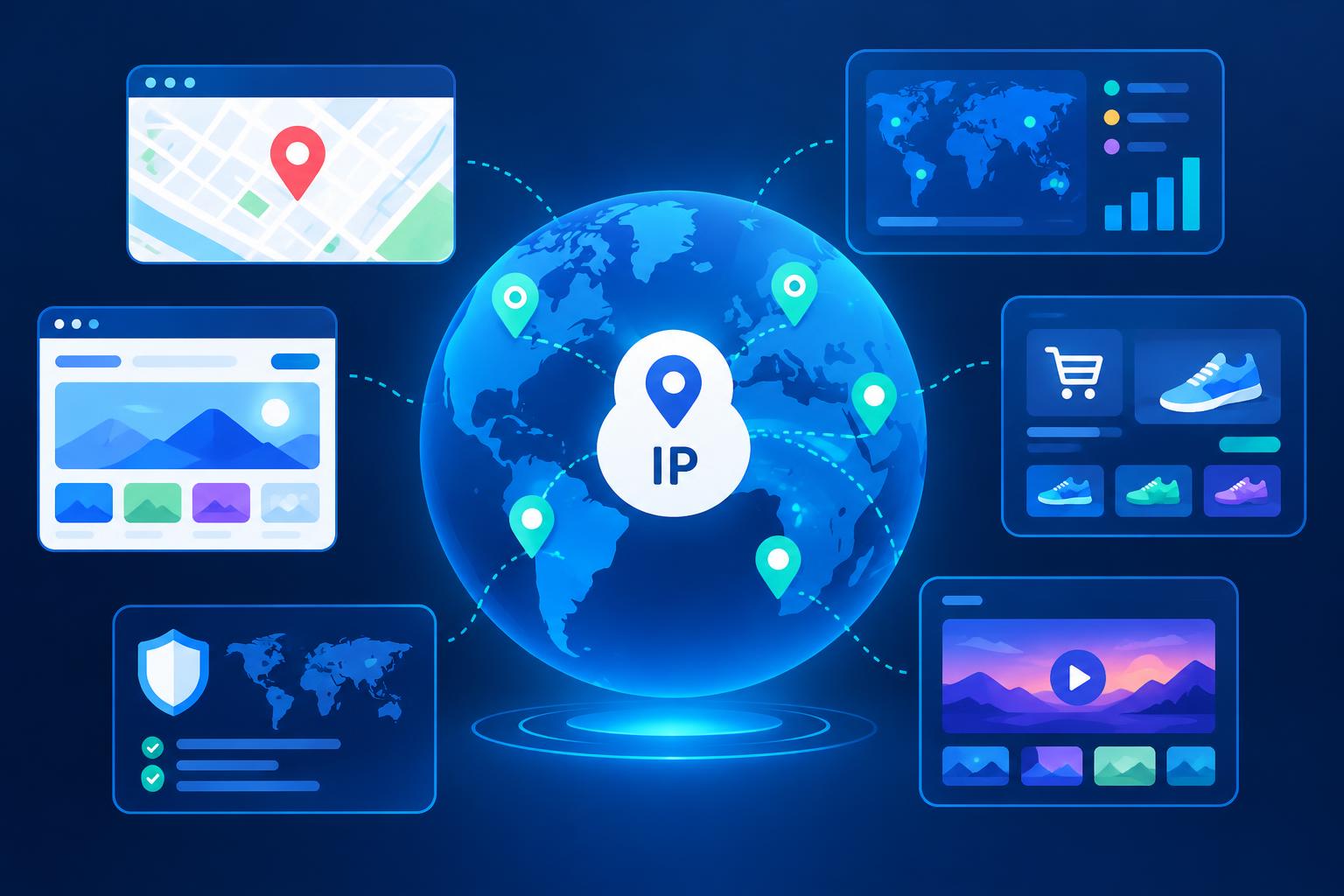
Summary: An IP Geolocation API helps businesses estimate the geographic location and network details associated with an IP address. By integrating this information into websites, applications, analytics platforms, and security systems, organizations can personalize digital experiences, understand visitor distribution, and identify potentially suspicious activity. Choosing the right API involves evaluating data coverage, accuracy, supported fields, response speed, scalability, and integration requirements. With the right implementation, IP geolocation can become a useful part of a company's digital infrastructure without requiring users to enter their location manually.
Every device communicating over the internet uses an IP address, which helps route information between connected systems. An IP address can also provide clues about the network and approximate geographic area associated with a connection.
An IP Geolocation API makes this information accessible to software applications. A developer submits an IPv4 or IPv6 address through an API request, and the service returns available location and network information in a structured format, commonly JSON.
Depending on the provider and subscription, the response may include country, region, city, postal code, approximate coordinates, time zone, internet service provider, autonomous system number, and connection information.
Businesses use this information to make digital services more context-aware. For example, an ecommerce website may adapt its displayed currency, while an analytics platform may categorize traffic by country or city.
However, IP geolocation does not reveal a person's precise physical address. Results are estimates based on available IP allocation and network data, and accuracy varies by location, internet provider, and connection type.
Table of Contents
How Does an IP Geolocation API Work?
The process typically involves three steps.
1. Identify the IP address. An application obtains the relevant public IP address from the incoming connection or another authorized data source. Developers must account for proxies, load balancers, and forwarded headers to avoid using an untrusted or incorrect address.
2. Submit the lookup request. The application sends the address to the provider's API endpoint, usually with an API key when authentication is required.
3. Process the response. The API returns available attributes, which the application can use to support its intended function.
For example, a website might use country information to suggest a regional storefront. A security platform might combine network attributes with login history and device signals to identify unusual access patterns.
The API provides contextual data rather than a final decision. Applications should interpret results alongside other relevant information.
Five Practical Uses of IP Geolocation
1. Personalized Website Experiences
Visitors arrive from different countries, regions, and language environments. An IP Geolocation API can help a website make its initial experience more relevant by suggesting a language, regional store, or locally appropriate content.
An online retailer, for example, could use estimated country information to recommend the correct regional website. A travel platform might display destination information relevant to a visitor's broader market.
Personalization should remain flexible. Visitors should be able to change their region or language manually because an IP address does not always reflect their preferred location.
2. Website Analytics and Audience Insights
Businesses need to understand where their traffic originates to evaluate marketing performance and identify potential growth opportunities.
Geolocation data can group website visits by country, region, or city, depending on the available dataset. Marketing teams can compare engagement, conversion rates, and campaign performance across geographic segments.
These insights can help organizations identify markets worth investigating further. However, IP-derived location should not be treated as a complete picture of a customer's residence, identity, or purchasing preferences.
3. Fraud Detection and Account Security
Unusual location information can provide a useful signal during account authentication and transaction review.
For example, a login from an unexpected country might prompt additional verification when it also differs from the customer's established behavior. Network attributes, proxy detection, and connection information may contribute further context when supported by the selected service.
Geolocation alone cannot establish fraud. Travelers, corporate networks, mobile connections, VPNs, and shared internet gateways can all produce unexpected results.
Businesses should combine IP intelligence with appropriate authentication controls, transaction history, device signals, and risk-scoring policies.
4. Regional Content and Access Rules
Some digital services need to apply different rules depending on a visitor's apparent location. An IP Geolocation API can help identify the country or region associated with a connection and support preliminary routing or content decisions.
For example, a company may direct visitors toward the appropriate regional information page or flag a request for further review.
Where geographic restrictions are legally or contractually required, businesses should validate their approach carefully. IP location can be inaccurate, and the implementation must account for exceptions, legitimate travel, and other operational requirements.
5. Network Intelligence and Infrastructure Planning
Network information can help technical teams understand the origin and characteristics of incoming traffic.
Depending on the API, attributes such as ISP, organization, autonomous system number, and connection type can provide additional context for traffic analysis and security monitoring.
These fields may help teams investigate unusual request patterns, categorize network sources, or improve operational reporting. They should be interpreted with other logs and security signals rather than used as standalone evidence.
What Should You Look for in an IP Geolocation API?
Not every API provides the same information or service level. Evaluate the following factors before integrating one into a production application.
Data coverage and freshness: Check support for IPv4 and IPv6, geographic coverage, and the provider's update practices. Regularly refreshed data can help maintain useful results as IP assignments change.
Available fields: Confirm whether you need only country information or more detailed attributes such as city, postal code, ISP, ASN, time zone, or proxy indicators.
Accuracy limitations: Review how the provider describes geographic precision. City-level results may be useful for analytics but should not be treated as verified device coordinates.
Performance and reliability: Consider response latency, service availability, request limits, and the effect of an API outage on your application.
Scalability and pricing: Estimate average and peak lookup volumes. Review daily request limits, batch capabilities, rate limits, and the cost of expanding usage.
Developer support: Clear documentation, examples, SDKs, and practical troubleshooting guidance can reduce integration time.
Security and privacy: Protect API credentials, use HTTPS where supported, minimize unnecessary logging, and review the provider's data-handling terms.
API Integration: Common Mistakes to Avoid
One frequent mistake is assuming that an IP address identifies a user's exact location. Mobile carriers, VPNs, corporate gateways, and internet service providers may route traffic through infrastructure far from the user.
Another mistake is relying on a single lookup for a high-impact decision. A geographic mismatch can support additional investigation, but it should not automatically block a legitimate customer without appropriate safeguards.
Developers should also handle invalid addresses, missing fields, request limits, timeouts, and temporary provider failures. Caching may reduce repeated requests where permitted by the provider's terms and the application's requirements.
Finally, avoid exposing private API keys in public client-side code unless the provider explicitly supports a suitable public-key configuration. Server-side requests can offer greater control over credentials and usage.
Why DB-IP Is Worth Evaluating
Organizations comparing geolocation services can explore DB-IP's API and database offerings. Its documented services provide location information and, depending on the selected product, additional network attributes. Developers can review the official documentation to understand response fields, request formats, and integration options before choosing a plan.
The appropriate product depends on the application's requirements, expected traffic, and the level of detail needed. Testing representative IP addresses and measuring performance during development can help determine whether a service meets those requirements.
Conclusion
An IP Geolocation API can help businesses personalize websites, analyze traffic, support https://db-ip.com/investigations, and add network context to digital operations. Its value depends on choosing suitable data fields, understanding location uncertainty, protecting API access, and combining results with other signals where necessary.
For organizations evaluating these capabilities, DB-IP provides an option for exploring IP geolocation APIs and databases. Reviewing its documentation, available fields, and service plans can help developers determine whether DB-IP fits their technical needs and business objectives.
FAQs
1. What does an IP Geolocation API do?
It estimates geographic and, depending on the service, network information associated with an IP address. Applications can use the returned data for analytics, personalization, and security workflows.
2. Can an IP Geolocation API identify an exact address?
No. IP geolocation generally estimates a location such as a country, region, or city. It does not reliably identify a person's exact street address.
3. Is an IP Geolocation API useful for fraud detection?
Yes, as one supporting signal. Location and network details can help identify unusual activity, but they should be combined with authentication, device, and transaction information.
4. What factors affect API selection?
Important factors include geographic coverage, data freshness, available fields, response speed, reliability, request limits, pricing, documentation, and security.
5. Can IP geolocation work with IPv6 addresses?
Many modern geolocation services support both IPv4 and IPv6. Developers should verify the selected provider's coverage and test the address formats used by their applications.