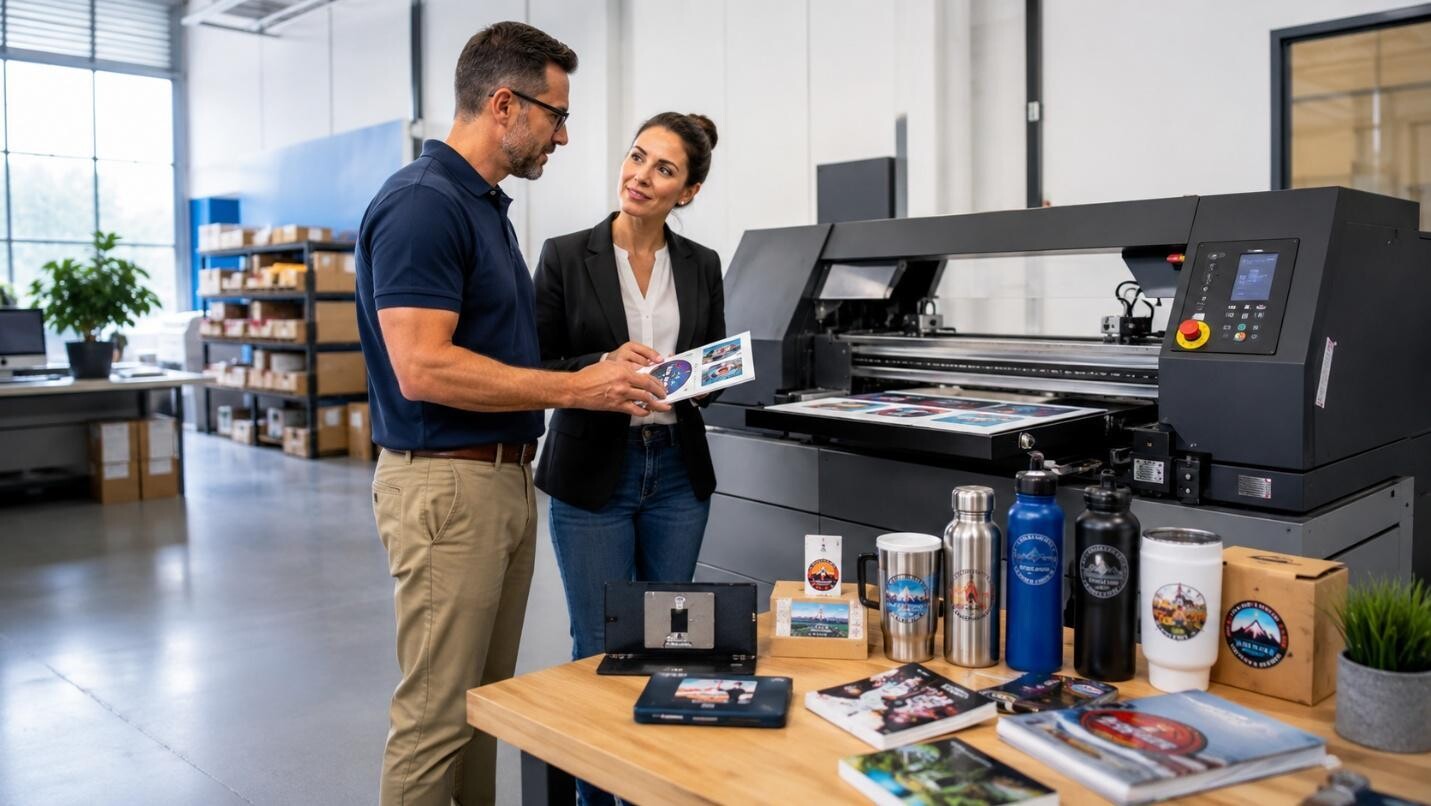
A commercial UV DTF printer makes the most sense when a print shop already has recurring B2B customers, sees demand for branded hard-surface products, and can turn that demand into repeatable production rather than occasional custom jobs.
For established print shops, the next stage of growth does not always mean finding more customers. Sometimes it means selling more products to the customers you already have.
A company that orders employee shirts may also need branded tumblers. An event client may want bottles, giveaways, packaging, or decals. A school or organization may need both apparel and hard-surface merchandise.
That is where UV DTF can become commercially interesting.
Instead of treating it as another printing technology, B2B print shops can evaluate UV DTF as a way to expand the product mix, increase revenue per client, and keep more orders inside their own production workflow.
Table of Contents
Why UV DTF Is Relevant to Print Shops in 2026
The broader print market is putting more pressure on businesses to improve margins and find new revenue.
PRINTING United Alliance’s 2026 State of the Industry report found that participating printing companies increased sales by only 0.4% on average during 2025, while operating-cost inflation reached 4.8%. That gap makes productivity, pricing discipline, and revenue diversification increasingly important for print businesses.
At the same time, apparel decorators and promotional-product businesses continue to overlap. Recent ASI research found that 66% of surveyed apparel decorators were diversifying into promotional products, while print-on-demand services were also becoming more common.
For a print shop, the practical takeaway is simple:
Growth can come from producing more types of branded products for existing customers—not only from increasing shirt volume.
What Can a Commercial UV DTF Printer Add?
UV DTF is primarily designed to create transfers for compatible hard surfaces.
That can give print businesses access to products such as:
- Tumblers and drinkware
- Bottles
- Promotional containers
- Acrylic products
- Packaging
- Signs
- Selected plastic, metal, glass, and wood surfaces
This makes the technology particularly useful for shops already serving businesses, schools, events, organizations, promotional-product buyers, and branded-merchandise programs.
Instead of selling one printed item, the shop can begin building a broader branded-product package.
Commercial UV DTF vs. Entry-Level Thinking
A business buying production equipment should look beyond whether a printer can simply produce a successful sample.
The real question is whether it can support repeat commercial work.
| B2B Question | Why It Matters |
|---|---|
| Can production remain consistent across repeat orders? | Business customers expect reorders to match previous work. |
| Can the workflow handle several jobs per day? | Commercial profitability depends on throughput, not demonstrations. |
| Is maintenance manageable? | Downtime can delay multiple customer orders. |
| Are consumables readily available? | Supply interruptions can stop production. |
| Can operators be trained easily? | A business should not depend completely on one employee. |
| Is technical support available? | Equipment problems become business problems when deadlines are involved. |
A commercial purchase therefore needs to be evaluated as a production system, not just a printer.
What Should B2B Print Shops Check Before Buying?
Start with the type of work the business expects to produce.
Then review printhead configuration, ink channels, curing system, supported media, RIP software, electrical requirements, workspace conditions, maintenance procedures, warranty, and technical support.
For example, shops comparing a commercial UV DTF printing machine can use the P604U as one reference point for this type of evaluation. Its current specifications include three Epson I3200-U1 printheads, CMYK + White + Varnish support, UV curing, 6PASS/8PASS modes, and compatibility with Maintop and FlexiPRINT RIP software.
The important lesson is not that every shop needs those exact specifications.
It is that B2B buyers should compare machines using operational requirements, not marketing headlines.
Calculate Opportunity Before Calculating Speed
Print speed matters, but revenue opportunity matters first.
Before investing, review your customer base and identify how many existing clients could realistically buy UV DTF products.
A useful exercise is to review the last 90 days of orders.
- How many apparel customers also buy promotional products?
- How many have asked for bottles, decals, signage, packaging, or branded hard goods?
- How many orders are currently outsourced?
- How often do you decline these requests?
If the demand already exists, bringing production in-house can be easier to justify.
If nobody is asking for these products, buying equipment first and hoping demand appears later creates much more risk.
Think in Terms of Revenue per Account
For B2B print shops, one of UV DTF’s strongest opportunities is account expansion.
Suppose a business customer already orders 100 staff shirts.
The same customer may also need:
- Employee drinkware
- Branded welcome kits
- Event merchandise
- Product packaging
- Promotional giveaways
Winning an entirely new account requires marketing and sales effort.
Selling another product category to an existing satisfied customer can be much easier.
That is why UV DTF should be evaluated partly through customer lifetime value, not only cost per transfer.
Dedicated UV DTF Equipment Still Needs the Right Fit
Not every shop should buy the same machine.
A company producing occasional personalized products has different requirements from a shop supplying branded merchandise every day.
Businesses that want to compare widths, capacities, configurations, and dedicated systems can review broader UV DTF printer options before selecting a specific production setup.
The strongest purchase is usually the one that matches current demand while leaving realistic room for growth.
Oversized equipment that sits idle does not create a competitive advantage.
The Next Level Is a Better Business Model, Not Just Another Printer
Adding UV DTF production should solve a business problem.
It may help a shop keep outsourced work in-house. It may create faster turnaround. It may allow sales teams to offer a wider branded-product package. Or it may increase revenue from customers the company already serves.
In a print market where operating costs remain under pressure, equipment investments need to create measurable commercial value.
For the right B2B print shop, a commercial UV DTF printer can do exactly that.
But the strongest reason to invest is not simply because UV DTF is another capability.
It is because the shop has identified real customer demand, a workable production process, and a clear path from new capability to new revenue.